
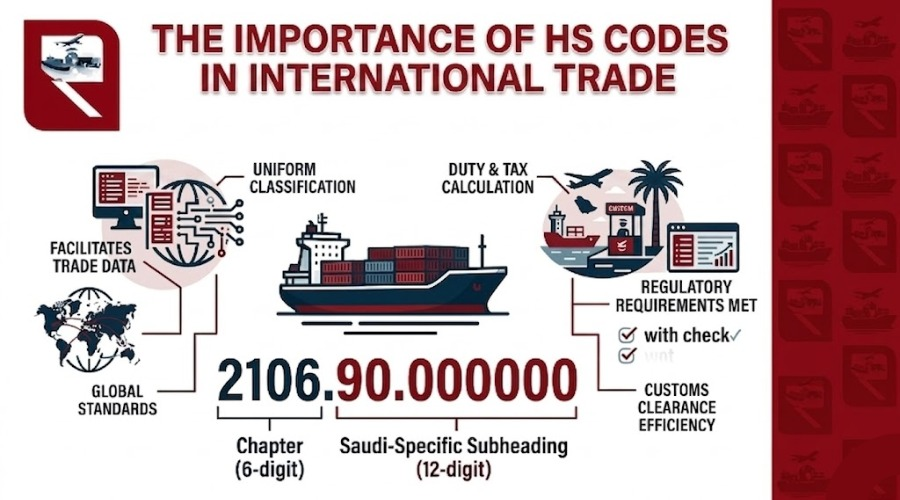
The Harmonized System (HS) Code — or رمز النظام المنسق — is the universal language of global trade. It is a standardized numerical classification system used to categorize traded goods for customs and statistical purposes. Developed by the World Customs Organization (WCO) — المنظمة الجمركية العالمية — this system is used by over 200 countries worldwide to facilitate international trade, reduce trade expenses, and standardize trade documentation . The code typically ranges from 6 to 12 digits (من 6 إلى 12 رقمًا), with the first six digits representing the globally harmonized standard, while additional digits allow countries to apply more granular, country-specific classifications .
The Global Standard (المعيار العالمي)
The World Customs Organization (WCO) — المنظمة الجمركية العالمية — maintains and updates the Harmonized System, with the most recent major revision being the 2022 edition, which came into effect in January 2022. The WCO reviews the system every five years to accommodate technological advancements, new product categories, and evolving trade patterns . This ensures that the system remains relevant in an era of rapid innovation—from electric vehicles to renewable energy components.
Core Objective (الهدف الأساسي)
At its heart, the HS code serves as the foundation for identifying goods and calculating tariffs — الأساس لتحديد البضائع وحساب الرسوم الجمركية. It determines not only the customs duty rate but also which regulatory requirements, trade agreements, and statistical tracking mechanisms apply to a shipment. Without accurate HS classification, the entire machinery of international trade—from customs clearance to trade policy enforcement—grinds to a halt.
The Vital Importance of HS Codes in Global Trade (الأهمية الحيوية لرموز HS في التجارة العالمية)
Tariff and Duty Determination (تحديد الرسوم الجمركية والضرائب)
Accurate HS classification is the only reliable way to calculate correct customs duties and taxes — الطريقة الوحيدة الموثوقة لحساب الرسوم الجمركية والضرائب الصحيحة. A single digit error can mean the difference between a 5% standard duty and a 20% luxury rate—or even duty exemption. In Saudi Arabia, where the standard GCC common external tariff is 5% but certain categories like tobacco face 100% duties, precision is not optional . The HS code directly determines the financial viability of an import transaction.
Trade Policy Enforcement (تطبيق سياسات التجارة)
HS codes are the enforcement mechanism for anti-dumping duties (رسوم مكافحة الإغراق), quotas (الحصص), and trade agreements (اتفاقيات التجارة). Governments use these codes to identify products subject to special trade measures. For example, when Saudi Arabia introduced new sugar content classifications in November 2025—creating four distinct tiers for sweetened beverages based on added sugar levels—all enforcement relied on precise HS subcategories . Similarly, the new HS code 98.04 — الرمز الجمركي 98.04 — introduced in late 2025, specifically covers goods transferred between customs zones within Saudi Arabia, including free zones .
Global Trade Statistics (إحصائيات التجارة العالمية)
Governments and international organizations rely on HS-coded data to analyze import/export trends and economic health — تحليل اتجاهات الاستيراد/التصدير والصحة الاقتصادية. The United Nations, World Bank, and national statistical offices use this data to track trade flows, identify emerging markets, and formulate economic policy. Over 98% of international trade products are classified using HS codes, making it the most comprehensive trade dataset in existence .
Supply Chain Efficiency (كفاءة سلسلة التوريد)
HS codes ensure consistency across shipping manifests (قوائم الشحن), insurance documents (وثائق التأمين), bills of lading (بوليصات الشحن), and customs declarations (الإقرارات الجمركية). When every party in the supply chain—from manufacturer to freight forwarder to customs broker—uses the same classification, the risk of documentation mismatches, port delays, and compliance failures drops dramatically. This consistency is especially critical in multimodal shipments where goods cross multiple jurisdictions.
The Specific Role of HS Codes in Saudi Customs (ZATCA) (دور رموز HS في الجمارك السعودية — هيئة الزكاة والضريبة والجمارك)
The 12-Digit Saudi Integrated Tariff (التعريفة الجمركية السعودية المدمجة المكونة من 12 رقمًا)
Saudi Arabia, along with other GCC nations, transitioned to a 12-digit Integrated Customs Tariff — التعريفة الجمركية المدمجة المكونة من 12 رقمًا — on January 1, 2025 . This represents a significant expansion from the previous 8-10 digit system. The structure breaks down as follows:
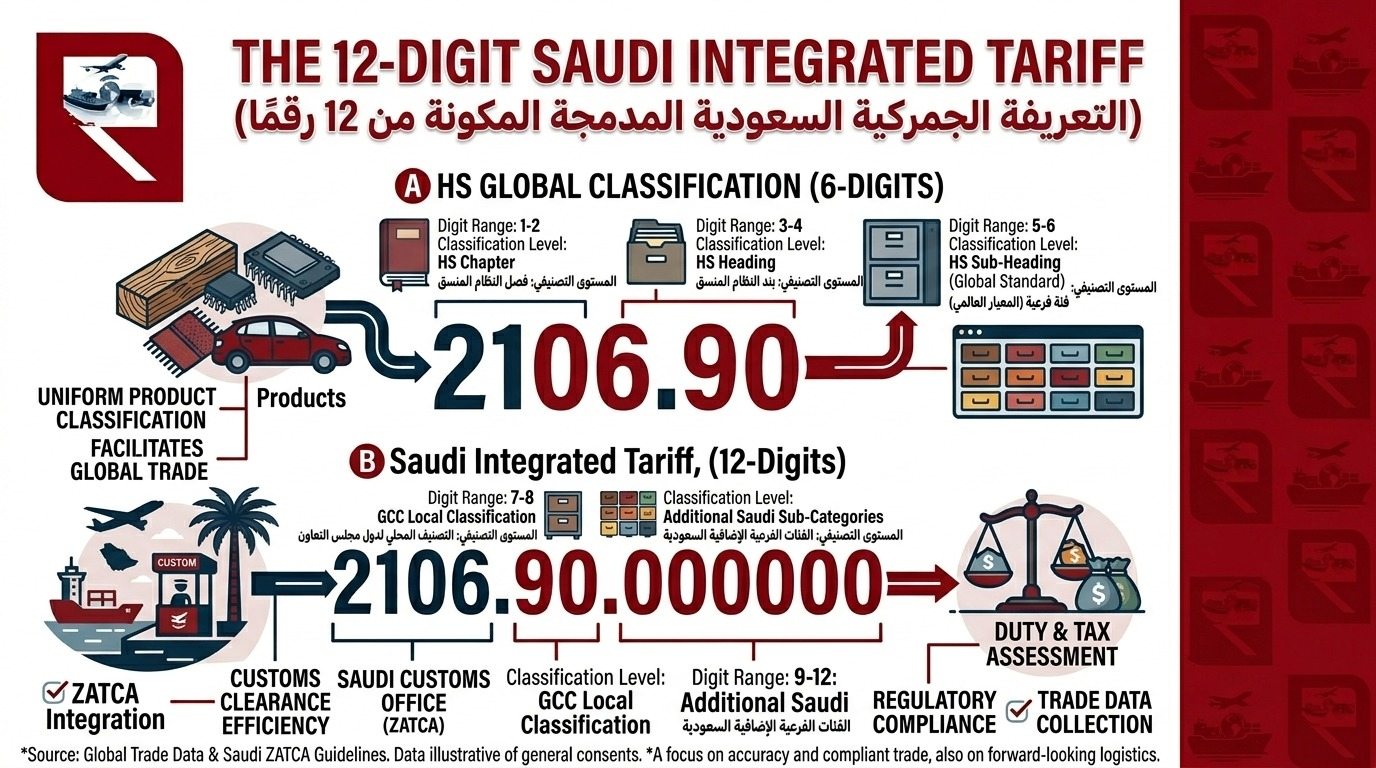
This expansion increased the number of tariff lines from approximately 7,800 to over 13,400 — nearly doubling classification possibilities . The 12-digit system provides Saudi authorities with granular control over product categories, enabling more precise duty application and regulatory oversight.
ZATCA Regulations (2025-2026 Update) (تحديثات هيئة الزكاة والضريبة والجمارك 2025-2026)
In late 2025, Saudi Arabia issued significant amendments to its Integrated Tariff through Decision No. (1447-88-5) dated 27 October 2025, and Decision No. (1447-88-7) dated 14 November 2025 . These amendments, published in the official Saudi Gazette on 27 November 2025, introduced several critical changes:
- Over 400 new HS codes — أكثر من 400 رمز جديد — and 100+ sub-categories to improve classification accuracy
- Revised tariff classifications across food products, construction materials, chemicals, industrial inputs, and consumer goods
- Transition of some previously exempt products into standard duty categories
- New sugar content classifications for beverages, creating four tiers based on added sweetener levels (effective January 1, 2026)
- Introduction of HS code 98.04 for goods moved between customs zones, including free zones
- Revised customs duty rates for specific HS codes, with some items now subject to rates up to 20%
These changes reflect Saudi Arabia’s ongoing efforts to align with WTO commitments — التزامات منظمة التجارة العالمية — and GCC tariff harmonization — توحيد التعريفة الجمركية لدول مجلس التعاون — while supporting domestic industrial policy .
Automated Risk Management (إدارة المخاطر الآلية)
Saudi Customs leverages HS codes within its automated risk management systems — أنظمة إدارة المخاطر الآلية — to flag prohibited or restricted items. The FASAH platform (منصة فصة) — Saudi Arabia’s unified digital single-window for trade clearance — uses HS code data to conduct pre-arrival risk assessment . This automated screening identifies:
- Prohibited items (البضائع الممنوعة) such as pork products (HS 02xx), alcohol (HS 22xx), and weapons (HS 93xx)
- Restricted goods (البضائع المقيدة) requiring special permits, such as pharmaceuticals (SFDA approval — موافقة هيئة الغذاء والدواء), wireless devices (CST certification — شهادة هيئة الاتصالات), and chemicals
- High-risk categories (الفئات عالية المخاطر) subject to enhanced inspection, including used electronics, camouflage clothing, and certain technical equipment
The system cross-references HS codes against multiple databases—including SABER conformity certificates, import licenses, and sanctioned party lists—before the shipment physically arrives at the border .
HS Codes in the Saudi Digital Ecosystem (رموز HS في النظام البيئي الرقمي السعودي)
The SABER Platform (منصة سابر)
The SABER platform (منصة سابر) — Saudi Product Safety Program — is the mandatory electronic portal for product conformity certification, and HS codes are the entry key — المفتاح الدخول — to the entire system . Here’s how it works:
- Product Registration (تسجيل المنتج): Importers must categorize products based on the Customs Code (HS Code) — الرمز الجمركي — when creating SABER accounts
- Certificate of Conformity (CoC) — شهادة المطابقة: A correct HS code is mandatory to obtain both the Product Certificate of Conformity (PCoC) — شهادة مطابقة المنتج — valid for one year—and the Shipment Certificate of Conformity (SCoC) — شهادة مطابقة الشحنة — required for each individual shipment
- Technical Regulations (TRs) — اللوائح الفنية: The HS code determines which SASO Technical Regulations — لوائح الهيئة السعودية للمواصفات والمقاييس — apply to a specific product. For example, electronics fall under HS Chapter 85 and must comply with IEC safety standards and EMC requirements
Critical 2026 Update: As of January 1, 2026, the SABER platform automatically rejects Product Certificate applications that do not align with the new 12-digit Saudi-specific classification . Existing certificates issued under old tariff codes remain valid until expiry, but new registrations must use updated codes . This affects major categories including textiles, building materials, electrical equipment, ICT devices, electric vehicles, and vehicle spare parts .
The FASAH Portal (بوابة فصة)
FASAH (فصة) — Facilitate Sea, Air, and Highway Customs Clearance — is Saudi Arabia’s unified digital single-window platform that integrates all customs procedures . HS codes are embedded throughout the FASAH workflow:
- Pre-clearance filing (الإيداع المسبق): Submitting shipment data before cargo arrival, including HS codes, invoice values, and consignee details
- Automated duty calculation (الحساب الآلي للرسوم): The system instantly calculates duties based on the declared HS code and CIF value
- Certificate validation (التحقق من الشهادات): FASAH cross-checks HS codes against SABER certificates, CST approvals, and SFDA registrations in real-time
- Release authorization (تصريح الإفراج): Only after HS code validation and duty payment does the system issue release notifications
Pre-clearance filing through FASAH significantly reduces port storage fees and clearance delays by catching document or classification issues before the shipment reaches the border .
Technical Regulations (TRs) (اللوائح الفنية)
Saudi Arabia’s Technical Regulations — اللوائح الفنية — are HS-code dependent. The classification determines:
- Which standards apply (أي المعايير تنطبق): Electronics must meet SASO IEC standards; toys must comply with EN 71; construction materials require fire resistance testing (SASO 34)
- Labeling requirements (متطلبات التسمية): Food and cosmetics require Arabic labeling; electronics need specific safety warnings
- Inspection protocols (بروتوكولات الفحص): High-risk categories like batteries and children’s products may require factory audits or virtual inspections
- New sustainability mandates (متطلبات الاستدامة الجديدة): As of 2025, environmental impact reports are required for certain plastics, and biodegradable certifications are being introduced
Risks and Consequences of Misclassification (المخاطر والعواقب الناتجة عن التصنيف الخاطئ)
Heavy Financial Penalties (الغرامات المالية الثقيلة)
ZATCA imposes severe financial penalties — غرامات مالية شديدة — for misdeclaration or incorrect HS code usage. According to official ZATCA documentation:
- Tax evasion penalties (عقوبات التهرب الضريبي): Submitting false documents to evade payment can result in fines of at least the amount of VAT due, up to three times the value of the goods
- Late filing fines (غرامات التأخير في الإيداع): Up to 25% of the tax value that should have been declared
- Late payment fines 5% of the unpaid tax amount per month or part thereof until payment
- General violations (المخالفات العامة): Maximum fines of SAR 50,000 for violations of VAT regulations, failure to maintain records, or obstruction of ZATCA officials
- Incorrect tax returns: 50% of the difference between calculated tax and actual tax due
Additionally, applying an incorrect HS code can result in underpayment or overpayment of customs duties — الدفع الزائد أو الناقص للرسوم الجمركية — both of which trigger financial consequences. Underpayment may be treated as duty evasion, while overpayment represents lost working capital.
Shipment Delays and Demurrage (تأخير الشحنات والرسوم التأخيرية)
Misclassification is one of the leading causes of customs holds — الأسباب الرئيسية لاحتجاز الجمارك — in Saudi Arabia . When a shipment is flagged for incorrect HS coding:
- Immediate customs hold (الاحتجاز الفوري): The shipment cannot clear until the classification is corrected
- Re-classification process (عملية إعادة التصنيف): Requires formal correction through ZATCA, often involving physical inspection and documentation review
- Demurrage charges (رسوم التأخير): A shipment delayed by three days at Jeddah Islamic Port can incur demurrage of SAR 3,000 to SAR 15,000 depending on container size and terminal
- Storage fees (رسوم التخزين): Additional daily charges accumulate while the shipment awaits resolution
- Supply chain disruption (تعطل سلسلة التوريد): Delayed raw materials halt production lines; delayed retail shipments miss sales seasons
In 2025, customs brokers reported that incorrect HS codes trigger inspections and delays in 15-30% of held shipments .
Legal Action and Blacklisting (الإجراءات القانونية والقائمة السوداء)
The consequences extend beyond immediate financial penalties:
- Import license suspension (تعليق ترخيص الاستيراد): Repeated misclassification can lead to suspension or revocation of import privileges
- Criminal charges (التهم الجنائية): Intentional misdeclaration to evade duties may be prosecuted as customs fraud
- Blacklisting (القائمة السوداء): Companies with repeated violations may be added to watchlists, subjecting all future shipments to 100% inspection
- Loss of Trusted Trader status (فقدان صفة المتداول الموثوق): Companies in the Authorized Economic Operator (AEO) program may lose their privileged “Green Lane” access, forfeiting benefits like 48-hour clearance and reduced inspections
- Goods confiscation (مصادرة البضائع): Prohibited items imported under false codes may be seized and destroyed, with no compensation to the importer
Expert Tips for Choosing the Correct HS Code (نصائح الخبراء لاختيار الرمز الجمركي الصحيح)
Gather Full Product Specifications (جمع المواصفات الكاملة للمنتج)
Before attempting classification, compile comprehensive product data:
- Material composition (تركيبة المادة): What is the product made of? (e.g., stainless steel — الفولاذ المقاوم للصدأ, plastic — البلاستيك, cotton — القطن)
- Function and use case (الوظيفة وحالة الاستخدام): What is the primary purpose? (e.g., medical device — الجهاز الطبي vs. consumer gadget — الجهاز الاستهلاكي)
- Manufacturing process (عملية التصنيع): How was it made? (e.g., forged — مُطرق, molded — مُشكّل, assembled — مُجمّع)
- Technical specifications (المواصفات الفنية): Dimensions, weight, voltage, chemical composition
- Packaging and labeling (التعبئة والتسمية): How is it sold? Does it include accessories?
The General Rules for Interpretation (GRIs) — القواعد العامة للتفسير — of the Harmonized System require classification by heading and legal notes, considering similarity when goods fit multiple headings, and classifying packaging with the product when applicable .
The Value of Professional Consultation (قيمة الاستشارة المهنية)
For complex shipments, partnering with a licensed customs broker — وسيط جمركي مرخص — is not a luxury—it’s risk management. Expert brokers provide:
- Classification audits (تدقيق التصنيف): Reviewing product portfolios to ensure all SKUs use correct codes
- Regulatory alignment (مواءمة اللوائح): Ensuring HS codes match SABER certificates, import licenses, and technical regulations
- System updates (التحديثات النظامية): Monitoring tariff amendments and updating classifications proactively
- Pre-clearance filing (الإيداع المسبق): Submitting FASAH declarations before cargo arrival to catch issues early
- Penalty mitigation (تخفيف العقوبات): If misclassification occurs, experienced brokers can navigate ZATCA correction procedures to minimize delays and fines
Given that the 2025-2026 amendments introduced over 400 new HS codes and reclassified numerous product categories , even experienced importers benefit from professional review of their classification databases.
Conclusion (الخاتمة)
The HS code is far more than a bureaucratic number—it is a strategic asset in international business — أصل استراتيجي في الأعمال التجارية الدولية. In Saudi Arabia’s rapidly evolving trade environment, accurate HS classification determines:
- The cost of doing business (through correct duty calculation) — تكلفة ممارسة الأعمال
- Market access (through SABER conformity requirements) — الوصول إلى السوق
- Operational efficiency (through FASAH pre-clearance) — الكفاءة التشغيلية
- Legal standing (through compliance with ZATCA regulations) — الموقف القانوني
- Competitive advantage (through supply chain predictability) — الميزة التنافسية
With the Kingdom’s shift to 12-digit codes, the introduction of hundreds of new classifications, and the integration of HS codes across digital platforms like SABER and FASAH, the margin for error has never been smaller—or the consequences of error more severe.
Vision 2030 Alignment (مواءمة رؤية 2030)
Saudi Arabia’s Vision 2030 — رؤية المملكة 2030 — aims to transform the Kingdom into a global logistics hub — مركز لوجستي عالمي — and diversify its economy beyond oil. Accurate HS code usage directly supports this vision by:
- Enhancing trade data quality (تحسين جودة بيانات التجارة): Granular 12-digit classifications provide precise statistics for economic planning
- Streamlining customs processes (تبسيط إجراءات الجمارك): Digital integration of HS codes across SABER, FASAH, and ZATCA systems reduces clearance times and administrative burden
- Protecting consumers (حماية المستهلكين): Proper classification ensures dangerous or substandard goods are flagged before reaching the market
- Supporting industrial policy (دعم السياسة الصناعية): Tariff adjustments via HS subcategories can incentivize local manufacturing and protect nascent industries
- Facilitating foreign investment (تسهيل الاستثمار الأجنبي): Predictable, transparent classification systems reduce investor risk and compliance costs
As Saudi Arabia continues its customs modernization journey—with initiatives like the elimination of export service fees, reduction of import service fees to 0.15%, and the introduction of flat-rate e-commerce charges —the HS code remains the foundational element upon which all other trade facilitation measures depend.
For businesses trading with Saudi Arabia, the message is clear: invest in accurate HS classification today, or pay the price in penalties, delays, and lost opportunities tomorrow.
Let Radhi Awad Handle Your HS Code Classification!
Struggling with HS Code Classification? Let the Experts Handle It!
At Radhi Awad AlAnazy Custom Clearance Co. — شركة راضي عوض العنزي للتخليص الجمركي, we understand that navigating Saudi Arabia’s complex customs landscape is not just about knowing the rules—it’s about having the right partner by your side. Since 1988, we have been the trusted customs broker — وسيط جمركي موثوق — for businesses importing and exporting across Saudi Arabia’s key trade gateways including Dammam, Jeddah, Riyadh, Al Batha, Al Khafji, King Abdulaziz Port, King Fahad International Airport, and more .
Why Choose Radhi Awad? (لماذا تختار راضي عوض؟)
✅ Expert HS Code Classification — تصنيف خبير للرموز الجمركية: Our team ensures your products are classified under the correct 12-digit Saudi Integrated Tariff — التعريفة الجمركية المدمجة المكونة من 12 رقمًا, eliminating the risk of costly misclassification penalties.
✅ SABER Certification Specialists — متخصصو شهادات سابر: We handle the full Product Certificate of Conformity (PCoC) — شهادة مطابقة المنتج and Shipment Certificate of Conformity (SCoC) — شهادة مطابقة الشحنة process, ensuring seamless compliance with SASO Technical Regulations .
✅ FASAH Platform Pros — محترفو منصة فصة: We leverage the FASAH digital single-window — النافذة الرقمية الموحدة فصة for pre-clearance filing, reducing your shipment clearance time from days to hours .
✅ Nationwide Coverage — تغطية على مستوى المملكة: With branches across Saudi Arabia’s most critical trade gateways, wherever your goods arrive, our experts are nearby to clear them swiftly and compliantly .
✅ 24/7 Clearance Support — دعم التخليص على مدار الساعة: We don’t just work 9-to-5. Our team is available around the clock to handle urgent shipments and unexpected customs holds .
✅ Penalty Protection — حماية من الغرامات: Our proactive compliance monitoring saves clients from the heavy fines, demurrage charges, and legal risks associated with HS code misclassification .
📞 Get Your Free HS Code Consultation Today! (احصل على استشارتك المجانية للرمز الجمركي اليوم!)
Don’t let a single wrong digit cost your business thousands of Riyals.
Whether you’re importing electronics, textiles, construction materials, food products, chemicals, or industrial equipment, our team at Radhi Awad will:
- 🔍 Audit your current HS code classifications — تدقيق تصنيفاتك الحالية
- 📋 Identify compliance gaps — تحديد فجوات الامتثال
- 🛡️ Protect you from ZATCA penalties — حمايتك من غرامات هيئة الزكاة
- ⚡ Accelerate your customs clearance — تسريع إجراءات التخليص الجمركي
📍 Contact Radhi Awad AlAnazy Custom Clearance Co. Today!
📧 Email: Info@radhiawad.com.sa
📞 Phone: +966 50 635 5501
📍 Address: King Saud St, Said Ibn Haibara, Dammam 31412, Saudi Arabia
🌐 Visit our website: www.radhiawad.com.sa
“Time is money. Let’s not waste either.”
— Radhi Awad AlAnazy Custom Clearance Co.
Book your appointment now — احجز موعدك الآن and get your customs clearance done on a priority basis. Let us turn your customs complexity into competitive advantage! 🚢✈️🚛
Add a Comment