
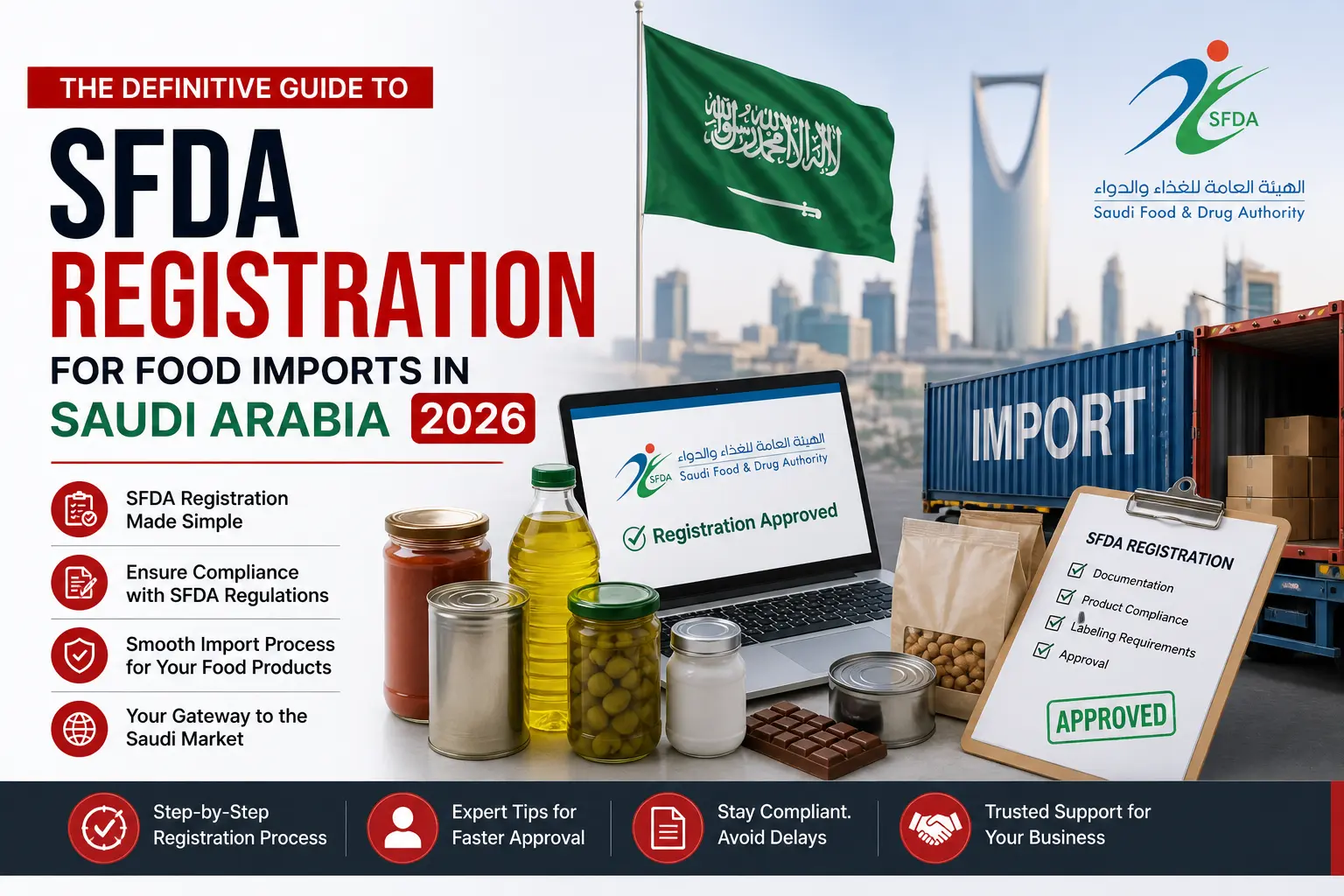
Saudi Arabia’s food sector stands as one of the most lucrative markets in the Middle East, driven by a population of over 36 million, rising disposable incomes, and ambitious diversification goals under Vision 2030. The Kingdom’s strategic push to reduce oil dependency has transformed its food and beverage industry into a priority sector, with government investments aimed at boosting local production while simultaneously opening doors for high-quality international imports. For global food exporters, this represents an unprecedented opportunity—but one that comes with a rigorous regulatory gatekeeper.
Saudi Food and Drug Authority (SFDA) — الهيئة العامة للغذاء والدواء
At the center of this regulatory framework sits the Saudi Food and Drug Authority (SFDA) — الهيئة العامة للغذاء والدواء. Established to safeguard public health, the SFDA enforces some of the most stringent food safety and compliance standards in the Gulf region. Every food product destined for Saudi shelves must earn the authority’s approval through a structured digital registration process. Understanding this system is not optional; it is the fundamental prerequisite for market access.
Navigating SFDA regulations, ZATCA customs protocols, and bilingual labeling requirements can overwhelm even experienced exporters. This is where the expert customs clearance agent become indispensable—bridging the gap between global food manufacturers and Saudi regulatory compliance. From initial documentation to final customs clearance, expert guidance transforms a complex bureaucratic maze into a streamlined pathway to market entry.
What is the SFDA Food Registration System?
The Food Registration System (نظام تسجيل الغذاء) is the SFDA’s mandatory digital framework for regulating all imported and locally manufactured food products. This system ensures that every item entering the Saudi market meets strict safety, quality, and labeling standards aligned with Gulf Cooperation Council (GCC) regulations.
The Digital Gateway: Ghad Portal
All registrations flow through the Ghad Portal (منصة غد), the SFDA’s official electronic platform for product registration, approvals, and compliance tracking. The portal serves as a centralized command center where companies submit product data, upload technical documentation, and monitor application status in real-time. As of 2026, registration on the Ghad platform is mandatory for all companies intending to import food products into Saudi Arabia.
SFDA Certificate (شهادة الهيئة العامة للغذاء والدواء) & Customs Clearance (التخليص الجمركي)
The ultimate objective of this process is obtaining the SFDA Certificate (شهادة الهيئة العامة للغذاء والدواء). This certificate acts as your product’s passport for Customs Clearance (التخليص الجمركي) at Saudi ports of entry. Without it, shipments face detention, rejection, or destruction at the importer’s expense.
Essential Certifications & Standards
Success in the Saudi market demands more than just quality products—it requires a portfolio of internationally recognized certifications that demonstrate commitment to safety and compliance.
HACCP Certification in Saudi Arabia (نظام تحليل المخاطر ونقاط التحكم الحرجة)
The Hazard Analysis and Critical Control Points (HACCP) system serves as the baseline for food safety management. Saudi regulators expect imported food to originate from facilities implementing HACCP principles, ensuring systematic identification and control of potential biological, chemical, and physical hazards throughout the production process.
ISO 22000 Certification in Saudi Arabia (شهادة آيزو 22000)
ISO 22000 provides the global framework for food safety management systems, integrating HACCP principles with interactive communication and system management. While not always explicitly mandatory, possessing ISO 22000 certification significantly strengthens your SFDA application and signals manufacturing excellence to Saudi inspectors.
The Saudi Barcode (الباركود السعودي)
For retail distribution, products must carry compliant barcodes enabling Traceability (تتبع المنتجات) across the supply chain. This requirement supports the Kingdom’s broader food safety objectives and facilitates rapid response in case of product recalls or safety alerts.
Halal Certification (شهادة حلال)
Since November 2020, Saudi Arabia mandates Halal certification for all meat and poultry shipments. Under regulations SFDA.FD/GSO 2055-1 and SFDA.FD/GSO 993, this requirement extends beyond raw meat to include composite products containing animal-derived ingredients such as gelatin, collagen, animal fats, and rennet. All Halal certificates must be issued by certification bodies designated by the SFDA Halal Center.
Technical Requirements for Product Labels
Saudi labeling regulations are among the most strictly enforced in the region. Non-compliance remains the leading cause of border rejections.
Bilingual Labeling
Arabic Labeling (البطاقة الغذائية باللغة العربية) is mandatory. While English may accompany Arabic, all information must be identical across both languages. Arabic stickers are only permitted if affixed by the manufacturer, are irremovable under normal handling conditions, and do not obscure original labeling.
Mandatory Data Elements
Every prepackaged food label must include:
- List of Ingredients (قائمة المكونات): Listed in descending order of predominance, with additives identified by functional class and international numbering.
- Nutritional Facts (البيانات التغذوية): Presented in the approved format following GSO standards.
- Production & Expiry Dates (تاريخ الإنتاج والانتهاء): Displayed in both Hijri and Gregorian calendars.
- Country of Origin (بلد المنشأ): Must be indicated through permanent marking (printing, engraving, or embossing). Stickers are acceptable only if irremovable.
- Allergen Warnings: Mandatory disclosure for 13 specified allergens including gluten, crustaceans, eggs, fish, peanuts, soybeans, nuts, milk, sulfites, celery, mustard, sesame, and lupine.
Step-by-Step SFDA Registration Process
Step 1: Account Setup
Register your company on the SFDA Electronic Portal (البوابة الإلكترونية للهيئة). This requires submission of your Commercial Registration (CR), tax ID, and authorized contact information. Account verification typically takes several business days.
Step 2: Product Categorization
Select the correct HS Code (الرمز التنسيقي) for your food item. Accurate classification determines applicable regulations, testing requirements, and duty rates. Misclassification can trigger delays or compliance failures.
Step 3: Document Upload
Submit your technical dossier including:
- Product composition and formulation details
- Manufacturer licenses and GMP certificates
- Health Certificate (الشهادة الصحية) from the country of origin
- Laboratory analysis reports from SFDA-accredited labs
- Halal certificates (where applicable)
- Label artwork with Arabic translations
Step 4: Final Approval
Upon successful review, the SFDA issues the Product Registration Number (رقم تسجيل المنتج). Average processing timelines range from 3–6 weeks, with additional time required if laboratory testing is mandated.
Why Radhi Customs Clearance is Your Strategic Partner in KSA
Navigating ZATCA (هيئة الزكاة والضريبة والجمارك) regulations requires specialized knowledge of Saudi customs procedures, VAT obligations (currently 15% on imports), and documentation requirements. Radhi team ensures your shipments meet every customs checkpoint without surprises.
Time Efficiency
Port delays cost money. By ensuring complete documentation and pre-clearance compliance, Radhi Awad reduces bottlenecks at the Port of Entry (منفذ الدخول), preventing demurrage charges and preserving product shelf life.
End-to-End Logistics
From SFDA Registration (تسجيل الهيئة) through customs clearance to final delivery, a single strategic partner eliminates coordination gaps between regulators, shipping lines, and ground transport—transforming complex multi-stakeholder logistics into a seamless operation.
Read Saudi Food and Drug Authority Importer Guide 9 Sep 2026 for latest updates.
Streamlining Your Saudi Trade Journey
Saudi Arabia’s food import market offers extraordinary potential for global exporters, but that potential is gated by rigorous regulatory requirements. Success demands more than quality products—it requires precise compliance with SFDA registration protocols, bilingual labeling standards, Halal certifications, and ZATCA customs regulations.
Compliance is the key to market access. In a regulatory environment where a single missing document or mistranslated label can result in shipment rejection, working with experienced local expertise isn’t just convenient—it’s essential.
Don’t let regulations slow you down. Partner with Radhi Customs Clearance for expert SFDA Registration (تسجيل الغذاء) and efficient customs services.
Ready to enter the Saudi market?
Contact Radhi Customs Clearance today to transform regulatory complexity into your competitive advantage.
📍 Office: Uhud District, Eastern Province City Dammam, Kingdom Of Saudi Arabia
📧 Email: Info@radhiawad.com.sa
📞 Phone: +966558959205
Add a Comment