
Key Takeaways at a Glance
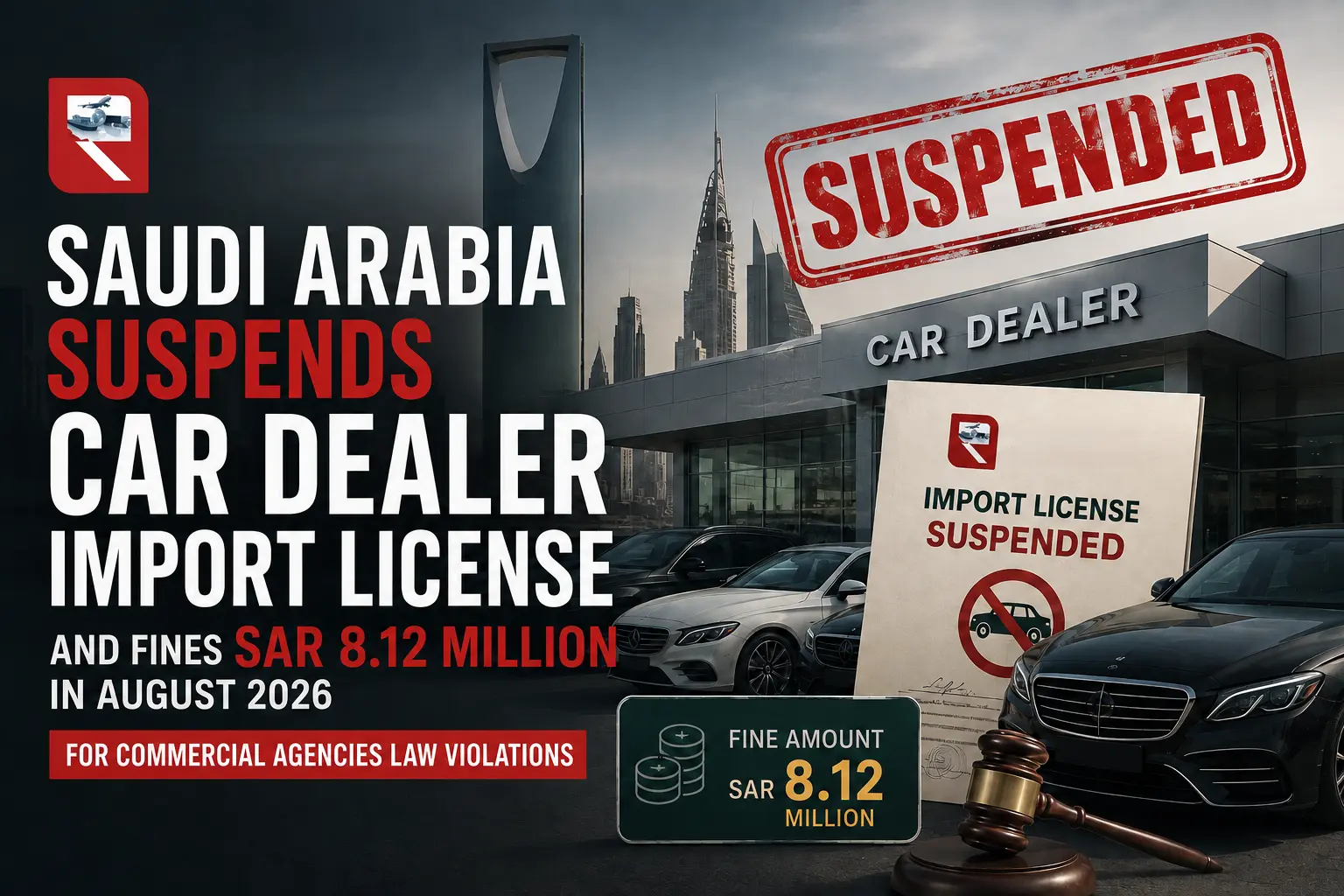
- WHAT: وزارة التجارة السعودية (Saudi Ministry of Commerce) suspended a car dealership’s import license on August 9, 2026, and imposed a sar 8.12 million fine car dealer.
- WHY: 175 violations of the قانون الوكالات التجارية (Commercial Agencies Law) — including spare-parts failures, warranty breaches, refusal to provide replacement vehicles, and after-sales service gaps.
- IMPACT: The foreign manufacturer was summoned; the brand is being transferred to a new local agent; affected customers were contacted and compensated.
- CONTEXT: This is not an isolated case. It is part of a broader regulatory tightening under Vision 2030 and حماية المستهلك السعودية (Saudi consumer protection). In June 2026 alone, 29 automakers faced import suspensions over CAFE supply-plan non-compliance.
What Happened?
On August 9, 2026, Saudi Arabia’s وزارة التجارة السعودية suspended a car dealership’s import license, banned it from importing vehicles, and fined it SAR 8.12 million ($2.17 million USD) after confirming 175 violations of the قانون الوكالات التجارية. Violations included failure to provide spare parts, replacement vehicles during maintenance, manufacturing-quality guarantees, and after-sales services to consumers. The Ministry has initiated proceedings to transfer the brand to a new local agent and is monitoring recall campaigns to protect existing customers.
Full Timeline of the August 2026 Suspension
The Announcement (August 9, 2026)
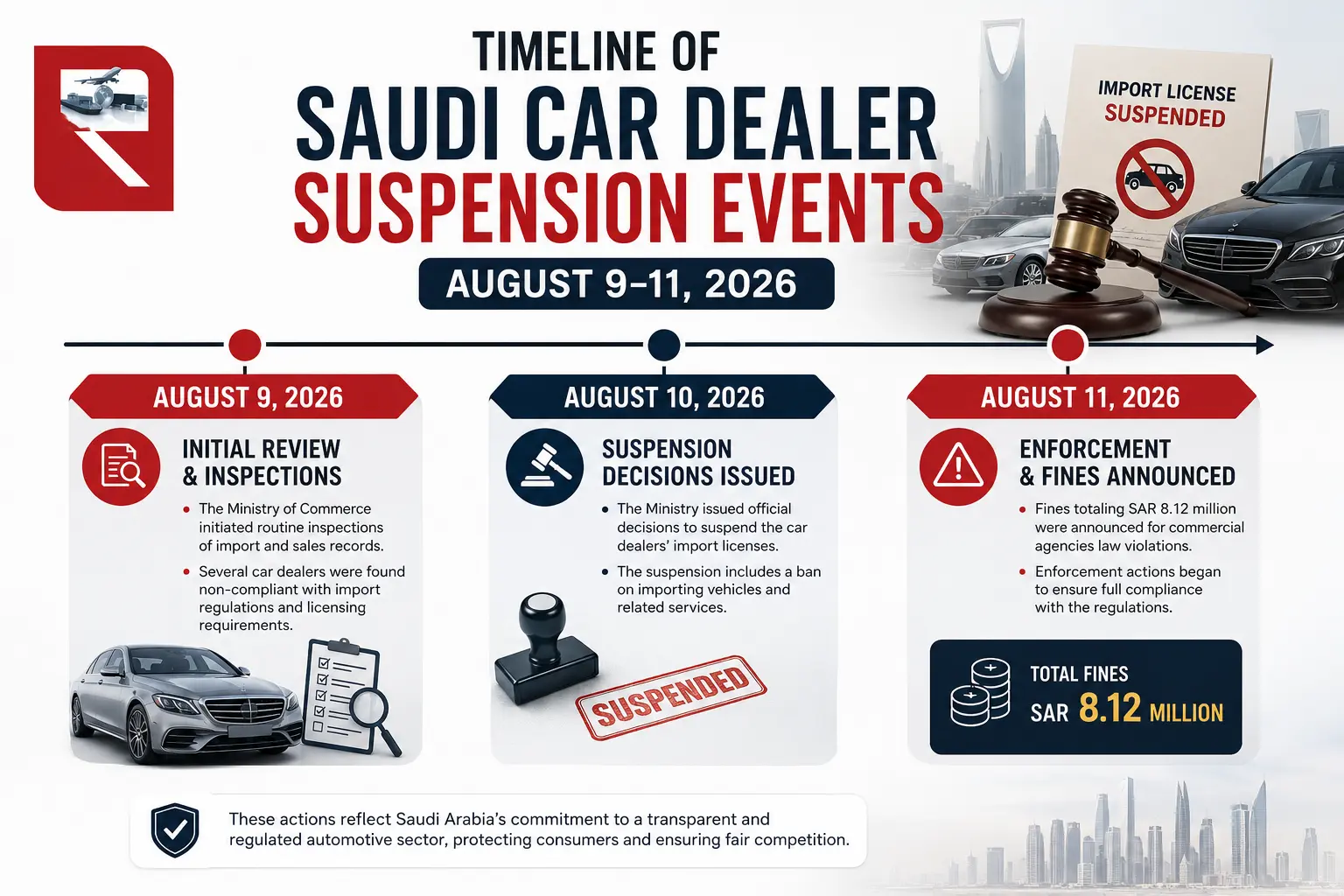
On August 9, 2026, the وزارة التجارة السعودية (Ministry of Commerce) issued an official statement through its website (mc.gov.sa) and accompanying press releases. The announcement confirmed that a specialized team had completed an investigation into a local car dealership and found 175 violations of the قانون الوكالات التجارية (Commercial Agencies Law) and its executive regulations.
The Ministry’s immediate actions were severe and multi-layered:
- Import license suspension — The dealership is prohibited from importing any new vehicles into the Kingdom.
- Vehicle import ban — A complete halt on bringing vehicles through Saudi ports and borders.
- Financial penalty — A sar 8.12 million fine car dealer was imposed, one of the largest penalties of its kind in the Saudi automotive sector.
- Manufacturer summons — The foreign parent company was officially summoned to address the systemic failures.
- Brand transfer initiated — The Ministry began legal proceedings to transfer the brand representation to a new, compliant local agent.
This action sent a clear signal: saudi arabia consumer protection car dealership standards are no longer negotiable.
The Investigation
The Ministry’s specialized investigation team conducted a comprehensive audit of the dealership’s operations. According to reports from Saudi Gazette and Asharq Al-Awsat, the investigation covered:
- Spare-parts inventory records — Whether the dealer maintained adequate stock to service sold vehicles.
- Service center capabilities — Availability of qualified technicians and proper maintenance facilities.
- Warranty fulfillment — Whether warranty claims were honored within statutory timeframes.
- Replacement vehicle provision — Compliance with the obligation to provide substitute vehicles during extended repairs.
- After-sales service quality — Overall customer satisfaction and complaint resolution rates.
The team also contacted affected customers directly, arranged compensation and replacement vehicles where applicable, and monitored the manufacturer’s response to corrective orders.
The Outcome
By August 10–11, 2026, the full scope of the penalty was public. The saudi ministry of commerce car dealer fine of SAR 8.12 million was confirmed across multiple outlets including Ajel (English), Argaam, MarkLines, and Zawya.
The Ministry’s statement included a stern warning: it “will not hesitate to enforce penalties against any commercial facility that violates regulations.” This language signals a permanent shift in enforcement posture — from warnings to immediate, high-cost action.
For importers reading this, the message is unambiguous: car import ban saudi arabia 2026 is not a theoretical risk. It is happening now, to real businesses, with devastating financial consequences.
175 Violations lead to suspension
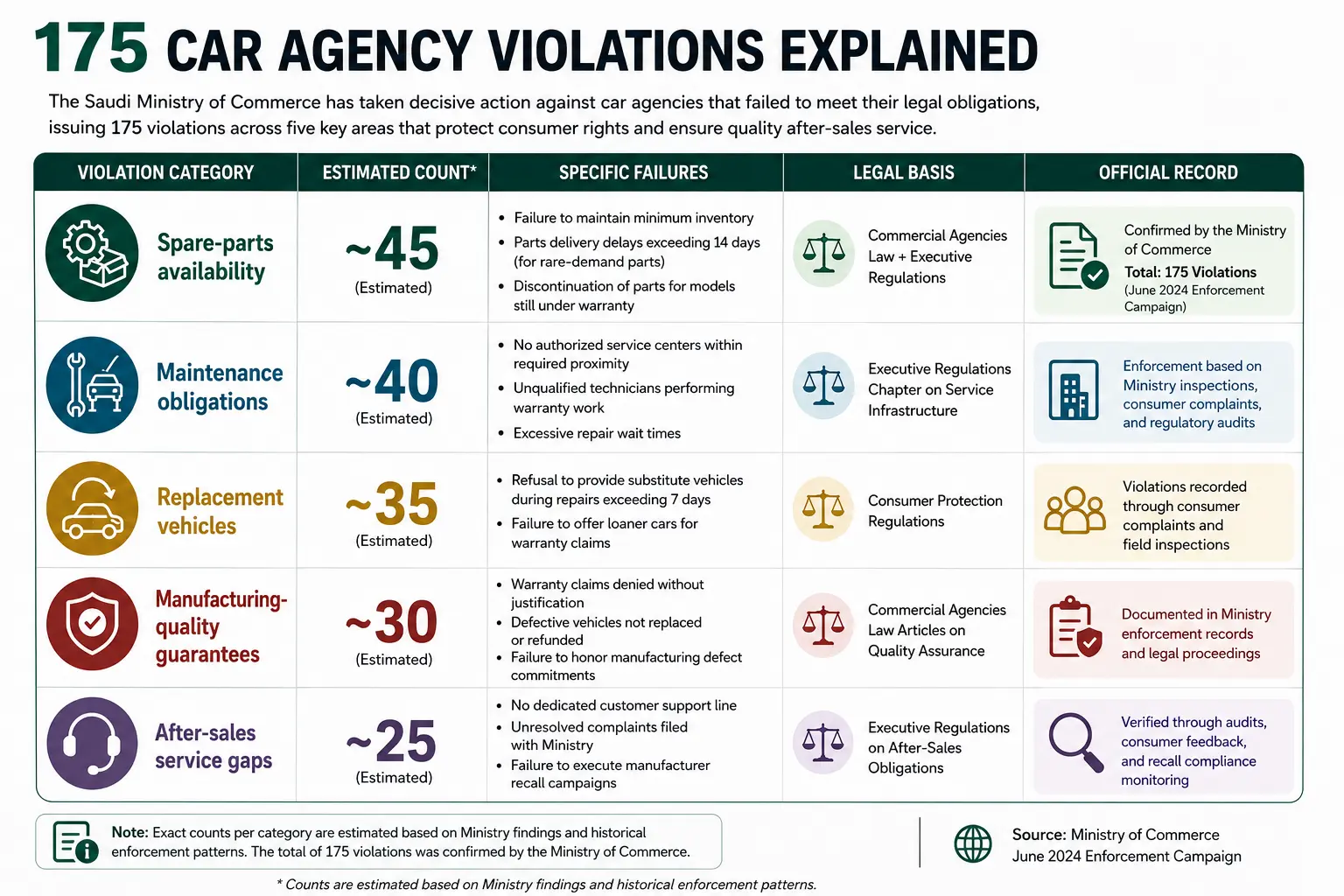
Each category represents a pillar of حماية المستهلك السعودية (Saudi consumer protection). When a dealer fails on spare parts, a vehicle becomes undrivable. When maintenance obligations are ignored, safety is compromised. When replacement vehicles are denied, the consumer bears the cost of the dealer’s failure. When quality guarantees are breached, the buyer is left with a defective asset. And when after-sales service collapses, there is no recourse. The commercial agencies law violation saudi arabia framework exists precisely to prevent this cascade of consumer harm. The August 2026 enforcement action proves that the Ministry is now treating these obligations as binding legal requirements, not marketing promises.
Commercial Agencies Law in Saudi Arabia
The قانون الوكالات التجارية (Commercial Agencies Law) is Saudi Arabia’s primary legislation governing the relationship between foreign manufacturers and their local distributors or agents. It mandates that agents maintain spare-parts inventory, honor warranty obligations, provide replacement vehicles during service, and ensure manufacturing-quality guarantees for consumers. The law was enacted to prevent exactly the scenario that unfolded in August 2026: a foreign brand entering the Saudi market through a local agent, collecting revenue, and then failing to support the product after sale. Under Vision 2030, this law has gained new enforcement teeth as the Kingdom prioritizes consumer rights and market quality over pure volume growth.
Key Obligations Under the Law
For any saudi car dealer import license suspended 2026 case, the underlying failures typically trace back to these statutory obligations:
- Spare-parts availability — Dealers must maintain inventory sufficient to service all models sold within the last 10 years, with delivery within 15 days for standard parts and 30 days for specialized components.
- Warranty coverage — Minimum warranty terms must match or exceed manufacturer global standards, with claim resolution within 14 days.
- Replacement vehicle provision — If a warranty repair exceeds 7 days, the dealer must provide a substitute vehicle of equal or greater class at no cost.
- After-sales service infrastructure — A minimum number of authorized service centers per region, staffed with manufacturer-certified technicians.
- Recall campaign compliance — Immediate execution of manufacturer recall notices, with customer notification within 48 hours.
Enforcement & Penalties
Violations trigger a graduated enforcement ladder:
- First notice: Written warning with 30-day corrective period.
- Second notice: Fine + public disclosure requirement.
- Third notice: Import license suspension + import ban + substantial financial penalty.
- Severe/repeated violations: Permanent license revocation + car import ban saudi arabia 2026 + brand transfer to new agent.
The August 2026 case appears to have bypassed early warnings entirely, suggesting either egregious non-compliance or a new Ministry policy of immediate escalation for consumer-safety violations.
Commercial Agencies Law (2026) VS CAFE Supply-Plan Compliance (2025–2026)
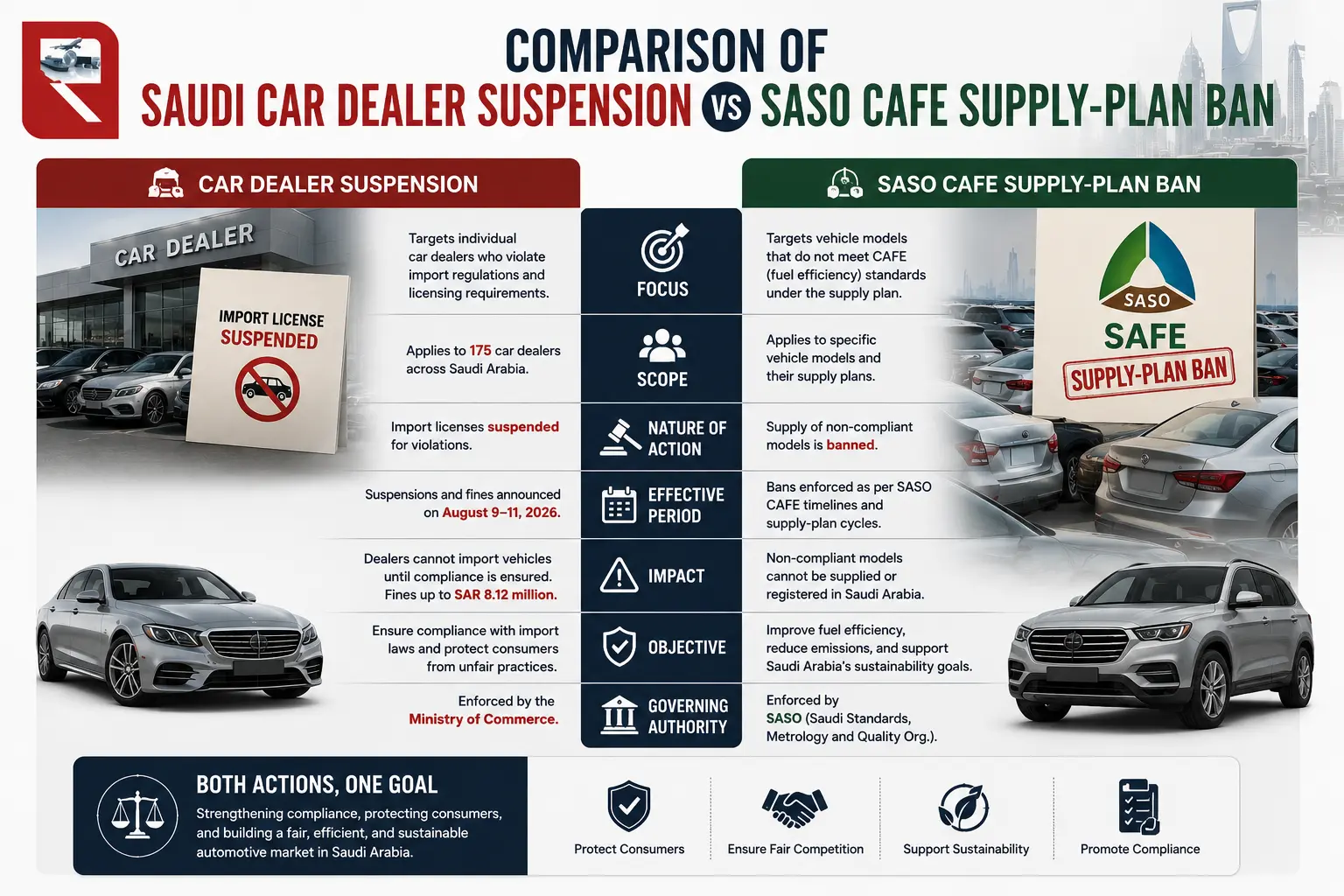
This is a technical compliance issue, not a consumer-rights failure. The distinction matters because:
- CAFE suspensions are reversible. Once the manufacturer submits the correct paperwork to SEEP, imports resume.
- Commercial Agencies Law suspensions are punitive. They indicate systemic operational failure and often result in permanent brand transfer.
Both Crackdowns Signal About Vision 2030
Together, these parallel enforcement tracks reveal a coordinated strategy:
- Consumer protection as a national priority — The saudi arabia consumer protection car dealership framework is no longer toothless. SAR 8.12 million fines prove enforcement has real financial consequences.
- Regulatory maturity — Saudi Arabia is moving from a “wild west” import market to a rules-based system where both technical compliance (SASO/CAFE) and operational compliance (MoC/after-sales) are mandatory.
- Quality over price competition — The old model of importing cheap vehicles with minimal support is dying. The new standard requires full after-sales infrastructure, spare-parts commitment, and warranty honor.
- Environmental integration — CAFE standards tie market access to fuel-efficiency compliance, aligning the auto sector with Saudi green-energy goals.
- Message to international brands — Compliance is non-negotiable. Entering the Saudi market without a robust local partner, spare-parts plan, and service infrastructure is now a high-risk proposition.
“Saudi Arabia’s large auto market and sustained demand make it one of the region’s most attractive. Stronger after-sales compliance should bolster market confidence and gradually shift competition toward quality and reliability rather than price alone.” — Mohammed Al-Farraj, Chief Asset Management Officer, Arbah Capital (Source: Asharq Al-Awsat, August 11, 2026)
What This Means for Importers & Distributors
If you import vehicles, parts, or automotive equipment into Saudi Arabia, the August 2026 suspension is a wake-up call. Here is your immediate action plan:
Immediate Compliance Actions
Step 1: Audit spare-parts inventory Compare your current stock against a 90-day demand forecast for every model you have sold in the last 5 years. If you cannot fulfill a parts request within 15 days, you are at risk.
Step 2: Verify service center capabilities Ensure every service center is staffed with manufacturer-certified technicians. Keep certification records updated and accessible for Ministry inspection.
Step 3: Review warranty claim resolution times Measure your average warranty resolution time. If it exceeds 14 days, redesign your process. Delays are now evidence of commercial agencies law violation saudi arabia.
Step 4: Establish replacement-vehicle protocols Create a written policy guaranteeing substitute vehicles for any warranty repair exceeding 7 days. Maintain a small fleet of loaner vehicles specifically for this purpose.
Step 5: Submit updated supply plans to SASO/SEEP If you represent a brand subject to CAFE regulations, confirm that your manufacturer’s supply plan is filed and current. A missing form can trigger a car import ban saudi arabia 2026.
Step 6: Register all products on SABER Every vehicle model and automotive part must have a valid SABER conformity certificate. Non-certified products are inadmissible at Saudi customs.
Step 7: Document everything Maintain detailed records of all after-sales interactions, warranty claims, parts orders, and service appointments. Regulatory audits now demand paper trails.
Need help auditing your import compliance before the next inspection? Our Saudi customs clearance team reviews supply plans, SABER registrations, and after-sales infrastructure. We identify gaps before the Ministry does.
What This Means for Car Buyers
If you are considering buying a vehicle in Saudi Arabia — or you already own one from a dealer now under scrutiny — here is what you need to know.
How to Check If Your Dealer Is in Good Standing
Step 1: Search the commercial registry Visit mc.gov.sa and search the commercial registry using the dealer’s Commercial Registration (CR) number. Verify the business is active and the scope includes vehicle import and distribution.
Step 2: Cross-check the authorized agent list Contact the vehicle manufacturer directly (via their global website) and confirm that your dealer is listed as an authorized agent for Saudi Arabia. Unauthorized dealers have no legal obligation to honor warranties.
Step 3: Check SASO’s SEEP portal Visit the Saudi Energy Efficiency Program (SEEP) portal and search for the manufacturer’s compliance status. If the brand is listed as non-compliant, new imports are suspended — which means spare parts may become scarce.
Step 4: Read consumer reviews Search local platforms and social media for recent complaints about the dealer. Patterns of unresolved warranty claims or parts delays are red flags.
Step 5: Get written confirmation before signing Before you pay a deposit or sign a sales contract, request written confirmation of:
- Warranty terms (duration, coverage, claim process)
- Spare-parts availability guarantee
- Service center locations and capabilities
- Replacement vehicle policy during repairs
If You Already Bought From a Suspended Dealer
- Your warranty may still be valid. If the manufacturer has assigned a new agent, that agent inherits all warranty obligations. Contact the manufacturer directly to confirm.
- File a complaint if needed. The Ministry of Commerce consumer protection hotline is your first recourse. Document every service issue with dates, photos, and correspondence.
- Do NOT cancel your vehicle registration. Canceling complicates any future transfer of ownership or warranty claims.
- Monitor recall notices. If your vehicle is subject to a manufacturer recall, contact the new agent immediately. The Ministry is monitoring recall execution as part of its oversight.
How to Verify a Dealer’s License in Saudi Arabia
Knowing how to check car dealer license saudi arabia is now an essential skill for any buyer or business partner. Here is the complete process:
Method 1: Ministry of Commerce Commercial Registry
- Go to mc.gov.sa
- Navigate to the “Commercial Registry Search” service
- Enter the dealer’s CR number or trade name and verify.
- Business status is “Active” (نشط)
- License scope includes “Vehicle Import and Distribution”
- No enforcement actions or suspensions are listed
Method 2: Manufacturer Authorization Verification
- Visit the brand’s official global website
- Locate the “Find a Dealer” or “Authorized Agents” section
- Select “Saudi Arabia” as the region
- Confirm your dealer’s name appears on the list
- If not listed, the dealer may be operating without manufacturer authorization — a major risk for warranty coverage
Method 3: SASO SEEP Portal Check
- Visit seep.gov.sa
- Search for the manufacturer’s CAFE compliance status
- If the status shows “Non-Compliant” or “Suspended,” new vehicle imports are halted
- This does not necessarily void existing warranties, but it may affect future parts availability
Method 4: Direct Ministry Inquiry
For high-value purchases or commercial partnerships, submit a formal inquiry to the Ministry of Commerce through their electronic services portal. Response times are typically 3–5 business days.
For a detailed walkthrough of the full import process, see our guide: How to Import a Car to Saudi Arabia: Complete 2026 Guide →
For professional customs clearance support, visit our Saudi Customs Clearance Services → page.
What Analysts Say
The August 2026 enforcement action has drawn significant attention from industry analysts and investment professionals.
“The Saudi auto market is entering a new phase of maturity. The Ministry of Commerce is sending an unambiguous signal that after-sales service is not a cost center to be minimized — it is a legal obligation. Brands that treat Saudi Arabia as a pure sales market without operational investment will face exclusion.” — Automotive Sector Analyst, Argaam, August 10, 2026
“From an investor perspective, this strengthens the case for established, well-capitalized distributors. The barriers to entry are rising, which protects incumbents who have already invested in service infrastructure. The days of importing containers and hoping for the best are over.” — Mohammed Al-Farraj, Chief Asset Management Officer, Arbah Capital (Source: Asharq Al-Awsat, August 11, 2026)
“The SAR 8.12 million fine is a watershed moment. It establishes a new ceiling for penalties and will likely be referenced in future enforcement actions. Importers should budget for compliance as a core operating cost, not an afterthought.” — Saudi Gazette Editorial, August 10, 2026
Frequently Asked Questions (FAQs)
Which car dealer was suspended in Saudi Arabia in August 2026?
The Ministry of Commerce did not publicly name the dealership, citing ongoing legal proceedings. The dealer was fined SAR 8.12 million and banned from importing vehicles after 175 violations were confirmed under the قانون الوكالات التجارية.
What is the Commercial Agencies Law in Saudi Arabia?
The قانون الوكالات التجارية is the law governing relationships between foreign manufacturers and local Saudi agents. It requires agents to maintain spare-parts inventory, honor warranties, provide replacement vehicles during service, and ensure manufacturing-quality guarantees. Violations can result in license suspension, fines, and public disclosure.
How much was the fine imposed by the Ministry of Commerce?
SAR 8.12 million (approximately $2.17 million USD). This is one of the largest fines imposed on a car dealer in Saudi Arabia for consumer-rights violations.
What were the 175 violations found by the Ministry?
The violations spanned five categories: spare-parts unavailability, maintenance service failures, refusal to provide replacement vehicles during repairs, manufacturing-quality guarantee breaches, and overall after-sales service gaps.
Can a suspended dealer resume vehicle imports in Saudi Arabia?
Only after full corrective action, compliance verification by the Ministry, and potentially a court ruling. In this case, the brand is being transferred to a new agent, suggesting the original dealer’s suspension may be permanent.
How does this affect car buyers with existing warranties?
Affected buyers were contacted by the Ministry and received compensation and replacement vehicles. For other buyers, the manufacturer has been summoned and a new agent is being appointed to honor existing warranties and service obligations.
How do I check if a car dealer is licensed in Saudi Arabia?
1) Search mc.gov.sa commercial registry,
2) verify the CR number against the brand’s authorized agent list,
3) check SASO SEEP portal for manufacturer compliance,
4) read consumer reviews,
5) request written warranty confirmation before purchase.
What is the difference between this suspension and the SASO CAFE ban?
This وزارة التجارة السعودية action targets a dealer for consumer-rights violations under the قانون الوكالات التجارية. The SASO CAFE ban (affecting 29 automakers in June 2026) targets manufacturers for failing to submit fuel-economy supply plans. One is about after-sales service; the other is about regulatory filing compliance.
Radhi Customs Clearance Co. is a Saudi customs clearance and import compliance specialist with over 38 years of experience navigating Fasah, SABER, SASO, and وزارة التجارة السعودية regulations.
Get Expert Help Before the Ministry Knocks
At Radhi Awad, we specialize in Saudi customs clearance, SABER registration, SASO CAFE compliance, and Commercial Agencies Law audits. Our team has helped importers and distributors avoid penalties, secure licenses, and maintain uninterrupted operations in the Kingdom.
Book a free 30-minute compliance consultation today. We will review your current status, identify exposure points, and build a corrective action plan tailored to your business.
🚀 Book Your Free Compliance Consultation →
Or call us directly: +966558959205 | Email: Info@radhiawad.com.sa
Add a Comment