
passenger vehicles must be 2021 model year or newer (the 5-year rule), you’ll pay 5% customs duty plus 15% VAT on the depreciated value, and you need a SABER Certificate of Conformity filed before the car ships. Most importantly, if you’re an expat on a regular Iqama, you can import only one car every 3 years — and if your vehicle fails energy-efficiency standards, you don’t get a fee option. You get rejected at the port.
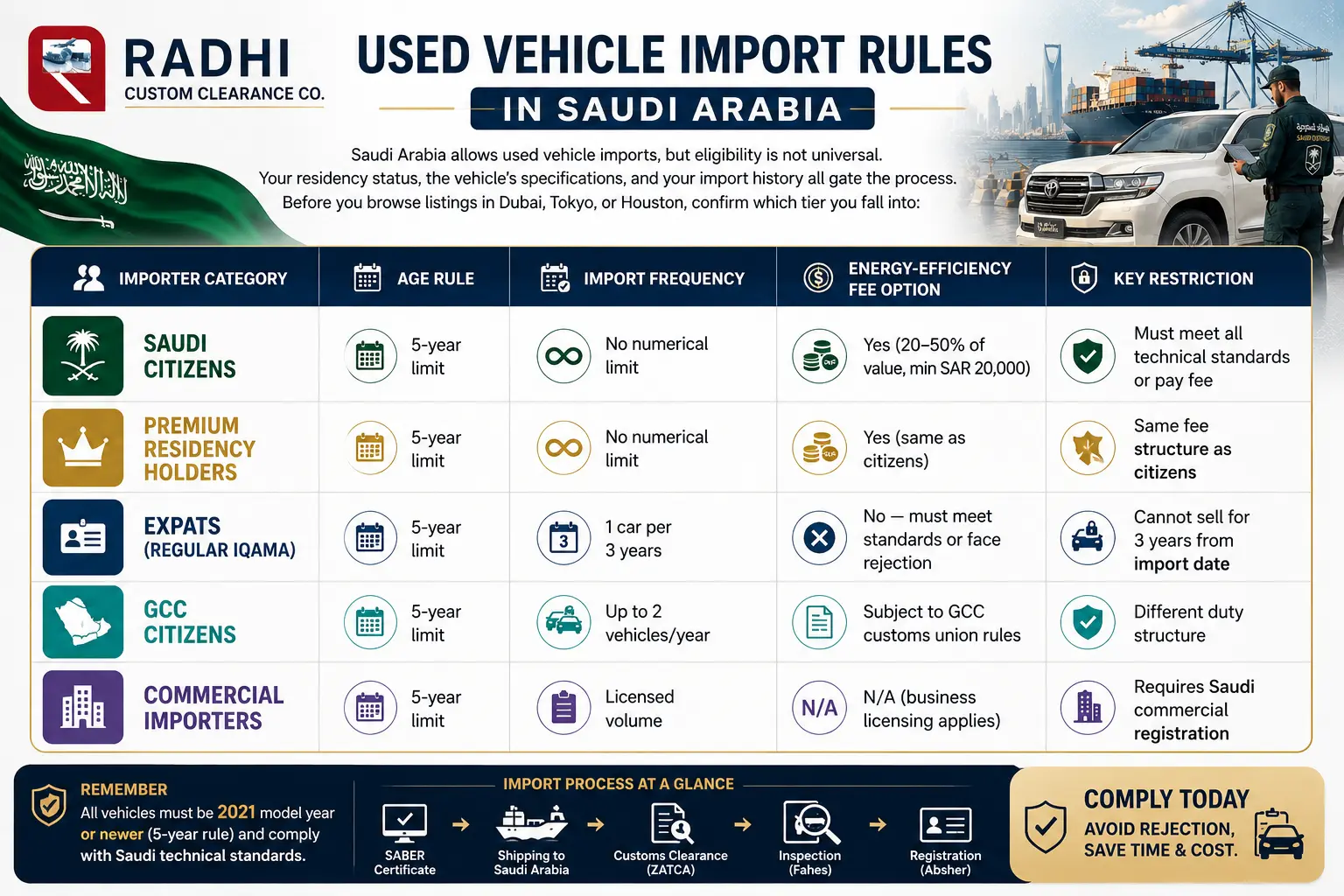
ZATCA handles customs clearance and duty collection. SASO sets the technical standards. SABER is the digital platform where conformity is certified. Fahes conducts the physical inspection. Absher handles final registration. Each entity depends on the previous step. Get one wrong, and the entire chain breaks.
Can You Import a Used Car into Saudi Arabia?
Yes — but who you are determines what you can import.
Saudi Arabia allows used vehicle imports, but eligibility is not universal. Your residency status, the vehicle’s specifications, and your import history all gate the process. Before you browse listings in Dubai, Tokyo, or Houston, confirm which tier you fall into:
The 5-Year Age Rule
Vehicles must be manufactured within 5 years of the import year, excluding the current year. This is the single most common reason for rejection — and the most expensive mistake to make.
For a 2026 import, the vehicle must be 2021 model year or newer. A 2020 model is automatically rejected at the port. No exceptions. No appeals. No “wasta” workaround.
Age Eligibility by Import Year
| Import Year | Oldest Eligible Model Year | Example Eligible Models |
| 2025 | 2020 | 2020 Toyota Camry, 2020 Honda Accord |
| 2026 | 2021 | 2021 Nissan Patrol, 2021 BMW X5 |
| 2027 | 2022 | 2022 Mercedes GLE, 2022 Lexus LX |
The Antique Exception (30+ Years)
Genuine classic vehicles (30+ years old) can be imported through a separate customs assessment track. However, they are stamped on the customs card and are not allowed to drive on public roads. These are for collection and display only — not daily transportation.
Can I import a 2019 car to Saudi Arabia in 2026?
No. It exceeds the 5-year limit and will be refused at the port.
The 3-Year Import Limit: Who Can Import and How Often
Residents on a regular Iqama can import ONE private car every 3 years. This is tracked by your Iqama number in ZATCA’s system. Attempting a second import within the window triggers an automatic hold.
Additional restrictions for residents:
- The vehicle cannot be sold for 3 years from the date of import.
- The importer’s Iqama must be valid at the time of import.
- The vehicle must be for personal use only — commercial activity requires a separate license.
Saudi citizens and premium residency holders face no numerical import limit, though they must still comply with all technical standards or pay the energy-efficiency fee.
Customs Duty, VAT, and the Real Landed Cost
5% customs duty and 15% VAT. But the real calculation involves depreciation, documentation quality, and potential penalty fees.
How Depreciation Works (Monthly, Not Annual)
The dutiable value is discounted based on the vehicle’s age. The calculation is monthly, not the commonly misunderstood “10% per year” rule:
| Age Period | Depreciation Rate | Example for SAR 100,000 Vehicle |
| First 6 months of model year | 0% (considered new) | SAR 100,000 |
| Months 7–12 of model year | 2% per month | SAR 88,000 (12% total) |
| Year 2 through Year 5 | 1% per month | SAR 76,000 (24% total at Year 2) |
| Maximum deduction | 60% (for vehicles >5 years old) | SAR 40,000 |
Note: Vehicles older than 5 years are already ineligible for import, so the 60% cap is theoretical for standard imports. For eligible vehicles (≤5 years), the practical maximum depreciation is approximately 42–48%.
The Documentation Trap
If you cannot produce trusted documents from the manufacturer’s authorised agent or a verifiable dealer, ZATCA is entitled to reassess the vehicle value upward — potentially doubling your duty exposure. The original purchase invoice and a clean ownership trail are not optional. They are part of the price of the car.
Energy-Efficiency Non-Compliance Fee
Light vehicles under 3,500 kg carry a SASO fuel-economy rating on a 6-level scale. A car that fails the energy-efficiency standard faces a penalty of 20% to 50% of the vehicle value, with a minimum fee of SAR 20,000.
Critical distinction: This fee option is only available to Saudi citizens and premium residency holders. Expats on regular Iqama do not have this option — their vehicles must meet the energy-efficiency standard, or they face rejection.
Additional Costs to Budget
| Cost Item | Estimated Range (SAR) |
| Shipping (RORO, e.g., Jebel Ali to Dammam) | 4,000–10,000 |
| Transit insurance | 500–1,500 |
| Port handling/storage (after free period) | 200–500/day |
| SABER/CoC fees | 1,500–3,000 |
| Fahes technical inspection | 300–500 |
| Registration and plates (Absher) | 500–1,000 |
| Total Additional Costs | ~SAR 7,000–16,000 |
Required Certificates: SASO, SABER, and Conformity
You cannot clear customs without the right certificates — and they must be obtained before the vehicle arrives, not after.
Certificate of Conformity (CoC)
The CoC confirms that the vehicle meets Saudi technical standards (GSO standards). It covers: – Emissions compliance (Euro 4/5/6 equivalent) – Safety features (ABS, airbags, child restraint anchors) – Structural integrity – Odometer verification
SABER Platform Registration
SABER is the digital platform managed by SASO. For vehicle imports, you need two certificates:
- Product Certificate of Conformity (PCoC): Issued for the vehicle model/type. Valid for 1 year.
- Shipment Certificate of Conformity (SCoC): Issued for the specific shipment. Must be obtained before the vehicle arrives at the Saudi port.
Important: SABER registration must be completed before the vehicle ships. Customs will not release a vehicle without a valid SCoC, and you cannot backdate SABER registration.
Pre-Export Inspection
The conformity inspection happens in the country of export, not after arrival in Saudi Arabia. A failed inspection abroad is cheap to fix. A failed arrival inspection means rejection, storage fees, and potential re-export costs.
Left-Hand Drive Only
Every Gulf state registers left-hand-drive cars only. A right-hand-drive vehicle — and even a car converted from right to left abroad — is rejected for registration. If you’re sourcing from the UK, Japan, Australia, or any RHD market, the car is a non-starter regardless of its age or condition.
Complete Documents Checklist To Import Used Cars
Use this checklist to verify you have every document before shipping. One missing paper can hold your vehicle at port for weeks.
| Before Shipping | At Port Clearance | For Registration |
| Vehicle title/ownership proof | Original Bill of Lading | Customs clearance certificate |
| Purchase invoice/receipt | Certificate of Conformity (CoC) | SASO conformity approval |
| Export certificate from origin country | SABER registration confirmation (PCoC + SCoC) | Fahes technical inspection report |
| Vehicle history report (no salvage/flood) | ZATCA import declaration | Proof of insurance |
| Transit insurance policy | Duty + VAT payment receipt | Absher registration application |
| Power of attorney (if using broker) | Energy-efficiency fee receipt (citizens only) | National ID / Iqama |
| Pre-export inspection report | Vehicle registration fee |
Top 10 Reasons ZATCA Rejects a Used Vehicle
- Vehicle exceeds the 5-year age limit — Most common rejection. Check the eligibility table before you buy.
- Right-hand-drive configuration — Zero exceptions. RHD vehicles are rejected regardless of origin or condition.
- Prior use as taxi, police, or rental vehicle — Commercial-use history disqualifies personal import.
- Salvage, flood, or major structural damage — Any frame damage, fire damage, or drowning history = automatic rejection.
- Missing or invalid Certificate of Conformity — CoC must be from a SASO-recognised body (e.g., TÜV Rheinland, Intertek).
- No SABER pre-registration — SCoC must be obtained before arrival. Cannot be done after the vehicle lands.
- Energy-efficiency non-compliance (expats only) — Citizens can pay the fee; expats on Iqama get rejected outright.
- Stolen vehicle or tampered chassis/VIN — Cross-checked against INTERPOL and manufacturer databases.
- Armored or heavily modified vehicles — Requires special permits not available for personal imports.
- Exceeds personal import limit (1 per 3 years) — ZATCA tracks this by Iqama number. No exceptions.
Special Cases
Hybrid Vehicles
Standard import rules apply. No confirmed duty exemption for 2026. UN38.3 battery certification required.
Electric Vehicles (EVs)
No confirmed duty exemption for 2026. Type 2/CCS charging standard mandatory. UN38.3 battery certification required. SASO has a dedicated Certificate of Conformity for EVs.
Antique Vehicles (30+ Years)
Importable through separate customs assessment. Customs card stamped. Not road-legal — for collection/display only.
Premium Residency Holders
Same energy-efficiency fee option as citizens (20–50% of value, min SAR 20,000). This is not a separate exception for older vehicles — the 5-year rule still applies unless the fee is paid.
GCC-Origin Vehicles
May qualify for reduced duty under GCC customs union. Requires GCC conformity certificate. Different documentation path through GCC standardisation.
7 Costly Mistakes First-Time Importers Make
- Buying before checking SABER eligibility — SABER rejects certain makes/models without warning. Check first.
- Ignoring the 3-year import limit — ZATCA tracks by Iqama. Second attempt = automatic hold.
- Assuming RHD from Japan/UK is allowed — It’s not. Ever. No conversion workarounds accepted.
- Skipping the vehicle history report — Flood cars from US Gulf Coast and hurricane zones often reach Saudi ports.
- Not budgeting for energy-efficiency fees — Citizens only, but SAR 20,000+ is a shock if unplanned.
- Shipping without transit insurance — Ocean damage is common. Uninsured = total loss.
- Using a non-SASO-recognised CoC provider — Invalid CoC = rejection, no refund, no appeal.
Frequently Asked Questions
Can I import a car older than 5 years into Saudi Arabia?
No, for standard passenger vehicles. The 5-year rule is strict with no exceptions for expats or regular residents. Antique vehicles (30+ years) can be imported for collection but cannot be driven on public roads.
How much does it cost in total to import a used car to Saudi Arabia?
Total cost = vehicle value + shipping (SAR 4,000–10,000) + customs duty (5%) + VAT (15% on value + duty) + compliance fees (SAR 1,500–3,000) + potential energy-efficiency fee (20–50% of value, citizens only). Budget SAR 15,000–30,000 above the vehicle purchase price.
What documents do I need before shipping a used car to Saudi Arabia?
Vehicle title, purchase invoice, export certificate, vehicle history report, transit insurance, and SABER registration confirmation (PCoC + SCoC). See our complete checklist above.
Can expats import right-hand-drive cars?
No. Left-hand drive is mandatory with zero exceptions. RHD vehicles are rejected at port regardless of origin, condition, or conversion work.
What happens if my car gets rejected at the port?
You have 3 options: (1) Re-export at your expense, (2) Abandon to customs (vehicle auctioned), or (3) Appeal with corrected documentation (rarely successful). Storage fees accrue daily at SAR 200–500/day.
How many cars can I import as an expat?
One private car every 3 years. You cannot sell it for 3 years from the import date. ZATCA tracks this by your Iqama number.
Can I import a car for my spouse or family member?
Only if they are the primary importer with their own Iqama and haven’t imported in the last 3 years. You cannot use your quota for someone else.
How long does the import process take?
2–4 weeks with an experienced broker and complete documentation. 6–8 weeks or longer if issues arise. Port storage fees apply after the free period (usually 7–14 days).
Ready to Import? Start With a Free Eligibility Check
Importing a used car to Saudi Arabia is possible — but one missed step can cost you thousands in rejected shipments, storage fees, and re-export costs. At Radhi Custom Clearance Co., we offer a free eligibility check that verifies your vehicle against all ZATCA, SASO, and SABER requirements before you spend a single riyal on shipping.
🚗 Get Your Free Eligibility Check →
📞 Explore Our Customs Clearance →
This guide is for informational purposes only and does not constitute legal or regulatory advice. Import regulations and technical requirements may change based on official updates. Verify current requirements through ZATCA, SASO before making import decisions.
Radhi Custom Clearnce Co. is a licensed customs clearance and trade compliance consultancy based in Saudi Arabia, specialising in ZATCA customs procedures, SASO/SABER conformity, and import logistics for businesses and individuals across the Kingdom.
Add a Comment