
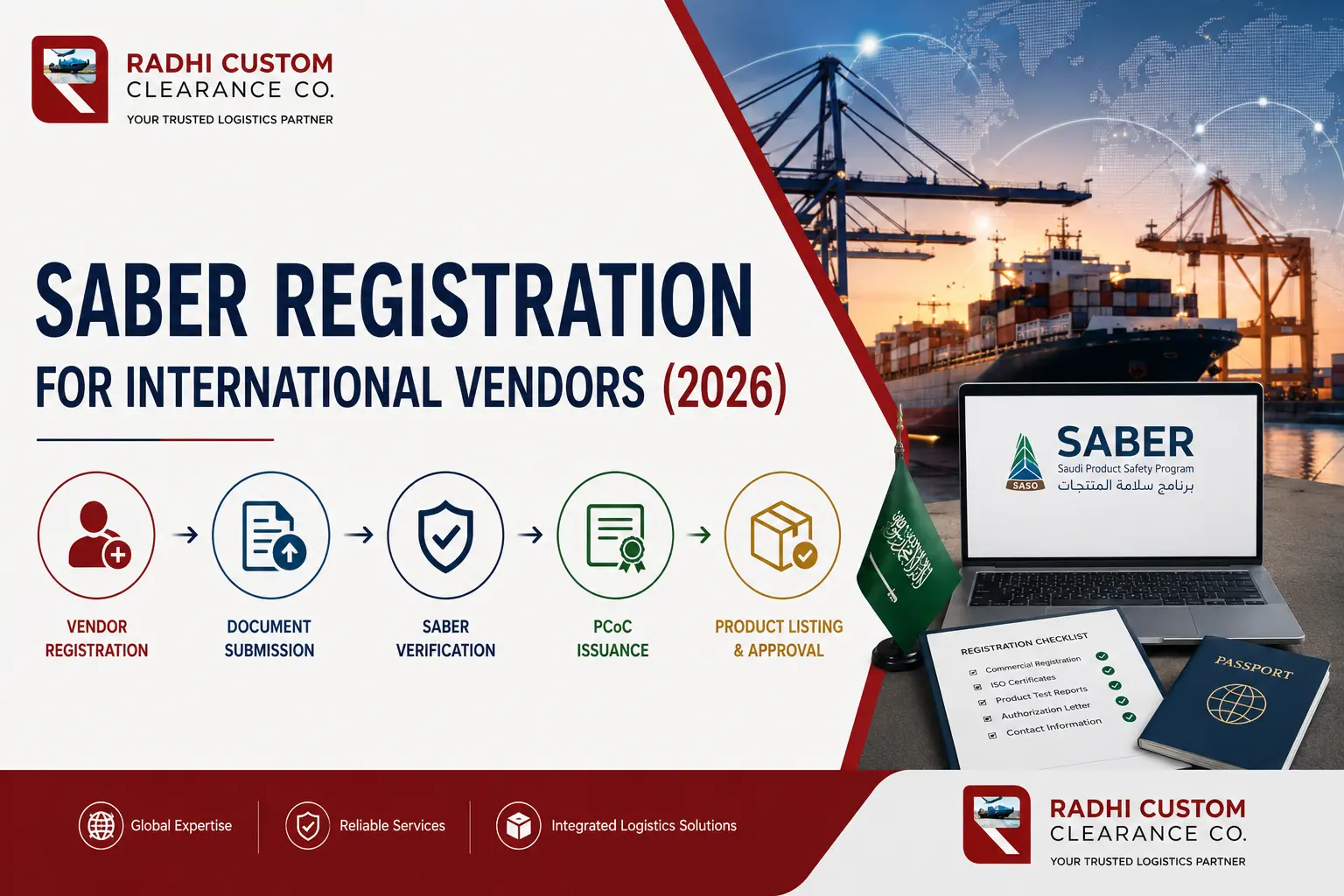
The $50M Problem: Why SABER Compliance Is Make-or-Break for Giga Project Suppliers
In 2026, 40% of shipments bound for Saudi Arabia’s Giga Projects face customs holds due to SABER non-compliance. A single rejected Product Certificate of Conformity (PCoC) costs between 5,000 and 20,000 SAR in non-refundable fees — plus 2 to 4 weeks of catastrophic project delay. For a NEOM construction timeline where every day of delay triggers contractual penalties, SABER is not an administrative checkbox. It is a strategic supply chain framework that can make or break your contract.
Saudi Arabia’s Giga Projects — NEOM, Qiddiya, Red Sea Global, Diriyah Gate, AMAALA, and ROSHN — represent the largest infrastructure investment program in modern history. Collectively backed by the Public Investment Fund (PIF), these projects are transforming the Kingdom’s landscape with cutting-edge infrastructure, smart city technology, renewable energy systems, and world-class hospitality developments. They also operate on aggressive construction timelines where a single delayed shipment due to compliance issues can trigger massive contractual penalties across the entire supply chain.
The SABER platform, managed by the Saudi Standards, Metrology and Quality Organization (SASO), has evolved from a simple certification portal into a deeply integrated compliance ecosystem directly linked with Saudi customs through the Fasah platform. In 2026, SASO has intensified digital enforcement, and the consequences of non-compliance are immediate and severe: rejection at Jeddah and Dammam ports, non-refundable fees, and potential blacklisting for repeat offenders.
Critical 2026 Update: SASO has officially eliminated the Letter of Undertaking (LUT) workaround that many suppliers previously used to bypass full certification. As of early 2026, full PCoC and SCoC compliance is mandatory for all regulated imports — no exceptions, no shortcuts.
But here is the core challenge that most international vendors discover too late: SABER is an importer-centric system. An international vendor cannot directly open a SABER account without a legal Saudi entity. This guide bridges that gap — providing the exact roadmap global suppliers need to navigate SABER, secure their certificates, and ensure their shipments clear Saudi customs without delay.
Key Takeaway: International vendors CANNOT directly open SABER accounts. You need a Saudi legal entity, joint venture partner, or an Importer of Record (IOR) service to interface with the platform. Plan this relationship before you sign your supply contract.
[🟢 Get Your Free SABER Compliance Assessment]
Find out if your product qualifies for SABER — and what it will cost — before you ship. Zero obligation. 24-hour turnaround from Radhi Customs Clearance.
[Start Free Assessment →]
⚡ 24/7 Emergency Response | 📍 Riyadh & Jeddah Offices |
Stuck at Saudi Customs? We Clear It in 48 Hours
Radhi’s SABER desk has cleared over $50 million in held shipments for global suppliers. If your cargo is currently stuck at Dammam or Jeddah port, we know exactly why — and how to fix it.
Emergency Clearance Support →
📞 WhatsApp: +966558959205 | 📧 info@radhiawad.com.sa
How International Vendors Can Access SABER — 3 Legal Pathways
Before you can issue a single certificate, you must solve the access problem. SABER accounts can only be opened by Saudi-registered entities with valid Commercial Registration (CR) numbers verified against the Ministry of Commerce database. For international vendors, this creates three viable pathways:
Local Importer Partnership
The most common route for international suppliers is partnering with a Saudi importer who already has an active SABER account. The importer registers your products under their CR, issues the PCoC and SCoC, and acts as the consignee on your Bill of Lading.
Advantages: – Fastest setup if you already have a Saudi buyer – No need to establish your own legal entity – Importer handles Arabic documentation and local communication
Risks: – You are entirely dependent on the importer’s compliance history – If their SABER account has previous rejections or suspensions, your products may face additional scrutiny – Limited control over timeline and certificate management – Potential conflicts if the importer also sources from your competitors
Best For: One-off shipments, trial orders, or suppliers with established Saudi distributor relationships.
Joint Venture Entity
For suppliers planning long-term, high-volume engagement with Giga Projects, establishing a joint venture (JV) with a Saudi partner provides maximum control. This requires obtaining a MISA (Ministry of Investment) license and registering a new Commercial Registration (CR) specifically for the JV entity.
Advantages: – Full control over SABER account and certificate management – Direct relationship with SASO and certification bodies – Ability to build independent brand presence in Saudi market – Potential eligibility for Saudi government incentives and preferential procurement
Challenges: – Setup time: 3 to 6 months minimum – High capital requirements and ongoing compliance costs – Complex shareholder agreements and governance structures – Requires deep understanding of Saudi commercial law
Best For: Suppliers with multi-year Giga Project contracts, strategic market entry plans, or proprietary technology requiring direct IP protection.
Importer of Record (IOR) Service (Recommended for Project-Based Suppliers)
An Importer of Record (IOR) is a specialized logistics and compliance firm that acts as the legal importer on your behalf. The IOR opens the SABER account, manages all certification processes, handles customs clearance through Fasah, and delivers your goods to the final project site — all under a service agreement.
Advantages:
- Fastest route: typically 3 to 5 days to activate
- No need for Saudi legal entity or CR
- Expert handling of all SABER, Fasah, and customs complexities
- Fixed-cost predictability (usually 2% to 5% of shipment value)
- Risk transfer: IOR assumes legal liability for compliance
Considerations:
- Ongoing service fees for each shipment
- Less control over direct customer relationships
- Need to vet IOR’s SASO accreditation and track record
Best For: Project-based suppliers, first-time Saudi exporters, and companies testing market demand before committing to full entity establishment.
Account Setup Protocol (2026)
Regardless of pathway, the SABER account setup now requires:
- Nafath Two-Factor Authentication (2FA): All SABER logins must be verified through Nafath, Saudi Arabia’s national digital identity system, linked to the account holder’s Absher profile.
- SADAD Payment Integration: All SABER fees — system fees, certificate fees, and renewal charges — are processed exclusively through the SADAD payment network. These fees are non-refundable if your application is rejected.
- Delegation Management: If using a customs broker or third-party service provider, you must formally delegate SABER account access through the portal’s delegation management module, specifying exact permissions and time limits.
| Pathway | Setup Time | Cost | Control | Risk Level | Best For |
| Local Importer | 1–2 weeks | Low | Low | High | One-off shipments |
| Joint Venture | 3–6 months | High | High | Medium | Long-term commitment |
| IOR Service | 3–5 days | Medium | Medium | Low | Project-based suppliers |
Not Sure Which Pathway Fits Your Project? Book a 15-minute strategy call with Radhi’s Customs Clearance team. We’ll map the fastest, cheapest route for your specific product category and project timeline.
Step 1: Map Your Product to Saudi’s 12-Digit HS Code (Updated January 2026)
The entire SABER compliance framework is built on a single data point: your product’s Harmonized System (HS) code. Get this wrong, and everything that follows fails.
The International HS Code Trap
Most international suppliers operate with 6-digit or 8-digit HS codes — the global standard used for customs classification worldwide. These codes are insufficient for SABER. Saudi Arabia uses a 12-digit customs tariff classification that includes Saudi-specific subcategories determining which Technical Regulations (TRs) apply, what testing is required, and whether your product is classified as regulated or non-regulated.
Using an international 6-digit code for “General Plastic” when your product is actually a “Child’s Toy” will trigger a cascade of failures: wrong TR assignment, incorrect testing requirements, certificate rejection, and potentially a complete shipment hold at port.
🚨 Critical 2026 HS Code Update
Effective January 1, 2026, SASO implemented a major update to the HS codes used within the SABER platform. Several existing codes were removed and replaced with new classifications, affecting products across multiple Technical Regulations:
- Textiles (clothing, fabrics, technical textiles)
- Building materials (metals, ceramics, sanitaryware, pipes)
- Pressure equipment and simple pressure vessels
- Electrical equipment and appliances
- Machinery and lifting equipment
- ICT devices (laptops, tablets, smartphones)
- Electric vehicles and vehicle spare parts
What This Means for Existing Certificates:
- Valid PCoCs and SCoCs issued under old tariff codes remain valid until their expiry date
- However, when these certificates are presented at Saudi ports after January 1, 2026, Saudi Customs (ZATCA) will automatically assign the new 12-digit codes during clearance
- This automatic reassignment often causes significant processing delays and additional scrutiny
Strong Recommendation: Update your SABER registrations to the new 12-digit standard now, even if your current PCoC is still valid
The updated HS code list is available at saber.sa/Assets/Home/hscodes-11-2025.pdf
The 12-Digit HS Code Mapping Process
Follow this exact sequence to classify your product correctly:
Step 1.1: Use the ZATCA tariff lookup tool to identify the base 8-digit HS code for your product category.
Step 1.2: Cross-reference with the SABER product category database to identify the Saudi-specific 12-digit extension.
Step 1.3: Confirm the classification output in SABER, which will automatically determine:
- Risk classification (Regulated High/Medium vs. Non-Regulated Low)
- Applicable Technical Regulation(s)
- Required certificate type (PCoC + SCoC vs. SCoC only)
- Testing and audit requirements
| Risk Level | Certificate Required | Testing Needs | Examples |
| Regulated (High Risk) | PCoC + SCoC | Full lab testing + possible factory audit | Pressure equipment, electricals, toys, automotive |
| Regulated (Medium Risk) | PCoC + SCoC | Lab testing (no audit) | Building materials, machinery, textiles |
| Non-Regulated (Low Risk) | SCoC only | Self-declaration | Raw materials, general hardware, packaging |
Wrong HS code = automatic rejection. Non-refundable SADAD fees lost. Always verify against the latest SASO tariff list before production begins. A 15% discrepancy exists between Chinese and Saudi HS classifications — never guess.
Step 2: Determine Your SASO Technical Regulation (TR) and Risk Level
Once your 12-digit HS code is confirmed, SABER automatically maps your product to one or more of the 60+ SASO Technical Regulations (TRs). Understanding which TR governs your product is critical because it determines the exact certification pathway, testing standards, and documentation requirements.
The Technical Regulations
SASO maintains separate Technical Regulations for major product categories. For Giga Project suppliers, the most commonly encountered TRs include:
- TR-01: Building Materials — Cement, steel, ceramics, glass, insulation materials
- TR-04: Low Voltage Electrical Equipment — Cables, switches, distribution boards, lighting
- TR-08: Pressure Equipment — Boilers, pressure vessels, piping systems (critical for Green Hydrogen projects)
- TR-10: Toys — Children’s products, educational materials
- TR-16: Automotive Spare Parts — Vehicle components, filters, brake systems
- TR-24: Electrical Energy Efficiency — Appliances, HVAC systems, lighting efficiency ratings
- TR-26: Restriction of Hazardous Substances (RoHS) — Electronics, electrical components
Risk Mitigation Matrix
| Product Category | Risk Level | Certificate Required | Special Requirements |
| Building Materials (structural steel, cement) | Medium | PCoC + SCoC | Saudi Quality Mark (SQM) mandatory for structural steel |
| Low Voltage Electricals (cables, switches) | High | PCoC + SCoC + IECEE | Energy efficiency label required; IECEE Recognition Certificate |
| Pressure Equipment (hydrogen systems) | High | PCoC + SCoC + SQM | ASME/ISO alignment; factory audit mandatory |
| General Machinery (pumps, generators) | Low | SCoC only | Self-declaration sufficient |
| Toys (project site safety equipment) | High | PCoC + SCoC | SFDA + SASO dual compliance required |
| ICT Devices (smart building systems) | High | PCoC + SCoC | USB Type-C mandate (Phase 2, April 2026); EMC testing |
When You Need More Than PCoC/SCoC
Several product categories require additional certifications beyond the standard SABER certificates:
Saudi Quality Mark (SQM):
- 3-year validity (vs. 1-year for PCoC)
- Mandatory for electrical plugs, switches, and certain building materials
- Requires factory audit and ongoing surveillance
- Significant competitive advantage in procurement tenders
IECEE Recognition Certificate:
- For electrical and electronic products
- Based on international IEC standards testing
- Accepted by SASO as equivalent to local testing for many categories
- Reduces certification timeline by 2–3 weeks
Energy Efficiency Registration:
- Mandatory for air conditioners, refrigerators, lighting, and motors
- Must display Saudi Energy Efficiency Label on product and packaging
- Test reports must be from SASO-accredited laboratories
SFDA Parallel Track:
- Food, pharmaceuticals, cosmetics, and medical devices require simultaneous SFDA clearance
- Separate documentation, separate portal, separate timeline
- Plan for 4–6 weeks additional processing time
Unsure About Your TR Classification? One wrong classification costs 5,000–20,000 SAR and 4 weeks. Radhi customs clearance expert reviews your product specs and confirms the exact TR, required certificates, and testing needs — in 24 hours.
Step 3: Obtain Your Product Certificate of Conformity (PCoC)
The PCoC is your “type approval” — it proves that your specific product model complies with Saudi safety and quality standards. Without a valid PCoC, you cannot issue a single SCoC, and your shipment will be rejected at port.
Selecting the Right R-CAB by Country
PCoCs must be issued by a SASO-accredited Recognized Conformity Assessment Body (R-CAB). The choice of R-CAB significantly impacts cost, timeline, and acceptance rates. Selection should be based on:
- Product expertise: Does the R-CAB have deep experience in your specific product category?
- Country coverage: Is the R-CAB accredited to operate in your manufacturing country?
- Turnaround time: Standard vs. expedited processing options
- Factory audit capability: Required for high-risk products
- Cost structure: Fixed fee vs. variable testing costs
Pro Tip: For Giga Project suppliers with multi-country sourcing, consider using a single global R-CAB with accreditation across all your manufacturing locations. This simplifies certificate management and ensures consistent standards interpretation.
Document Upload Protocol (2026)
SABER requires a comprehensive technical file for PCoC applications. Missing or incorrect documents are the #1 cause of rejection. Your submission must include:
- Test Reports:
- From ISO 17025 accredited laboratories
- Less than 3 years old (some TRs require <1 year)
- Must reference the exact Saudi standard (SASO standard number, not just international equivalent)
- Risk Assessment:
- Per ISO 12100 for machinery and industrial equipment
- Must identify all potential hazards and mitigation measures
- Required in English or Arabic
- Factory Audit Records:
- Mandatory for high-risk products (Type 3 certification)
- Must demonstrate quality management system (ISO 9001 preferred)
- Audit valid for 2 years
- Product Images:
- High-resolution photographs showing:
- Complete product (all angles)
- Product labeling and markings
- Packaging (showing Arabic + English labels)
- Warning labels and safety instructions
- 2026 Update: Images must clearly show the GTIN-13 barcode applied to each individual unit
- High-resolution photographs showing:
- Technical Specifications:
- Complete product datasheet
- Bill of materials (BOM) for complex products
- Wiring diagrams for electrical products
- Material safety data sheets (MSDS) for chemicals
PCoC Cost and Timeline Breakdown
| Cost Component | Amount (SAR) | Timeline |
| SABER System Fee | 200–300 | Instant (upon submission) |
| R-CAB Assessment Fee | 1,500–5,000+ | 3–15 working days |
| Laboratory Testing | 2,000–10,000+ | 5–20 working days |
| Factory Audit (high-risk) | 3,000–8,000 | 7–14 working days |
| Total Typical Range | 5,000–20,000+ | 10–30 working days |
Important Notes:
- All SABER fees are paid through SADAD and are NON-REFUNDABLE if the application is rejected
- PCoC validity: 1 year from date of issuance
- 2026 Renewal Alert: Q2 2025 registrations are expiring mid-2026. Apply for renewal at least 60 days before expiry to avoid shipment holds
Step 4: Issue Your Shipment Certificate (SCoC) and Activate Fasah Clearance
The SCoC is your “batch approval” — it proves that the specific items in this particular shipment belong to a valid PCoC and are cleared for entry. Every single shipment requires its own SCoC, regardless of how many times you have shipped the same product before.
SCoC Requirements Per Shipment
For each shipment, you must provide:
Active PCoC: Must be valid (not expired, not suspended, not under review)
Commercial Invoice:
- Invoice number must match exactly across all documents
- Product descriptions must match PCoC registered descriptions
- Values must be declared accurately (ZATCA cross-checks against market values)
- Currency must be specified
- Packing List:
- Exact quantity (units, cartons, pallets)
- Gross weight and net weight (must match Bill of Lading)
- Dimensions and volume
- Critical: Even a 0.5kg variance between Packing List and SCoC can trigger a ZATCA hold
- Bill of Lading / Airway Bill:
- Consignee name must match SABER account holder
- Port of discharge must be specified
- 🆕 2026: Address Short Code:
- Mandatory for ALL shipments as of January 1, 2026
- Format: 4 English letters + 4 Arabic numerals (e.g., RRRD2929)
- Issued by Saudi Post (SPL) through the National Address system
- Required for customs clearance, logistics routing, and last-mile delivery
- Action: Obtain from your Saudi consignee BEFORE booking shipment via splonline.com.sa
The Fasah Integration Reality
Since July 2020, SABER and Fasah have been fully integrated. When you issue an SCoC in SABER and complete payment, the certificate data automatically transfers to the Fasah platform within minutes. However, automatic transfer does NOT equal automatic clearance.
Critical Fasah Requirements:
- Fasah requires a 48-hour pre-arrival declaration for pre-clearance eligibility
- Without pre-arrival submission: 5–10 days port dwell time, $100–500/day demurrage
- ZATCA’s “24-hour clearance” target is only achievable for shipments with complete pre-arrival documentation
- SCoC must be active in Fasah BEFORE the vessel arrives at port
Complete Shipment Timeline
| Phase | Action | Deadline Before ETD | Owner |
| Pre-Production | HS Code verification against 2026 updated list | 30 days | Supplier |
| Production | Apply Arabic/English labels and GTIN-13 barcodes | Ongoing | Supplier |
| Pre-Shipment | Submit PCoC application to R-CAB | 21 days | Supplier / IOR |
| Booking | Issue SCoC in SABER | 3–5 days | Importer / IOR |
| Pre-Arrival | Submit Fasah declaration (48-hour rule) | 48 hours | Customs Broker |
| Arrival | Customs clearance (green channel if compliant) | 24–48 hours | ZATCA |
| Delivery | Final mile with Address Short Code | Same day | Local Logistics |
Step 5: The 7 Critical Failure Points (And How to Avoid Them)
This section addresses the real-world operational failures that cause Giga Project shipments to be rejected — issues that most generic SABER guides completely ignore.
Failure Point 1: The Non-Refundable Fee Trap
The Problem: SABER processes all payments through SADAD, and these fees are non-refundable if your application is rejected. A single rejected PCoC application means losing the full system fee, R-CAB assessment fee, and any testing fees already incurred.
Common Rejection Causes:
- HS code misclassification
- Expired test report (older than 3 years, or 1 year for some TRs)
- Product images not showing required labeling
- Mismatched technical parameters between test report and product declaration
- Factory audit findings (for high-risk products)
Mitigation:
- Pre-validate ALL documents with your R-CAB before SABER submission
- Use a compliance checklist specific to your product’s TR
- Maintain a document expiry tracking system with 90-day advance alerts
Failure Point 2: Quantity and Weight Variance
The Problem: ZATCA’s automated risk assessment system cross-references SCoC data against the Bill of Lading and Packing List. Even a 0.5kg variance in gross weight between the Packing List and the SCoC can trigger a manual inspection hold.
Real Impact: Manual inspection adds 2–5 days to clearance, plus potential opening and re-weighing fees. For Giga Projects operating on just-in-time delivery, this can delay entire construction sequences.
Mitigation:
- Weigh products AFTER final packaging (including pallets, wrapping, and dunnage)
- Update SCoC immediately if any weight changes occur between booking and departure
- Use calibrated scales and document the calibration certificate
Failure Point 3: Labeling Failures
The Problem: Saudi labeling requirements are strict and frequently underestimated by international suppliers:
- Country of Origin: Must be permanently marked on the product (not just on packaging)
- Arabic Language: Must be primary or equal prominence with English
- Warning Labels: Safety warnings must be in Arabic
- Product Name and Model: Must match PCoC exactly
- Voltage/Frequency: For electrical products, must specify 220V/60Hz (Saudi standard)
2026 Update: Arabic language requirements have been strengthened. Products with English-only labeling are now automatically flagged for inspection, even if all other documentation is correct.
Mitigation:
- Design labels with Arabic as primary or co-primary language from the start
- Engage a certified Arabic technical translator (not just Google Translate)
- Include labeling compliance in your factory quality control checklist
- Photograph labels during production for pre-validation
Failure Point 4: Barcode Scan Failures
The Problem: Every individual product unit must carry a non-removable GTIN-13 barcode. Customs officers at Dammam and Jeddah ports conduct random sample scans. If the barcode is:
- Missing
- Unscannable (poor print quality, damaged, wrong format)
- Removable (sticker instead of direct print)
- Linked to wrong product data
the entire shipment may be rejected or held for full inspection.
Mitigation:
- Print barcodes directly on product or packaging (not stickers)
- Test scan every batch before shipment
- Verify GTIN-13 registration in the GS1 database
- Include barcode images in your SABER product registration
Failure Point 5: Address Short Code Missing
The Problem: Since January 1, 2026, the Saudi Transport General Authority (TGA) mandates an Address Short Code for all deliveries. This 8-character code (4 letters + 4 numbers) is the unique identifier in Saudi Arabia’s National Address system.
Impact of Missing Code:
- Inability to submit shipment pre-alert information
- Customs clearance delays even if SCoC is valid
- Delivery failure at final mile
- Potential return-to-sender at shipper’s expense
Mitigation:
- Request Address Short Code from your Saudi consignee BEFORE booking
- Verify code validity at splonline.com.sa
- Include code on all shipping documents, not just SABER
Failure Point 6: PCoC Renewal Gap
The Problem: PCoCs are valid for exactly 1 year. Many suppliers forget to track expiry dates, especially when managing multiple products across multiple TRs.
The Gap Risk: If your PCoC expires on June 15, and you ship on June 16, the SCoC cannot be issued. Even a 1-day gap means:
- Complete shipment hold
- Emergency PCoC re-application (10–30 days)
- Potential contractual penalties from your Giga Project client
2026 Surge Alert: Q2 2025 registrations are expiring in mid-2026. SASO has formally reminded all registered exporters to initiate renewal procedures at least 60 days before expiry.
Mitigation:
- Maintain a certificate expiry calendar with 90-day, 60-day, and 30-day alerts
- Initiate renewal 60 days before expiry (SASO recommendation)
- For high-volume suppliers, consider multi-year SQM certification where applicable
Failure Point 7: Fasah Pre-Arrival Miss
The Problem: Many suppliers assume that issuing an SCoC in SABER is the final step. It is not. The SCoC must be linked to a Fasah pre-arrival declaration submitted at least 48 hours before the vessel arrives.
The Miss Impact:
- Post-arrival inspection (100% physical check)
- Demurrage: $100–500 per day depending on port and container type
- Potential rejection if SCoC-Fasah linkage fails
- Reputation damage with ZATCA (repeat offenders face enhanced scrutiny)
Mitigation:
- Integrate SABER and Fasah workflows into a single timeline
- Use a customs broker with automated Fasah submission
- Build a 48-hour buffer into every shipment schedule
- Monitor Fasah status through the MASAR tracking system
Step 6: Advanced Strategies for Multi-Shipment Giga Projects
For suppliers with ongoing Giga Project contracts, these strategies optimize compliance cost and timeline:
Bulk PCoC Strategy
Where SASO Technical Regulations allow, register product families under a single PCoC rather than individual certificates for each SKU. This requires:
- Test reports covering all variants within the family
- Consistent manufacturing process across variants
- Clear variant identification in product registration
Savings: 30–50% reduction in annual certification costs for suppliers with 10+ related SKUs.
RHQ “Green Track” Advantage
Suppliers who establish a Regional Headquarters (RHQ) in Saudi Arabia through MISA may qualify for expedited SABER technical review. Benefits include:
- Priority processing for PCoC applications
- Dedicated SASO liaison for complex classifications
- Streamlined renewal processes
- Enhanced credibility in Giga Project procurement tenders
Requirement: MISA RHQ license with minimum investment and local employment commitments.
Integrated SABER + Fasah + Logistics Dashboard
High-volume suppliers should consider API integrations connecting:
- SABER certificate management
- Fasah declaration submission
- MASAR shipment tracking
- Internal ERP/WMS systems
This creates real-time visibility across the entire compliance-to-delivery pipeline, enabling proactive exception management.
Seasonal Surge Planning
Saudi Arabia’s business calendar includes predictable slowdowns:
- Ramadan: 2–3 week reduction in government processing capacity
- Eid Al-Fitr and Eid Al-Adha: 1–2 week closures
- Hajj season: Logistics congestion around Jeddah and Mecca
- Riyadh Season: Increased port volume (September–March)
Action: Add 2 weeks to all certification and clearance timelines during these periods. For critical Giga Project milestones, avoid shipping during peak holiday periods.
Frequently Asked Questions
Q1: Can an international vendor register directly on SABER?
No. Only Saudi-registered entities with Commercial Registration (CR) can open SABER accounts. International vendors must use an importer partner, joint venture, or Importer of Record (IOR) service.
Q2: How much does SABER certification cost in 2026?
PCoC: 5,000–20,000+ SAR (including testing). SCoC: ~500 SAR per shipment. All SADAD fees are non-refundable if rejected.
Q3: What happens if my shipment arrives without SCoC?
Customs hold, potential rejection, return to origin, or penalties. No exceptions since SASO eliminated the Letter of Undertaking (LUT) workaround.
Q4: How long does SABER certification take?
PCoC: 10–30 working days. SCoC: 1–3 working days. Total: Plan 4–6 weeks from start to clearance.
Q5: Do I need Arabic labels for industrial equipment?
Yes. Arabic must be primary or equal prominence. Missing or inadequate Arabic labeling = automatic inspection hold.
Q6: What’s the difference between SABER and Fasah?
SABER = product compliance platform (managed by SASO). Fasah = customs clearance platform (managed by ZATCA). SCoC auto-transfers from SABER to Fasah, but Fasah requires a separate 48-hour pre-arrival declaration.
Q7: Can I use my international HS code in SABER?
No. You must use Saudi 12-digit customs tariff codes, updated January 2026. International 6–8 digit codes will be rejected.
Q8: Is SABER mandatory for all products?
Yes. All imports require SCoC. Regulated products additionally require PCoC + testing. Non-regulated products require SCoC only (self-declaration).
Q9: What is the Address Short Code requirement?
Since January 2026, all shipments need a Saudi Post Address Short Code (4 letters + 4 numbers, e.g., RRRD2929) for delivery. Obtain from your consignee.
Q10: How do I renew my PCoC?
Apply 60 days before expiry through the same R-CAB. New test reports may be required if standards have updated. Q2 2025 registrations expire mid-2026 — renew now.
Conclusion: Compliance as Competitive Advantage
SABER mastery is not merely about avoiding rejection — it is about building a sustainable competitive advantage in the world’s largest infrastructure investment program. Suppliers who treat compliance as a strategic capability rather than a bureaucratic burden will:
- Clear customs 30–50% faster than competitors
- Avoid demurrage costs that can exceed $50,000 per shipment
- Build stronger relationships with Giga Project procurement teams who value reliability
- Qualify for preferred supplier status in future tenders
- Position themselves for long-term success as Saudi Arabia continues its Vision 2030 transformation
The Kingdom is streamlining. The regulatory framework is tightening. The suppliers who master SABER today will dominate procurement pipelines tomorrow.
Let Radhi Customs clearance Co. play its role
Radhi Awad is a Saudi compliance and logistics expert specializing in customs clearance, and Giga Project supply chain management. With offices in Riyadh and Jeddah, Radhi Awad serves as an authorized Importer of Record (IOR) for international suppliers targeting Saudi Vision 2030 projects.
Contact: – 🌐 radhiawad.com.sa – 📞 WhatsApp: +966558959205 – 📧 info@radhiawad.com.sa
Add a Comment