
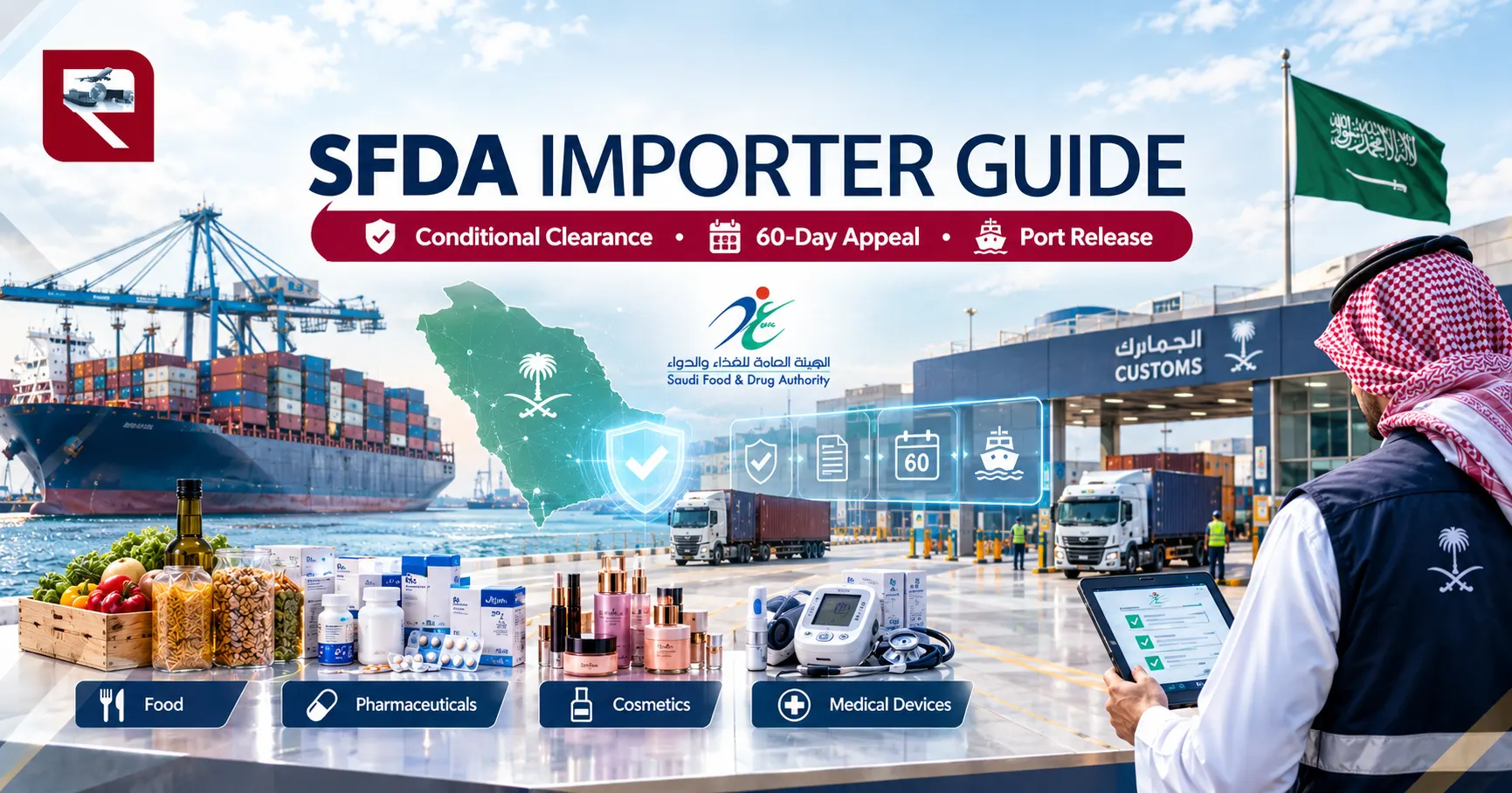
Your product registration is complete. But that container is not leaving the terminal on registration alone. On 9 September 2026, the Saudi Food and Drug Authority (SFDA) published a new Importer Guide for Clearance of Shipments – the SFDA importer guide 2026 that pulls food, drugs, cosmetics and medical devices into one electronic port-clearance workflow, from the first clearance request on FASEH to release through FASAH, the ZATCA single window, at ports including King Abdul Aziz Sea Port Dammam and King Fahd International Airport.
The SFDA importer guide 2026 is written for importers and customs brokers. It covers the full path – request, sampling, conditional clearance, rejection, and the 60-day reconsideration window – and explains why your SABER certificate and SASO conformity documents, while mandatory, do not replace SFDA clearance.
Key takeaways
- The SFDA importer guide 2026 was published 9 September 2026; tagged Food, Drug, Medical Devices and Cosmetics
- Clearance is electronic; importer and licensed broker both act
- Sampling can happen at port; lab cost is usually the importer’s
- Conditional clearance is not free sale
- Rejection means request reconsideration within 60 days
- SFDA indicative decision window: 15 working days
- SABER/PCoC does not replace SFDA registration or the FASEH request
- Pre-file your FASAH bayan 48-72 hours before arrival so SFDA can act before demurrage starts
What the 9 September 2026 SFDA Importer Guide actually is
The SFDA importer guide 2026 is the first consolidated, importer-facing workflow from SFDA that takes a regulated shipment from clearance request to post-clearance – replacing the old pattern of separate circulars for food, drugs, medical devices and cosmetics.
A Saudi commercial registration (CR) holder, a licensed warehouse (with limited exemptions for small-volume food importers), and a licensed customs broker. What it does not replace: product and facility registration on GHAD (food), eCosma (cosmetics), MDMA/MDIL (medical devices) and SDR (pharmaceuticals). Registration gives you permission to exist in the Saudi market. Clearance gives this consignment permission to enter it.
| Layer | Platform | Job |
| Product / facility registration | GHAD, eCosma, MDMA, SDR | Permission to exist in the KSA market |
| Shipment clearance request | FASEH (faseh.sfda.gov.sa) | SFDA says yes / conditional / no to *this* consignment |
| Customs declaration + duty/VAT | FASAH (ZATCA) | Bayan, duty payment, physical release from port |
FASAH vs FASEH – the mix-up that delays cargo
FASAH is ZATCA’s national single window for customs declarations. FASEH is SFDA’s shipment-clearance system. You need both, and they must talk to each other.
One letter apart, entirely different owners. In practice:
- FASAH – the carrier or broker files the bayan (declaration), linked to the bill of lading and port
- FASEH – the importer (usually via the broker) files the SFDA clearance request for the consignment through the platform for their product sector, exactly as the SFDA importer guide 2026 lays out
- The FASEH request must be linked to the bayan number / B/L / port so SFDA’s decision lands on the FASAH declaration
- ZATCA’s 48-72 hour pre-arrival declaration rule exists precisely so regulatory agencies like SFDA can complete their review before the vessel or aircraft arrives
- The Green Track is only realistic when the SFDA decision is already sitting on FASAH before the cargo physically lands – the SFDA importer guide 2026 assumes both filings are linked before arrival, not after
File the bayan after the vessel has berthed and you have turned a paperwork exercise into a demurrage bill.
The electronic clearance workflow, step by step
- Confirm product registration. The SKU – not just the brand – must be registered/notified on the correct SFDA sector system (GHAD, eCosma, MDMA, SDR).
- Confirm warehouse licence. Food importers need a licensed warehouse; limited small-volume exemptions exist, but they are volume-restricted – confirm your eligibility before planning around one.
- Collect consignment documents: commercial invoice, bill of lading / air waybill, certificate of origin, plus health, Halal or phytosanitary certificates where applicable.
- Open the FASEH clearance request – before, or at latest alongside, the FASAH bayan. The SFDA importer guide 2026 treats these as one linked filing, not two separate errands.
- The Certified Custom Clearance Agent links the prior notice to the import declaration and port.
- SFDA risk-routes the request: document check, physical inspection, or sampling.
- Outcome: release / conditional clearance / hold / rejection.
- Post-clearance: keep files for 5 years; complete first-batch analysis where required.
Conditional clearance – what you can and cannot do
Conditional clearance means SFDA lets the consignment leave the terminal under conditions – samples drawn, a signed undertaking, goods held in a licensed warehouse, and no sale or distribution until the lab result or condition is lifted. It is not full market release, and the SFDA importer guide 2026 is explicit that the undertaking binds the importer, not the other way round.
Common triggers:
- First shipment after product registration
- Vaccines, blood derivatives and similar sensitive categories
- Random risk-based sampling
- Minor label or documentation queries
What importers sign up for:
- An undertaking not to dispose of or sell the goods until SFDA confirms
- First-batch submission to the SFDA reference laboratory where your undertaking requires it – treat every timeline you sign as binding
- Temperature-sensitive cargo must arrive with cold-chain evidence (data logger serials on the invoice for pharma)
- Storage in a licensed warehouse, not the importer’s back office
If the lab fails after conditional release: expect recall, re-export or destruction – and a much harder conversation with SFDA than if the goods had never left the port.
Do not confuse this with SFDA “Conditional Approval” for new medicines – that is a registration pathway (often restricted to government supply), not a port-clearance status. Same words, different universe.
Sampling and lab holds
SFDA can draw samples at the port at no purchase cost to the authority – but testing fees are usually billed to the importer. Under the SFDA importer guide 2026, sampling is a normal part of risk routing, not a punishment. To keep it from becoming a two-week hold:
- Prepare extra cartons; inspectors will not dig for the bottom layer
- Make sure batch/lot number on the invoice = packing list = label
- For temperature-controlled cargo at KFIA Dammam, have data logger access ready on arrival
- Remember the real clock is not the lab’s turnaround – it is your demurrage and storage at the terminal. The guide sets indicative response timelines for conditional clearance; your undertaking may set shorter ones, and the undertaking wins.
Rejection – and the 60-day reconsideration window
After an SFDA rejection decision, the SFDA importer guide 2026 gives the importer 60 days to request reconsideration, and SFDA’s indicative window to decide is 15 working days. File through SFDA’s official digital channels – including the objection-to-non-clearance service – as early in the window as possible.
- The 60-day window opens on the date you are notified of the rejection decision – calendar it the same day, because it closes faster than most importers expect
- Attach: rejection notice, product photos, corrected labels, additional CoA, Halal or health certificates, batch records
- What usually fails a reconsideration: a different product than what was registered, missing registration altogether, prohibited claims (weight-loss, sexual enhancement), or a banned substance
- If reconsideration fails: re-export, destruction, or a fresh request – but only where the defect is actually fixable
- Watch the ZATCA storage/auction clock while you wait on SFDA. The two authorities do not pause for each other
Reconsideration file include 10 items:
- rejection notice,
- FASEH request number,
- bayan number,
- commercial invoice,
- B/L or AWB,
- product registration proof,
- photos of goods and labels,
- corrected documents,
- supporting certificates (CoA/Halal/health),
- and a cover letter addressing each rejection point.
Four product tracks
Tthe SFDA importer guide 2026 covers four sectors under one workflow, but each sector still has its own pre-import system and its own typical port failure.
| Track | Pre-import system | Per-shipment extras | Common port failure |
| Food & beverage | GHAD food registration + facility | COO, health/Halal/phyto, GSO 9 Arabic label | Unregistered SKU, Halal gap, label language |
| Cosmetics | eCosma notification (GHAD) | Notification match to invoice name, claims review | Medical claims, shade/SKU not notified |
| Medical devices | MDMA + ARL + **MDIL** import licence | Valid MDIL, MDEL, lot/UDI, declaration of conformity | MDIL expired, Class C/D file incomplete |
| Pharmaceuticals | SDR / registered MA + import permit | Batch in IBRCS where required, GMP site, cold chain | Name mismatch, suspended product, first-batch analysis pending |
Personal parcels run on a different SFDA individual path (e.g., cosmetics ~20 packs / 15 kg; OTC medicines ~3-month supply). Commercial invoices filed as “personal” is how small importers turn one box into a seizure.
Documents that must match
Every document in the SFDA importer guide 2026 checklist comes down to one rule: the paperwork must describe the same product three times without drift.
- Invoice product name = SFDA registered name = FASEH line. Transliteration differences count as different products
- Batch / lot / expiry on invoice or packing list
- Manufacturer name = registered site on GHAD/eCosma/MDMA/SDR
- HS code that actually routes to SFDA. A wrong HS code means no SFDA request was triggered – and a later rejection when someone notices
- Arabic label compliant with GSO 9 / cosmetic labelling rules
- Halal certificate for meat, gelatin and animal-origin inputs
How a licensed broker uses the new guide
At Radhi Awad – a licensed customs broker clearing shipments in Saudi Arabia since 1988 – the SFDA importer guide 2026 is now the checklist behind every regulated file we open:
- Pre-alert at 72 hours: invoice, B/L and registration numbers in hand before the vessel sails
- Dual filing: FASEH request + FASAH bayan opened together, linked, so SFDA’s decision lands on a live declaration
- Port coverage: King Abdul Aziz Sea Port, King Fahd International Airport, and the Eastern Province land ports
- Conditional-release coordination: licensed warehouse placement and undertaking management while labs run
- Reconsideration packs: assembled to the 10-item standard above, filed inside the window – not at its edge
Send us your B/L, invoice and SFDA registration numbers before the vessel sails – we will tell you within hours what the SFDA importer guide 2026 means for your shipment.
Frequently Asked Questions
What changed in the SFDA Importer Guide on 9 September 2026?
SFDA consolidated the previously separate food, drug, medical-device and cosmetics clearance procedures into one importer-facing electronic workflow. It standardises the request-to-release path, sampling, conditional clearance, rejection and a reconsideration mechanism with a 60-day filing limit and 15-working-day decision window.
What is SFDA conditional clearance?
Conditional clearance means SFDA allows a consignment to leave the port under conditions — samples drawn, a signed undertaking, storage in a licensed warehouse, and a prohibition on sale until SFDA lifts the condition. It is a port status, not market authorisation, and it is different from SFDA “Conditional Approval” for new medicines.
How long do I have to appeal an SFDA shipment rejection?
You have 60 days from notification of the rejection to file a reconsideration request through SFDA’s official digital channels, including the «ننجزها» service. Attach the rejection notice, your FASEH request number and corrected supporting documents, and file early in the window rather than at its edge.
How long does SFDA take to decide a reconsideration request?
The guide gives an indicative decision window of 15 working days from filing. Plan port storage and ZATCA timelines around this, as demurrage does not pause while the request is under review.
Is SABER enough to clear food or cosmetics in Saudi Arabia?
No. SABER (SASO conformity) and SFDA clearance are parallel, mandatory tracks. Food, cosmetics, drugs and devices need SFDA registration plus a FASEH clearance request and SABER/PCoC where the product falls under SASO technical regulations. One never substitutes for the other.
What is the difference between FASAH and FASEH?
FASAH is ZATCA’s national single window for customs declarations, duties and physical release. FASEH is SFDA’s electronic system for regulatory clearance of food, drug, cosmetic and device shipments. Both are required, and the FASEH decision must be linked to the FASAH bayan.
Can I sell goods released under conditional clearance?
No. Conditional clearance carries an undertaking not to sell or distribute until SFDA confirms — typically after lab results. Selling early risks recall, re-export or destruction orders and complicates every future file you hold with SFDA.
Who pays for SFDA laboratory testing?
The guide permits sampling at the port at no purchase cost, but testing fees are typically charged to the importer. Budget for this in landed-cost planning, especially for first shipments and random risk-based sampling.
Does the 60-day window apply to personal parcels?
No. SFDA operates a separate individual/personal-use path with quantity limits (e.g., ~20 packs of cosmetics, ~3-month supply of OTC medicines). The September 2026 guide governs commercial import clearance.
Add a Comment