
Why China-to-KSA Shipments Get Delayed?
“In 38 years of clearing customs at Dammam and Jeddah ports, we’ve seen the same 5 mistakes delay shipments again and again. The worst part? They’re all preventable.”
Here’s the reality that most China-to-Saudi import guides won’t tell you:
- 40% of shipments from China face customs delays due to SABER certificate issues
- Wrong HS codes trigger ZATCA audits, wrong duty rates, and weeks of back-and-forth
- Missing the new 2026 FASAH pre-arrival declaration (mandatory 48 hours before arrival) now incurs port dwell penalties
- Vague product descriptions like “Electronics” or “Spare Parts” automatically flag your shipment for Red Channel physical inspection
The good news? Every single one of these delays is preventable.
This guide will help you for updated 2026 SABER HS code changes and FASAH pre-arrival rules.
Radhi Awad is a licensed ZATCA customs broker operating in Saudi Arabia since 1988 — 38 years of hands-on experience clearing thousands of China-to-KSA shipments. We have 8 branches across the Kingdom, including at King Abdul Aziz Sea Port (Dammam), King Fahd Airport (Dammam), Al-Batha, Al-Khafji, KFCA Causeway, and Salwa.
We don’t write about customs clearance from an office in Shanghai. We live it every day at the ports.
💬 Not sure about your product’s HS code or SABER requirements? Get a free duty estimate from certified Customs Clearance Agent before placing your order. It takes 5 minutes and could save you weeks of delays.
Is Importing from China to Saudi Arabia Profitable in 2026?
Before you place your first order, you need to answer one question: Will this actually make money?
The short answer: Yes — if you understand the true cost structure.
The Saudi-China Trade Relationship
China is Saudi Arabia’s #1 trading partner, with bilateral trade exceeding $100 billion annually. Under Vision 2030, Saudi Arabia is investing billions in logistics infrastructure — new ports, rail links, free zones, and e-commerce fulfillment centers. This means:
- Faster clearance times at modernized ports
- Lower logistics costs as competition increases
- Growing consumer demand as the Saudi population expands and diversifies
- E-commerce boom creating new demand for China-sourced products
The Real Cost of Importing from China to Saudi Arabia
Most online “import calculators” only show you duty + shipping. They forget the hidden costs that eat your margin:
| Cost Component | Rate | When It Applies |
| Customs Duty | 5% — 25% | Based on HS code |
| VAT | 15% | On CIF + Duty |
| SABER PCoC | ~500 SAR/product | Before first shipment |
| SABER SCoC | ~350 SAR/shipment | Before each shipment |
| ZATCA Service Fee | 0.15% of CIF (capped at 500 SAR) | Every commercial shipment |
| Port Handling | Variable | Dammam vs Jeddah rates differ |
| Storage Fees | 20-40 SAR/container/day | After 72-hour free period |
| Customs Broker Fee | 500-2,000 SAR | Per shipment complexity |
The mistake most first-time importers make: They calculate landed cost as CIF + 5% duty + shipping. They forget VAT, SABER, port handling, and the broker fee. By the time the goods arrive, their margin is gone.
Profitability by Product Category
| Category | Duty Rate | Margin Potential | SABER Required? |
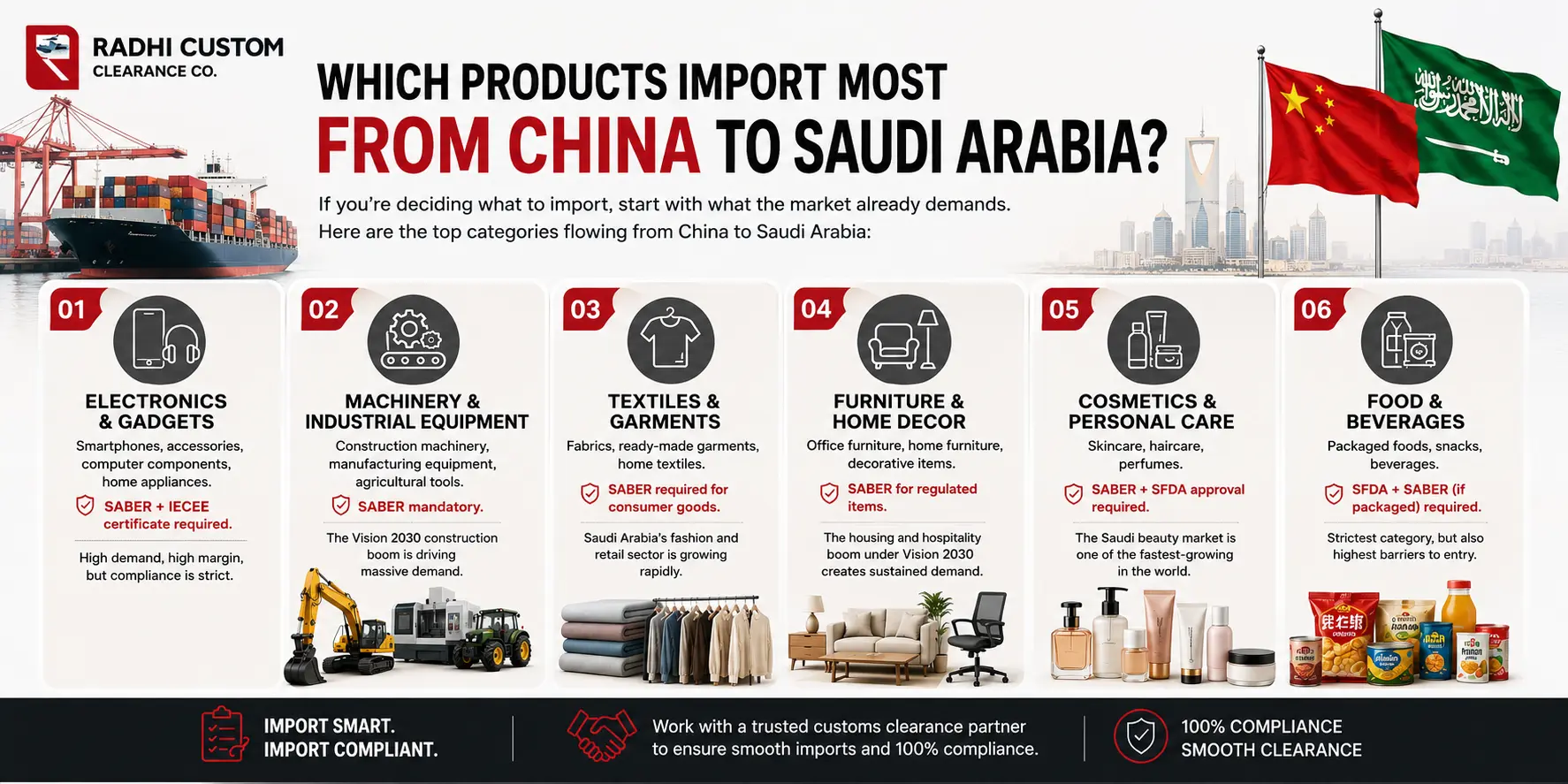
| Electronics | 5% | High | Yes + IECEE |
| Machinery | 5% | High | Yes |
| Furniture | 12% | Medium-High | Yes (regulated) |
| Textiles | 12% | Medium | Yes (consumer goods) |
| Cosmetics | 5% | High | Yes + SFDA |
| Food | 5% | Medium | Yes + SFDA |
Electronics, machinery, and furniture offer the best margins. Textiles are competitive but volume-dependent. Food and cosmetics require SFDA approval, which adds time but also creates a barrier to entry.
Which Products Import Most from China to Saudi Arabia?
The SABER Exemption
| Product Category | SABER Required? | Additional Approval |
| Raw materials (industrial use) | ❌ No | None |
| Consumer electronics | ✅ Yes | IECEE certificate |
| Packaged food | ✅ Yes | SFDA registration |
| Cosmetics | ✅ Yes | SFDA + SASO |
| Used machinery | ✅ Yes | Special SASO approval |
| Personal PPE (small quantities) | ❌ No | None |
| Industrial chemicals (bulk) | ❌ No | None |
If you’re importing raw materials for manufacturing, you might not need SABER at all. This saves you ~850 SAR per product and weeks of processing time. Always verify your specific HS code on the SABER platform before assuming compliance is required.
Who Controls Saudi Imports? The 3 Authorities Every Importer Must Know
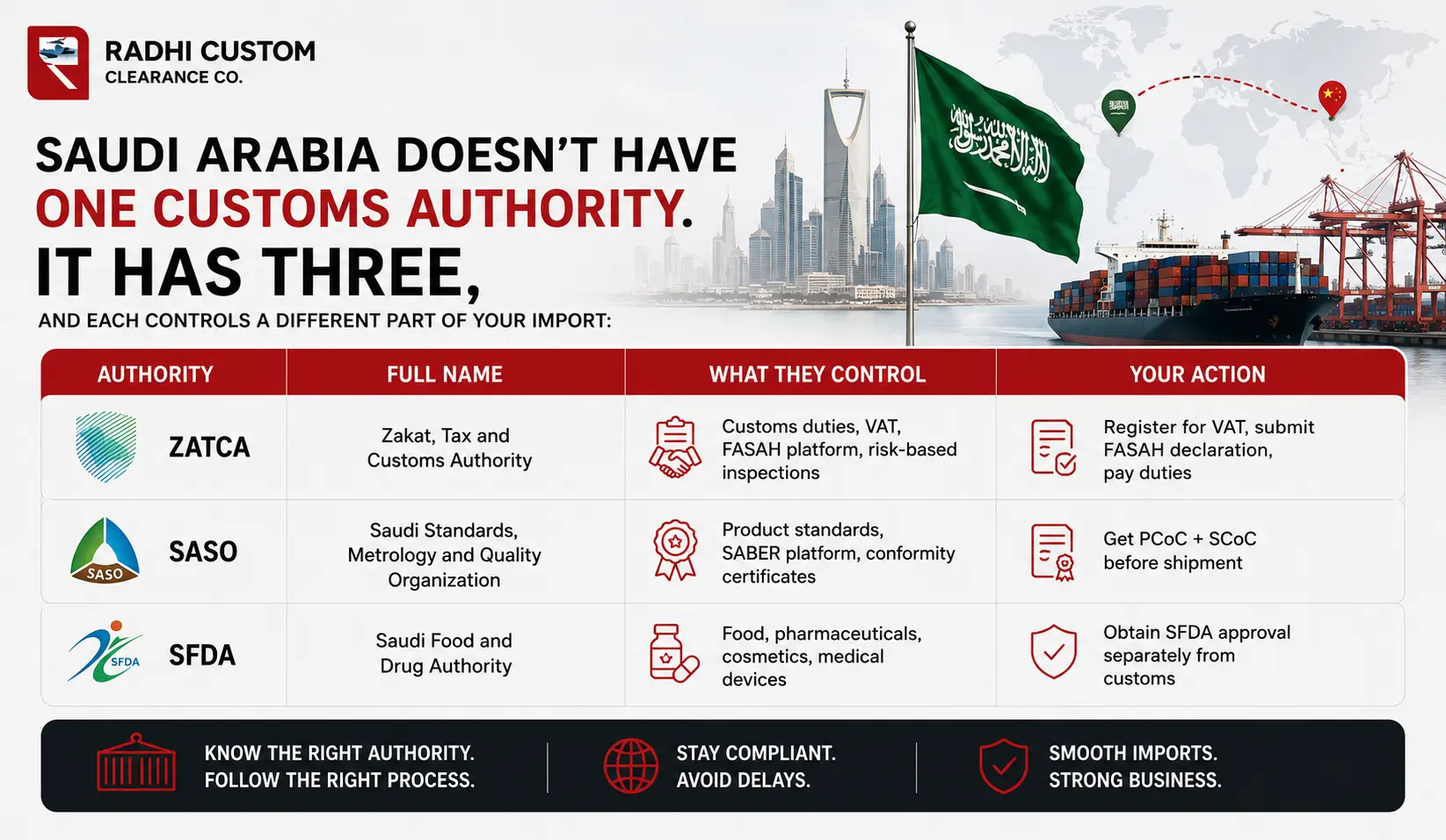
Saudi Arabia doesn’t have one customs authority. It has three, and each controls a different part of your import:
| Authority | Full Name | What They Control | Your Action |
| ZATCA | Zakat, Tax and Customs Authority | Customs duties, VAT, FASAH platform, risk-based inspections | Register for VAT, submit FASAH declaration, pay duties |
| SASO | Saudi Standards, Metrology and Quality Organization | Product standards, SABER platform, conformity certificates | Get PCoC + SCoC before shipment |
| SFDA | Saudi Food and Drug Authority | Food, pharmaceuticals, cosmetics, medical devices | Obtain SFDA approval separately from customs |
For food, pharmaceuticals, cosmetics, and medical devices, you need both SABER (SASO) and SFDA approval. They’re separate processes with separate portals and separate timelines.
Which Authority Handles Your Product?
| Product Type | ZATCA | SASO/SABER | SFDA |
| Electronics | ✅ | ✅ + IECEE | ❌ |
| Machinery | ✅ | ✅ | ❌ |
| Textiles | ✅ | ✅ | ❌ |
| Furniture | ✅ | ✅ (regulated) | ❌ |
| Cosmetics | ✅ | ✅ | ✅ |
| Food | ✅ | ✅ (packaged) | ✅ |
| Pharmaceuticals | ✅ | ✅ | ✅ |
| Raw Materials | ✅ | ❌ | ❌ |
Step-by-Step Process: Importing from China to Saudi Arabia in 2026
Follow these 8 steps in order, and your shipment will clear customs smoothly.
Step 1: Get Saudi Commercial Registration (CR) & ZATCA Registration
Before you order anything from China, you need to be legally registered to import in Saudi Arabia.
Importer of Record (IOR) Concept
In Saudi Arabia, only CR-registered Saudi entities can import commercially. You cannot import business goods on a personal visa or as an individual.
Requirements: –
- Valid Commercial Registration (CR) with import/trading activity code –
- ZATCA VAT registration (mandatory for all commercial imports) –
- Authorized signatory registered on the FASAH platform –
- Bank account in the company’s name for duty payments
Step 2: Find Your HS Code & Check 2026 ZATCA Tariff Updates
This is where most importers go wrong — and it costs them dearly.
🚨 BREAKING 2026 UPDATE
On January 1, 2026, Saudi Arabia updated SABER HS codes. Many products shifted categories. Duty rates changed for some classifications. And yet, most competitor blogs haven’t updated this information.
If you’re using an HS code from a 2024 or 2025 guide, you might be using the wrong code.
What Is an HS Code?
The Harmonized System (HS) Code is a 12-digit number that classifies your product for customs purposes. It determines: – Your duty rate (5% vs 25% makes a huge difference) – Whether SABER is required – Which inspection channel you enter (Green, Yellow, or Red)
12-Digit Structure:
- Digits 1-2: Chapter (broad category)
- Digits 3-4: Heading (product group)
- Digits 5-6: Subheading (specific product)
- Digits 7-8: Saudi-specific sub-classification
- Digits 9-12: Detailed product specification
Where to Verify Your HS Code
ZATCA Tariff Database — Official source, always up-to-date
SABER Platform HS Code Search — Shows SABER requirements per code
💡 Always verify your HS code with ZATCA’s official database before placing your order.
Step 3: Get Your SABER Certificate (PCoC & SCoC Explained)
This is the #1 reason shipments get delayed. 40% of customs holds are SABER-related.
If you remember nothing else from this guide, remember this: SABER must be obtained BEFORE your goods leave China.
The Two-Certificate System
SABER operates on a two-certificate model. Understanding the difference is critical:
| Certificate | Full Name | Type | Validity | Cost | When Needed |
| PCoC | Product Certificate of Conformity | Product-level | 1 year | ~500 SAR/product | Before first shipment of product |
| SCoC | Shipment Certificate of Conformity | Shipment-level | Per consignment | ~350 SAR/shipment | Before each individual shipment |
Step 4: Choose Shipping Method: Sea vs Air vs DDP
Your shipping method determines cost, speed, and customs complexity. Choose based on your product, budget, and urgency.
| Method | Transit Time | Best For | Cost | Customs Handling | Radhi Customs Clearance |
| Sea Freight (FCL) | 20-35 days | Bulk cargo, heavy machinery, containers | Lowest | Requires broker | King Abdul Aziz Sea Port, Dammam |
| Sea Freight (LCL) | 25-40 days | Smaller shipments, shared container | Low | Requires broker | King Abdul Aziz Sea Port, Dammam |
| Air Freight | 4-8 days | Urgent, high-value, perishable, small volume | High | Requires broker | King Fahd Airport, Dammam |
| DDP (Door-to-Door) | 25-40 days | E-commerce, first-time importers, hassle-free | All-inclusive | Included in service | All branches |
Sea Freight: The Workhorse
Best for: Bulk orders, heavy machinery, non-urgent inventory
- Dammam (King Abdul Aziz Sea Port): Closer to China’s shipping routes. Typically 2-3 days faster than Jeddah for China-origin cargo.
- Jeddah Islamic Port: Better for goods destined to western Saudi Arabia (Makkah, Madinah, Taif).
Air Freight: The Speed Option
Best for: Urgent orders, high-value electronics, perishables, samples
- King Fahd Airport (Dammam): Our dedicated branch handles air freight clearance in 24-48 hours.
- Jeddah (King Abdulaziz Airport): Alternative for western KSA destinations.
DDP (Delivered Duty Paid): The Beginner’s Choice
Best for: First-time importers, e-commerce sellers, those who want zero hassle
DDP means your logistics provider handles everything — shipping, customs clearance, duties, VAT, and final delivery to your warehouse. You pay one price. They handle the complexity.
Step 5: Prepare Import Documents Checklist
Documents are the backbone of customs clearance. Missing one document can delay your shipment by days or weeks.
Here are the 7 core documents every China-to-Saudi shipment needs:
| # | Document | What It Must Include | ⚠️ If Missing |
| 1 | Commercial Invoice | Triplicate, attested, HS codes, unit values, total CIF value in USD | Customs rejection, duty recalculation, potential audit |
| 2 | Packing List | Every carton’s weight, dimensions, contents, total packages | Physical inspection triggered, clearance delayed |
| 3 | Bill of Lading (B/L) | Sea freight — original or telex release, vessel name, voyage number | Cannot claim cargo from shipping line |
| 4 | Air Waybill (AWB) | Air freight — master or house AWB, flight details | Cannot claim cargo from airline |
| 5 | Certificate of Origin | Attested by China Chamber of Commerce (CCPIT) | Duty rate dispute, potential penalty, ZATCA review |
| 6 | SABER SCoC | Valid, matching shipment details, product descriptions | Shipment refused entry — sent back or destroyed |
| 7 | FASAH Customs Declaration | Submitted electronically via FASAH platform | Cannot clear customs at all |
Many documents must be attested (officially verified). This is where importers often slip up:
- Commercial Invoice: Must be attested by the supplier’s chamber of commerce in China
- Certificate of Origin: Must be attested by China Council for the Promotion of International Trade (CCPIT)
- Some documents: May require Saudi Embassy attestation for high-value shipments
Step 6: Submit Customs Declaration on FASAH (48 Hours Before Arrival)
🚨 NEW 2026 RULE: This is now mandatory, and the penalties are real.
What Changed in 2026
Starting January 1, 2026, Saudi Arabia made pre-arrival customs declaration mandatory on the FASAH platform. You must submit your declaration at least 48 hours before your vessel arrives at the port.
Miss this deadline, and you face:
- Port dwell penalties starting Day 4
- Automatic Yellow or Red Channel inspection (more delays)
- Potential rejection of late declarations for high-risk goodsubmit and receive declaration number
Step 7: Customs Inspection: Green, Yellow, or Red Channel?
ZATCA uses a risk-based inspection system that assigns every shipment to one of three channels:
| Channel | What Happens | How to Qualify | Typical Clearance Time |
| 🟢 Green | Automated clearance, no inspection | Accurate HS code, complete documents, compliant import history | 1-3 hours |
| 🟡 Yellow | Document review only (no physical inspection) | Minor discrepancies, new importer, random selection | 1-2 days |
| 🔴 Red | Full physical inspection of cargo | Wrong HS code, missing documents, high-risk product, random selection | 3-7+ days |
The #1 Factor: HS Code Accuracy
Your HS code accuracy and product compliance are the single biggest factors determining which channel you enter. Get these right, and 80%+ of your shipments will clear on Green channel.
How to maximize Green Channel probability: –
- Use verified, correct HS codes –
- Submit complete, accurate documents –
- Ensure SABER is valid and matches shipment –
- Use specific product descriptions (not vague terms) –
- Maintain clean import history (no past violations) –
- Work with a licensed broker who knows ZATCA’s risk criteria
What triggers Red Channel: –
- Wrong or suspicious HS code –
- Missing SABER or documents –
- Vague product descriptions (“Electronics,” “Spare Parts”) –
- First-time importer with no history –
- High-risk product category –
- Random selection (unavoidable, but rare)
Step 8: Pay Duties, VAT & Receive Your Shipment
The final step: paying what you owe and taking your goods.
How Customs Duty Is Calculated
Customs Duty = CIF Value × Duty Rate (5% — 25%)
VAT = (CIF Value + Customs Duty) × 15%
ZATCA Service Fee = CIF Value × 0.15% (capped at 500 SAR)
CIF Value = Cost of goods + Insurance + Freight (shipping cost to Saudi port)
Worked Example: $10,000 Electronics Shipment
| Item | Calculation | Amount (USD) |
| CIF Value | — | $10,000 |
| Customs Duty (5%) | $10,000 × 5% | $500 |
| VAT Base | $10,000 + $500 | $10,500 |
| VAT (15%) | $10,500 × 15% | $1,575 |
| ZATCA Service Fee | $10,000 × 0.15% | $15 |
| Total Landed Cost | — | $12,090 |
Your true cost isn’t $10,000. It’s $12,090. Plan your pricing accordingly.
Payment Process
- ZATCA issues payment notice via FASAH
- Pay through SADAD (Saudi payment system) or bank transfer
- Receive payment confirmation
- ZATCA issues clearance certificate
- Collect goods from port or arrange delivery
- Timeline: Payment to clearance = 2-24 hours for Green Channel shipments.
- Complete Documents Checklist for Importing from China to Saudi Arabia
The 10 Essential Documents
| # | Document | What It Must Include | ⚠️ If Missing | Where to Get |
| 1 | Commercial Invoice | Triplicate, attested, HS codes, CIF value in USD, supplier signature | Rejection + duty recalculation | Supplier (must be attested) |
| 2 | Packing List | Per-carton weight, dimensions, contents, total packages, marks & numbers | Physical inspection triggered | Supplier |
| 3 | Bill of Lading (B/L) | Original or telex release, vessel name, voyage number, container numbers | Cannot claim cargo | Shipping line |
| 4 | Air Waybill (AWB) | Master or house AWB, flight number, date, shipper/consignee details | Cannot claim cargo | Airline / Freight forwarder |
| 5 | Certificate of Origin | Attested by China CCPIT, product description matching invoice | Duty rate dispute, penalty | Supplier + CCPIT |
| 6 | SABER SCoC | Valid, matching shipment details, product descriptions, CB approval | Shipment refused entry | SABER platform |
| 7 | FASAH Declaration | Submitted 48hrs pre-arrival, all HS codes, CIF values, B/L reference | Cannot clear customs | FASAH platform |
| 8 | Import License | For regulated goods only (chemicals, weapons, certain electronics) | Seizure + legal penalties | Relevant ministry |
| 9 | SFDA Approval | For food, pharma, cosmetics, medical devices only | Seizure + destruction | SFDA portal |
| 10 | IECEE Certificate | For electrical/electronic products only | SABER rejection | IECEE system |
Document Verification Checklist (Before Shipment Leaves China)
Use this checklist before your supplier ships:
- Commercial invoice is attested by supplier’s chamber of commerce
- Certificate of Origin is attested by CCPIT
- HS codes on invoice match ZATCA database
- Product descriptions are specific (not vague)
- SABER PCoC is active for all products
- SABER SCoC is applied for (or ready to apply)
- Arabic labeling is present (if required for your product)
- All documents are in English or Arabic (bilingual preferred)
- CIF value is accurately calculated
- FASAH declaration is ready to submit upon B/L receipt
The Hidden Cost Most Importers Forget
| Hidden Cost | When It Applies | Typical Amount |
| Storage fees | After 72-hour free period | 20-40 SAR/container/day |
| Inspection fees | Red Channel physical inspection | 500-2,000 SAR |
| Demurrage | Late container return to shipping line | 50-150 SAR/day |
| Detention | Late empty container return | 30-100 SAR/day |
| Customs broker fee | Per shipment | 500-2,000 SAR |
| Delivery from port | To your warehouse | Variable by distance |
💬 Get a free, accurate landed cost estimate for your specific product. Contact Radhi Awad with your HS code and CIF value. We’ll calculate every cost — not just the obvious ones.
Why Use a Licensed Customs Clearance Agent in Saudi Arabia?
Here’s a fact most importers don’t know:
A licensed customs broker is mandatory for commercial imports in Saudi Arabia.
ZATCA regulations require that commercial imports be handled by a ZATCA-licensed customs broker acting as the Importer of Record or authorized representative.
What a Licensed Broker Does for You
| Service | What It Means | Value |
| HS Code Classification | Correct classification = correct duty + Green Channel | Saves money, prevents delays |
| SABER Management | Pre-shipment PCoC + per-shipment SCoC | Prevents 40% of customs holds |
| FASAH Submission | On-time declaration (48-hour rule) | Avoids port dwell penalties |
| Inspection Management | Green Channel optimization | 1-3 hour clearance vs 3-7 days |
| Duty Dispute Resolution | Challenging wrong classifications or valuations | Recovers overpaid duties |
| Port Handling Coordination | Container pickup, storage, delivery | Reduces storage fees |
| Document Verification | Pre-shipment document review | Catches errors before they cost you |
| Regulatory Updates | Staying current with 2026 rule changes | Compliance without research |
Radhi Awad: Your Licensed Partner Since 1988
38 years of clearing customs in Saudi Arabia. Thousands of China-to-KSA shipments. Branches across the Kingdom.
Our Branches: – 📍 Dammam — King Abdul Aziz Sea Port – 📍 Dammam — King Fahd Airport – 📍 Al-Batha – 📍 Al-Khafji – 📍 KFCA Causeway
Why importers choose Radhi Awad:
– ✅ Licensed ZATCA customs broker (not a freight forwarder pretending to be one)
– ✅ Direct relationships with SABER Certification Bodies
– ✅ 85% Green Channel clearance rate
– ✅ Arabic, English, and Urdu speaking staff
– ✅ 24/7 shipment tracking and updates
– ✅ Transparent pricing — no hidden fees
Frequently Asked Questions
Do I need a SABER certificate for all products from China?
No. Only regulated consumer goods, electronics, chemicals, and certain machinery require SABER. Non-regulated raw materials and some personal items may be exempt. Always verify using your HS code on the SABER platform before assuming compliance is required.
How long does customs clearance take in Saudi Arabia?
With complete documents and Green Channel: 1-3 business days. Missing SABER or FASAH issues can extend this to 7-14+ days with additional storage fees. Red Channel inspection: 3-7+ days.
What is the import duty rate from China to Saudi Arabia?
The standard rate is 5%, but ranges from 0% to 25% depending on HS code. VAT of 15% applies on top of CIF value plus duties. Some products under trade agreements may have reduced rates.
Can I import from China without a customs broker?
Technically possible for personal imports under 3,000 SAR. Commercial imports require a ZATCA-licensed customs broker as the Importer of Record or authorized representative. Attempting commercial import without a broker can result in shipment rejection.
What is the FASAH platform?
FASAH is Saudi Arabia’s National Single Window for Trade operated by ZATCA. It’s the portal where customs declarations must be submitted electronically. Since January 2026, pre-arrival declaration is mandatory 48 hours before vessel arrival.
What documents are needed to import from China to Saudi Arabia?
The 7 core documents: Commercial invoice (attested, triplicate), packing list, Bill of Lading/Air Waybill, Certificate of Origin (attested by CCPIT), SABER SCoC, and FASAH customs declaration. Regulated goods need additional permits (SFDA, IECEE, import license).
How much does a SABER certificate cost?
PCoC (Product Certificate): Approximately 500 SAR per product, valid for 1 year. SCoC (Shipment Certificate): Approximately 350 SAR per shipment. Total per product (first year): ~850 SAR + testing costs (if required).
What is the difference between PCoC and SCoC?
PCoC is product-level — one certificate per product type, valid for 1 year, covers all shipments of that product. SCoC is shipment-level — one certificate per individual consignment, required for every shipment.
Can I get SABER after my shipment arrives in Saudi Arabia?
No. SABER must be obtained before goods leave China. The PCoC process takes 5-15 business days. The SCoC process takes 1-3 business days. Applying after arrival results in automatic customs hold, storage fees, and potential rejection.
Which port is better for China imports — Dammam or Jeddah?
Dammam (King Abdul Aziz Sea Port) is closer to China’s shipping routes and typically 2-3 days faster for China-origin cargo. Jeddah Islamic Port serves western Saudi Arabia and is ideal for goods destined to Makkah, Madinah, or the Red Sea coast. For air freight, King Fahd Airport (Dammam) is the primary gateway.
What is the cheapest way to import from China to Saudi Arabia?
Sea freight to Dammam or Jeddah port is cheapest for bulk cargo. For smaller shipments, consolidated sea freight (LCL) reduces costs by sharing container space. Air freight is 3-5x more expensive but 5x faster.
How much does customs clearance cost in Saudi Arabia?
ZATCA charges 0.15% of CIF value (capped at 500 SAR). Broker fees vary by shipment complexity, typically 500-2,000 SAR. Additional costs: SABER (~850 SAR), port handling (~200-500 SAR), and potential storage fees.
Can I import from China to Saudi Arabia without a company?
Personal imports up to 3,000 SAR value are allowed without a company. Commercial imports require a Saudi-registered company with CR and VAT registration. A licensed customs broker is mandatory for commercial shipments.
How do I track my shipment in Saudi customs?
Use the FASAH platform with your declaration number. Your customs broker can also provide real-time updates. For Radhi Awad clients, we provide 24/7 tracking via WhatsApp and email.
What happens if my shipment is held at Saudi customs?
Common reasons: missing SABER, wrong HS code, incomplete documents, or Red Channel inspection. Contact your broker immediately. Storage fees apply after 72 hours. The sooner you act, the lower the cost.
How long does sea freight from China to Saudi Arabia take?
20-35 days depending on the port. Shanghai to Dammam: ~22-25 days. Shenzhen to Jeddah: ~28-32 days. Air freight: 4-8 days.
Do I need to speak Arabic to import to Saudi Arabia?
No, but it helps. All official documents must be in Arabic or English. ZATCA and SABER platforms are available in English. However, working with a bilingual broker (like Radhi Awad) eliminates language barriers entirely.
Ready to Import from China to Saudi Arabia? Get a Free Consultation
You’ve read the complete guide. You know the process. You understand the costs. You see the pitfalls.
Now, let us handle the complexity for you.
Radhi Awad has been Saudi Arabia’s trusted customs clearance partner since 1988. In 38 years, we’ve cleared thousands of China-to-KSA shipments. We’ve seen every mistake. We’ve solved every problem. And we’ve built the relationships that get your goods through customs fast.
Why Importers Trust Radhi Awad
- ✅ 38 years licensed ZATCA customs broker
- ✅ 8 branches across Saudi Arabia
- ✅ 85% Green Channel clearance rate
- ✅ 24/7 tracking and updates
- ✅ Transparent pricing — no hidden fees
- ✅ Arabic, English speaking staff
What You Get in a Free Consultation
- 📋 HS code verification for your product
- 💰 Accurate landed cost estimate
- 📄 SABER requirement assessment
- 🚢 Shipping method recommendation
- 📍 Optimal port and branch selection
- 📅 Timeline planning for your shipment
Contact Us Now
📞 Phone: +966558959205 📧 Email:info@radhiawad.com.sa 🌐 Website:radhiawad.com.sa
Add a Comment