
Saudi Arabia has introduced an important regulatory update that importers, manufacturers, and international suppliers cannot afford to overlook. Effective October 1, 2026, new SABER labeling requirements mandate that products covered by ten specified technical regulations display the supplier’s name and Commercial Registration (CR) number directly on the product. For a broader overview of available assistance, explore the Radhi Awad customs clearance.
The Saudi Standards, Metrology and Quality Organization (SASO) has reinforced these requirements to improve product identification, regulatory accountability, and compliance with Saudi Arabia’s Product Safety Law.
For businesses importing regulated goods into the Kingdom, the change is more than an administrative update. Missing or incorrect supplier identification can affect conformity certification, delay shipment preparations, and create potential customs clearance complications.
Whether your company imports industrial equipment, construction materials, solar photovoltaic systems, children’s strollers, or other covered products, understanding the SABER labeling requirements 2026 is essential for maintaining compliant supply chains.
This guide explains the new requirements, affected product categories, potential consequences of non-compliance, and practical steps importers should take to prepare for the Saudi market.
What Are the New SABER Labeling Requirements for 2026?
The new SASO labeling requirements took effect on October 1, 2026, and apply to products covered by ten specified Saudi technical regulations. Under the official circular issued to SABER beneficiaries, affected products must include two identification details:
- Supplier’s name: The name of the importer or local manufacturer responsible for the product.
- Commercial Registration (CR) number: The commercial registration number associated with that supplier.
This information must appear on the product in accordance with the applicable technical regulation. The circular reinforces provisions associated with Article 11 of the Saudi Product Safety Law and Article 19 of its Executive Regulations. For the primary source, consult the official SASO supplier-identification circular.
Important clarification: The October 2026 circular is not a blanket new labeling rule for every imported product. Its specific requirement covers products falling under the ten technical regulations identified by SASO. Other products may already be subject to separate labeling requirements.
Why Has Saudi Arabia Strengthened Product Labeling Requirements?
Product labeling plays an important role in regulatory compliance, consumer safety, and supply-chain accountability. Supplier identification enables authorities to connect products with their responsible commercial entity, supports regulatory accountability, helps verify compliance documentation, and makes market-surveillance activities more effective.
Which Products Are Affected by the SABER Labeling Requirements 2026?
According to the official SASO circular, the requirement applies to products governed by the following ten technical regulations:
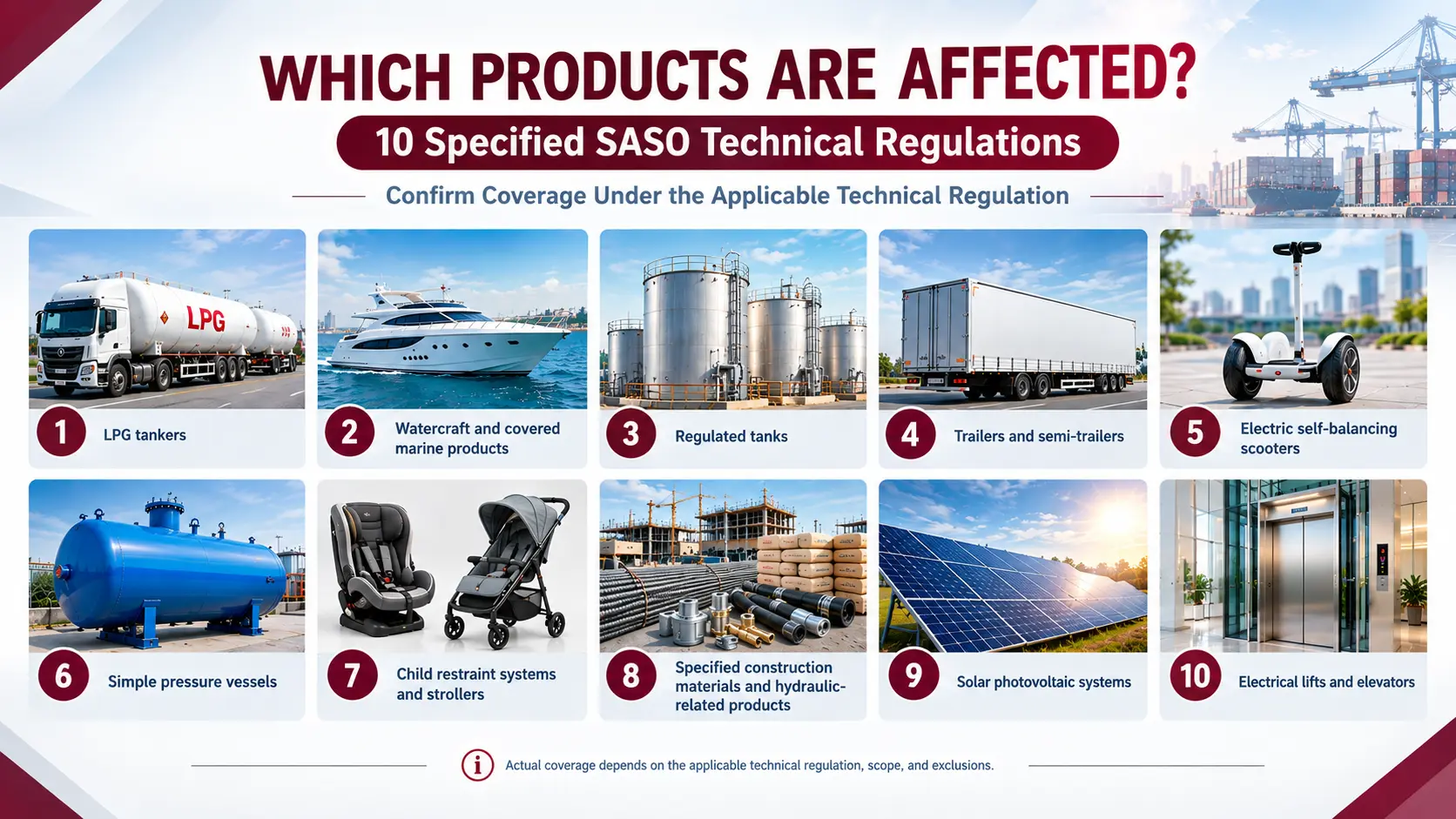
These general product descriptions are for orientation and do not replace each technical regulation’s legal scope, definitions, or exclusions.
How Can Importers Confirm Whether Their Products Are Covered?
Do not determine applicability solely from a product’s commercial name. Not every building material or tank necessarily falls under the respective technical regulation. For more detail on classification, read our Saudi Arabia HS code and SABER guide.
- Identify the correct Saudi customs classification or HS code.
- Review the applicable technical regulation published by SASO.
- Check regulatory classification through the official SABER platform.
- Confirm labeling provisions with the responsible conformity assessment body when needed.
- Review the product model, intended use, and technical specifications. You can also check the official SASO technical regulations directory.
What Information Must Appear on Product Labels?
1. Supplier Name: Importer or Local Manufacturer
Products covered by the circular must identify the relevant supplier, meaning the importer or local manufacturer. The supplier name should correspond to the responsible legal business entity and supporting commercial records. Verify it with overseas manufacturers before approving production or labeling artwork.
2. Commercial Registration (CR) Number
The product must display the relevant supplier’s Commercial Registration number. Importers should verify the current legal name and CR number; inconsistencies between the marking and business documentation may prompt further compliance questions.
Example of Supplier Identification
Supplier Name: Example Saudi Importing Company
Commercial Registration No.: [Valid CR Number]
This is illustrative information, not an approved label design. Final marking must comply with product-specific requirements, including any rules about placement, legibility, durability, language, or other mandatory information.
Can Importers Put the Supplier Information Only on Packaging?
Do not assume the outer carton or shipping packaging alone is sufficient. The circular refers to including the information on the product. Review the applicable regulation before choosing stickers, printed plates, engraving, or other marking methods; temporary labels are not necessarily acceptable.
How Do the New Labeling Rules Affect SABER Certification?
SABER is Saudi Arabia’s electronic platform for product registration, conformity certification, and shipment certificates. SASO will verify compliance with the new labeling requirements using information submitted through SABER. Importers should therefore address labeling before starting or completing the relevant conformity process. Learn about our SABER certificate assistance services.
Product Certificate of Conformity (PCoC)
Where a Product Certificate of Conformity applies, a conformity assessment body may review supporting technical documents and labeling evidence. Missing or incorrect markings can impede successful completion of assessment. For an importer-focused explanation, see our SABER certificate requirements for Saudi customs clearance.
Shipment Certificate of Conformity (SCoC)
Where required, the Shipment Certificate of Conformity relates to a particular shipment and applicable SABER certification pathway. Importers should satisfy the relevant product compliance requirements before requesting the certificate. Certification does not replace accurate customs declarations.
Why Labels Should Be Reviewed Before Shipping
For example, an importer may source compliant industrial equipment from an overseas manufacturer, but the product may not display the Saudi supplier’s name or CR number. If discovered during conformity assessment, corrections may be required and lead to documentation requests, production revisions, or shipping rescheduling. Pre-dispatch checks reduce this avoidable risk.
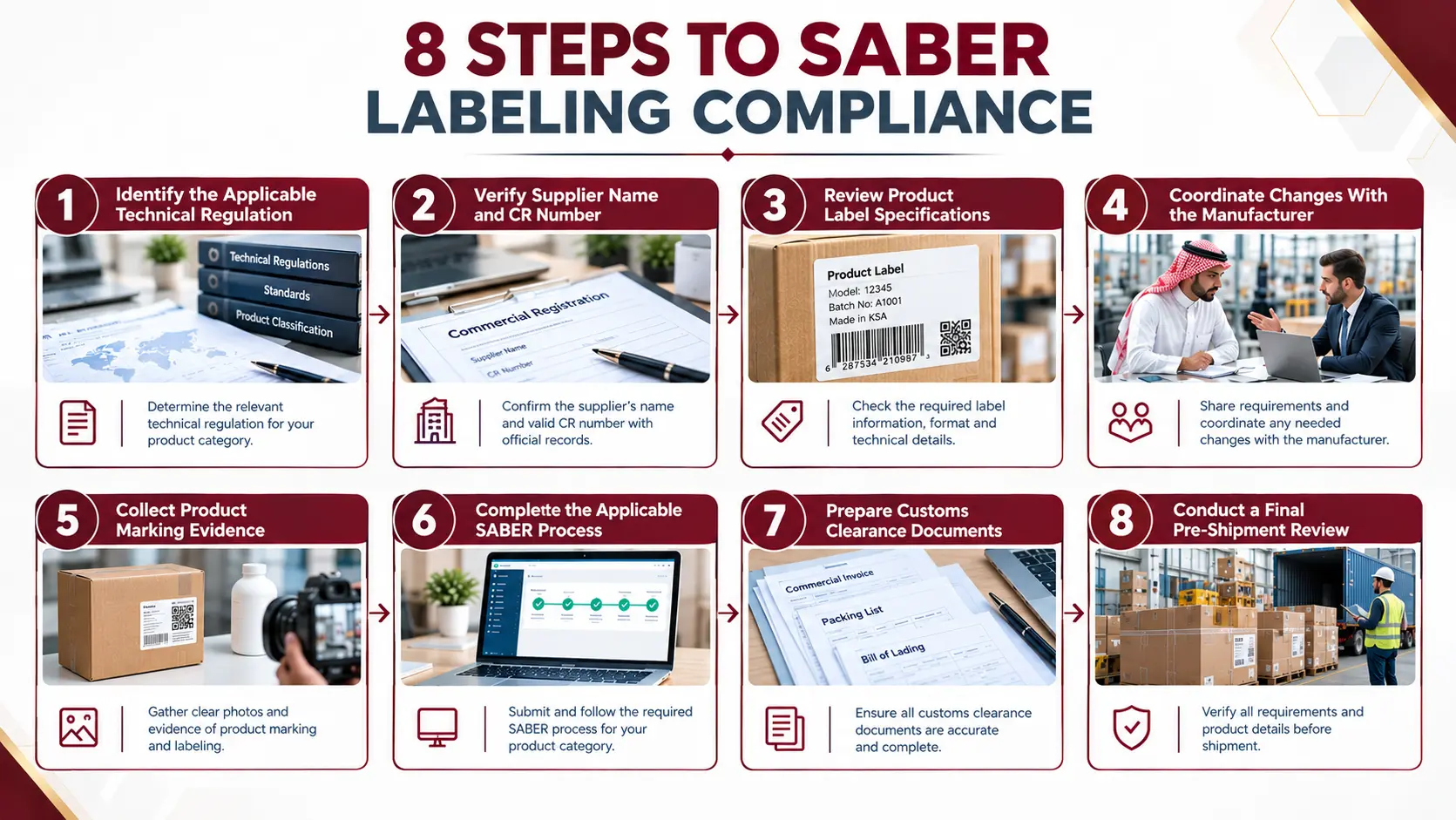
Step-by-Step Guide to Meeting SABER Labeling Requirements in 2026
What Happens If a Product Does Not Meet the Requirements?
The official SASO circular says compliance will be checked through information submitted via SABER and that penalties under the Product Safety Law and Executive Regulations may apply to non-compliant parties. The specific outcome depends on the product and circumstances.
Conformity Certification Problems
Incorrect markings can lead to an unsuccessful review or require correction before certification proceeds.
Shipment Preparation Delays
Late labeling corrections can delay dispatch or trigger additional documentation requests.
Additional Business Costs
Corrections may cause extra manufacturing, handling, storage, or logistics expenses; these are not fixed statutory fines.
Regulatory Enforcement
Applicable enforcement measures may be pursued under the Product Safety Law and Executive Regulations.
Customs Clearance Complications
If required conformity documents cannot be obtained, shipment planning and clearance readiness may be affected.
SABER Labeling Compliance Checklist for Saudi Importers
- Confirm the product is covered by one of the ten regulations.
- Verify Saudi HS code and technical classification.
- Check responsible Saudi supplier’s legal name.
- Verify Commercial Registration number.
- Ensure required identification appears on the product.
- Confirm marking method meets the applicable regulation.
- Check all other relevant labeling and safety requirements.
- Obtain clear evidence of final product markings.
- Complete applicable SABER conformity processes.
- Verify shipment certification and customs documents.
- Review everything before dispatch.
Common Mistakes Importers Should Avoid
This specific circular applies to ten regulations; other goods may have different labeling obligations.
Confusing Overseas Manufacturer With Saudi Supplier
A manufacturer’s overseas name alone may not satisfy the rule, which identifies the importer or local manufacturer as supplier.
Using Incorrect CR Details
Outdated or mismatched company information can lead to inconsistencies; verify before production.
Checking Labels Only After Arrival
Resolve labeling matters during manufacturing and before shipping.
Treating SABER as the Only Import Requirement
Customs declarations, permits, other approvals, and product-specific documentation may also be necessary.
How Do the New SABER Rules Affect Saudi Customs Clearance?
This supplier-identification update concerns product compliance, but certification and customs clearance are connected. Failure to complete a required conformity assessment may affect clearance readiness. This is especially relevant for shipments through gateways such as King Abdulaziz Port in Dammam and Jeddah Islamic Port. Coordinate early among manufacturers, conformity specialists, freight forwarders, and customs clearance representatives. For practical support, learn more about our customs clearance services in Saudi Arabia.
How Radhi Awad Can Help With Saudi Customs Clearance
Radhi Awad Custom Clearance Co. supports businesses navigating customs clearance requirements in Saudi Arabia. Early planning helps importers coordinate product compliance, shipping documents, and customs formalities.
- Reviewing clearance documentation requirements for incoming shipments.
- Coordinating shipment information among relevant parties.
- Supporting customs clearance preparation for regulated goods.
- Helping identify clearance-related documentation issues before cargo arrives.
- Guiding businesses toward relevant regulatory or conformity assessment channels where needed.
Final product conformity decisions and certification approvals remain with the relevant authorities and authorized conformity assessment bodies.
Planning to Import Goods Into Saudi Arabia?
If your business imports equipment, industrial products, construction materials, or other regulated goods into Saudi Arabia, understanding the applicable requirements before shipping is essential. Contact Radhi Awad Custom Clearance Co. to discuss shipment documentation and customs clearance support.
Frequently Asked Questions
What are the new SABER labeling requirements for 2026?
From October 1, 2026, products under ten specified SASO technical regulations must show the supplier’s name (importer or local manufacturer) and CR number on the product.
When did the rules become effective?
October 1, 2026, according to the official SASO circular.
Are they mandatory for all imported products?
No. This circular applies to ten identified regulations; other products may have separate obligations.
Is the Saudi importer’s CR number required?
For products covered by the circular, the relevant supplier’s CR number must be marked on the product under the applicable regulation.
Can the CR number be placed only on the outer carton?
Do not assume that is sufficient. The circular requires identification on the product; consult the relevant regulation for marking conditions.
What happens if a product is non-compliant?
There may be conformity assessment problems, delays, and potentially enforcement under the Product Safety Law and Executive Regulations.
Does this affect SABER certification?
Yes. SASO says compliance will be verified using information submitted through SABER.
How do I know if my product is affected?
Review the listed technical regulations, product specifications, classification, and guidance from the relevant conformity assessment body.
Do international manufacturers need to update labels?
They may need to update product markings to include the correct Saudi supplier identification; importers should coordinate in advance.
How can a customs clearance company help?
It can support customs documentation and shipment coordination, while conformity approval remains with the competent authorities and assessment bodies.
Conclusion: Prepare Your Imports for the SABER Labeling Requirements 2026
The SABER labeling requirements 2026, effective October 1, reinforce supplier identification for products covered by ten specified technical regulations. For importers, the priority is to identify affected products, verify supplier information, coordinate compliant markings, and complete applicable conformity procedures before shipping.
Addressing these requirements early can reduce avoidable certification problems, documentation inconsistencies, and shipment disruptions. Consult official SASO and SABER guidance for the latest requirements.
Need assistance with customs clearance in Saudi Arabia? Make a call now!
Official References
Regulatory information reviewed October 2026. Confirm product-specific requirements against the current applicable technical regulation and official guidance.
Add a Comment