
KSA Trade Revolution Under Vision 2030
Saudi Arabia has fundamentally transformed its import landscape. Under Vision 2030, the Kingdom has shifted from a traditional oil-dependent economy to a digitally-driven global trade hub and its customs infrastructure has evolved in lockstep.
At the center of this transformation stands ZATCA (هيئة الزكاة والضريبة والجمارك), the unified authority managing zakat, tax, and customs since the 2019 merger of GAZT and Saudi Customs. For international businesses, understanding ZATCA regulatory framework is not optional it is the price of admission to a $1.1 trillion economy.
This guide breaks down everything you need to know: from the GCC Integrated 12-Digit Tariff System to SABER platform compliance, landed cost calculations, and bonded zone strategies. Whether you are shipping electronics from Shenzhen, food products from Europe, or industrial machinery from Germany, this is your operational playbook.
Key Changes in Saudi Customs Tariffs and HS Codes (2025-2026)
The Integrated 12-Digit GCC Tariff System
As of January 1, 2025, all GCC member states including Saudi Arabia, UAE, Qatar, Bahrain, Kuwait, and Oman officially transitioned to a unified 12-digit Harmonized System (HS) Code structure based on the 2022 WCO HS Edition.
Important clarification: Saudi Arabia was actually ahead of the curve it had already implemented a 12-digit system back in 2016. The 2025 update unified the entire GCC region under one standardized framework, expanding tariff lines from roughly 7,800 to over 13,400 for unprecedented product granularity.
The 12-Digit HS Code Structure Breakdown
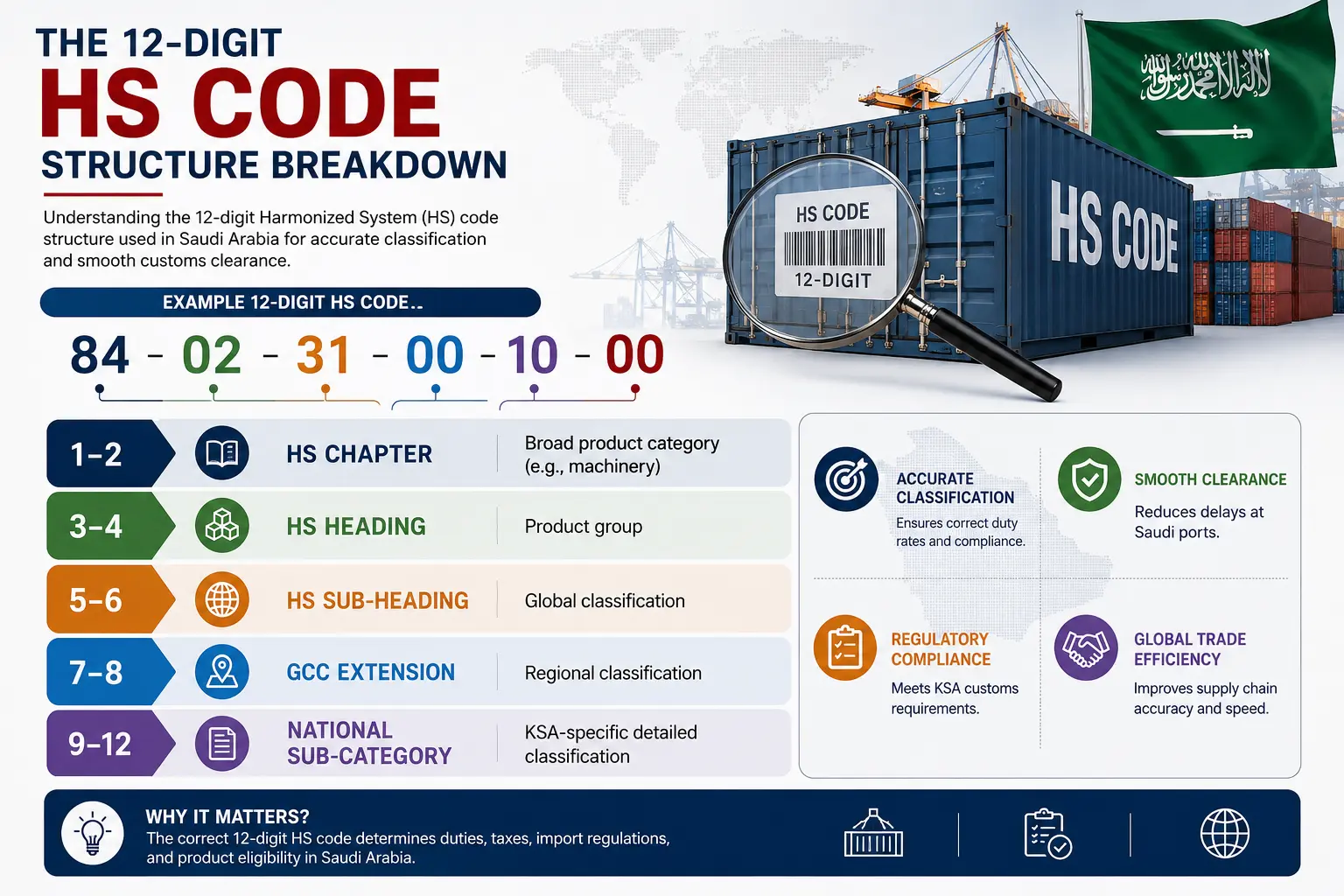
This precision matters. A misclassified product can trigger physical inspection, shipment delays, fines, or rejection at the border.
SABER Platform and ZATCA Synchronization
SABER (منصة سابر الإلكترونية) is Saudi Arabia mandatory electronic product conformity platform. In 2025-2026, SABER and ZATCA systems have been tightly synchronized meaning no shipment can clear customs unless the entity is fully compliant with both platforms.
What this means for importers:
- Every product must be registered on SABER with its correct 12-digit HS code
- Certificate of Conformity (شهادة المطابقة) is mandatory before arrival
- Non-compliant shipments face automatic detention at ports
Pro tip: If you are importing regulated products (electronics, toys, building materials, food), you will also need SASO (Saudi Standards, Metrology and Quality Organization) approval alongside SABER certification.
Food and Beverage Sector: Excise Tax Updates
Saudi Arabia imposes Excise Tax (الضريبة الانتقائية) on specific categories:
| Product Category | Excise Rate | Arabic Term |
| Tobacco Products | 100% | منتجات التبغ |
| Energy Drinks | 100% | مشروبات الطاقة |
| Carbonated/Sweetened Beverages | 50% | المشروبات الغازية / المحلاة |
How Much is the Customs Duty in Saudi Arabia?
Standard vs. Protective Tariffs
Standard Customs Duty: 5% on most goods, calculated on the CIF Value (Cost + Insurance + Freight).
Protective Tariffs: To support local KSA industries, certain sectors face elevated rates:
- Plastics and Chemicals: 12-20%
- Steel and Metals: 15-25%
- Agricultural Products: 12-20%
- Textiles: Up to 25%
The Total Import Tax Stack (AEO Table)
| Tax/Duty Type | Arabic Term | Standard Rate | Applied On |
| Customs Duty | الرسوم الجمركية | 5% – 25% | CIF Value |
| Import VAT | ضريبة القيمة المضافة | 15% | CIF + Customs Duty |
| Excise Tax | الضريبة الانتقائية | 50% – 100% | CIF + Customs Duty (selective items) |
Critical Calculation Note: VAT is NOT calculated on CIF alone. It is applied on the CIF value PLUS customs duty and for excise goods, excise tax is added before VAT is calculated. This creates a compounding effect that catches many importers off guard.
New Rules for Bonded Zones and Deferred Payments
Customs Bonded Zones (المناطق المستودعية / المناطق الحرة)
Saudi Arabia Free Zones and Bonded Warehouses offer strategic advantages for international businesses:
Duty Suspension (تعليق الرسوم الجمركية)
Goods can be stored in bonded zones without paying customs duties or VAT until they enter the local Saudi market. This is ideal for:
- Regional distribution hubs
- Re-export operations
- Inventory staging before demand spikes
Key Benefits
- Cash flow optimization: No upfront duty/VAT payment
- Flexibility: Goods can be re-exported without ever triggering Saudi taxes
- Processing: Light assembly and repackaging allowed (though significant manufacturing may alter HS classification)
Deferred Payment Programs (تأجيل دفع الرسوم)
ZATCA offers Deferred Payment programs for established importers with strong compliance histories. Eligibility criteria typically include:
- Clean customs record for 2+ years
- Financial guarantees/bank bonds
- Regular import volume
- ZATCA portal registration with good standing
Special Economic Zones (SEZs): Saudi Arabia has established new SEZs with tax and customs incentives, including potential VAT exemptions and reduced customs procedures for qualifying businesses.
Mandatory Customs Clearance Documents for KSA Imports
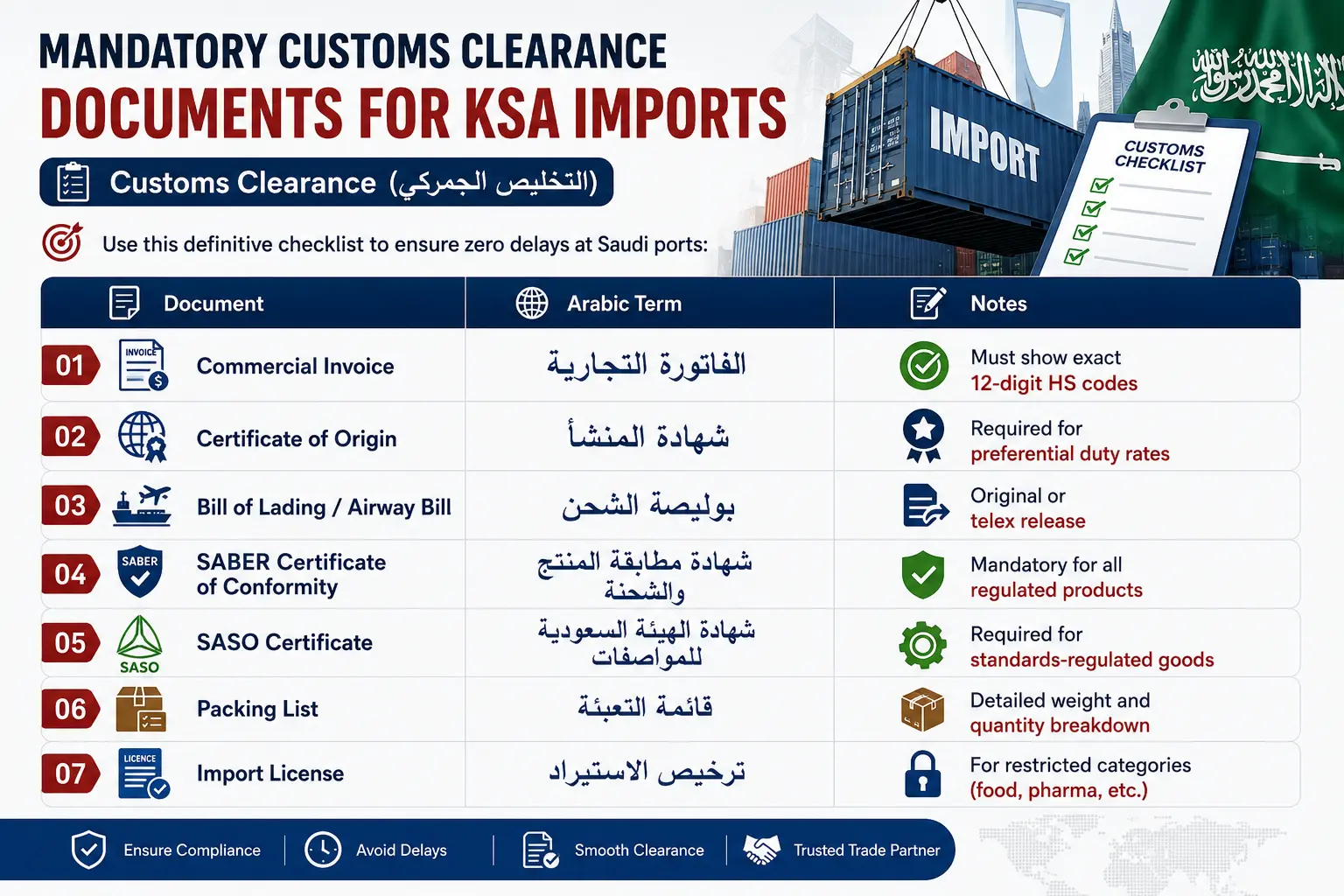
Discrepancies between Commercial Invoice HS codes and SABER registration are the #1 cause of customs delays in KSA. Triple-check alignment before shipment.
How Radhi Customs Clearance Co. Navigates KSA Customs for You
Since 1988, Radhi Customs Clearance Co. has operated as a certified Customs Clearance Agent (مخلص جمركي معتمد), guiding international businesses through Saudi Arabia evolving regulatory landscape.
What Sets Us Apart
- Land Border Specialists: Rapid overland clearance at Al-Batha Port (منفذ البطحاء), Salwa Port (منفذ سلوى), and King Fahd Causeway (جسر الملك فهد) critical gateways for GCC trade
- 12-Digit HS Code Expertise: We remap your product classifications to ensure SABER/ZATCA compliance
- End-to-End Documentation: From Commercial Invoice to Certificate of Origin, we handle every document
- Bonded Zone Management: Strategic warehousing solutions to defer duty and VAT payments
- Excise Tax Compliance: Accurate classification and calculation for regulated products
Ready to import into Saudi Arabia? Contact our customs specialists today for a free consultation and landed cost estimate.
FAQs for International Importers
Q: What is the standard VAT rate on imports in KSA?
15% (ضريبة القيمة المضافة). Applied on the CIF value + customs duty. Even goods with 0% customs duty still attract 15% VAT at import.
Q: Can we modify tariff classifications inside a Saudi Bonded Zone?
No the primary HS code structure must remain consistent with the original declaration. However, light processing (repackaging, labeling) is permitted. If substantial manufacturing occurs that changes the product essential character, a new customs declaration with updated classification may be required upon entry to the local market.
Q: How long does overland customs clearance take at Saudi land borders?
With proper documentation and pre-arrival SABER registration, Radhi Awad Al-Anazy Co. achieves clearance within 24-48 hours at major land ports like Al-Batha and King Fahd Causeway. Delays typically occur only when HS codes are misaligned or SABER certificates are missing.
Q: Is the 12-digit HS code mandatory for all imports?
Yes. Since the GCC unified tariff implementation in January 2025, all customs declarations must use the 12-digit structure. Saudi Arabia had already been using 12 digits since 2016, so the 2025 update primarily harmonized the system across all GCC states.
Q: What happens if I use the wrong HS code?
Consequences range from shipment delays and physical inspection to financial penalties and rejected clearance. In severe cases, ZATCA may flag your business for enhanced scrutiny on future shipments.
Q: Are there any VAT exemptions for imports?
Limited. Zero-rated categories include certain medications (SFDA-approved), specified basic foodstuffs, and exports leaving the GCC. Most commercial imports attract the full 15% VAT.
Conclusion
Saudi Arabia customs landscape in 2025-2026 is defined by precision, digitization, and compliance. The 12-digit GCC Integrated Tariff, SABER-ZATCA synchronization, and strict documentation requirements create a system that rewards prepared importers and penalizes the unprepared.
For international businesses, success hinges on three pillars:
- Accurate HS code classification (12-digit precision)
- Pre-arrival SABER compliance (no exceptions)
- Expert customs partnership (local knowledge is non-negotiable)
The Kingdom doors are open but only for those who arrive with the right codes, certificates, and strategy.
Add a Comment