
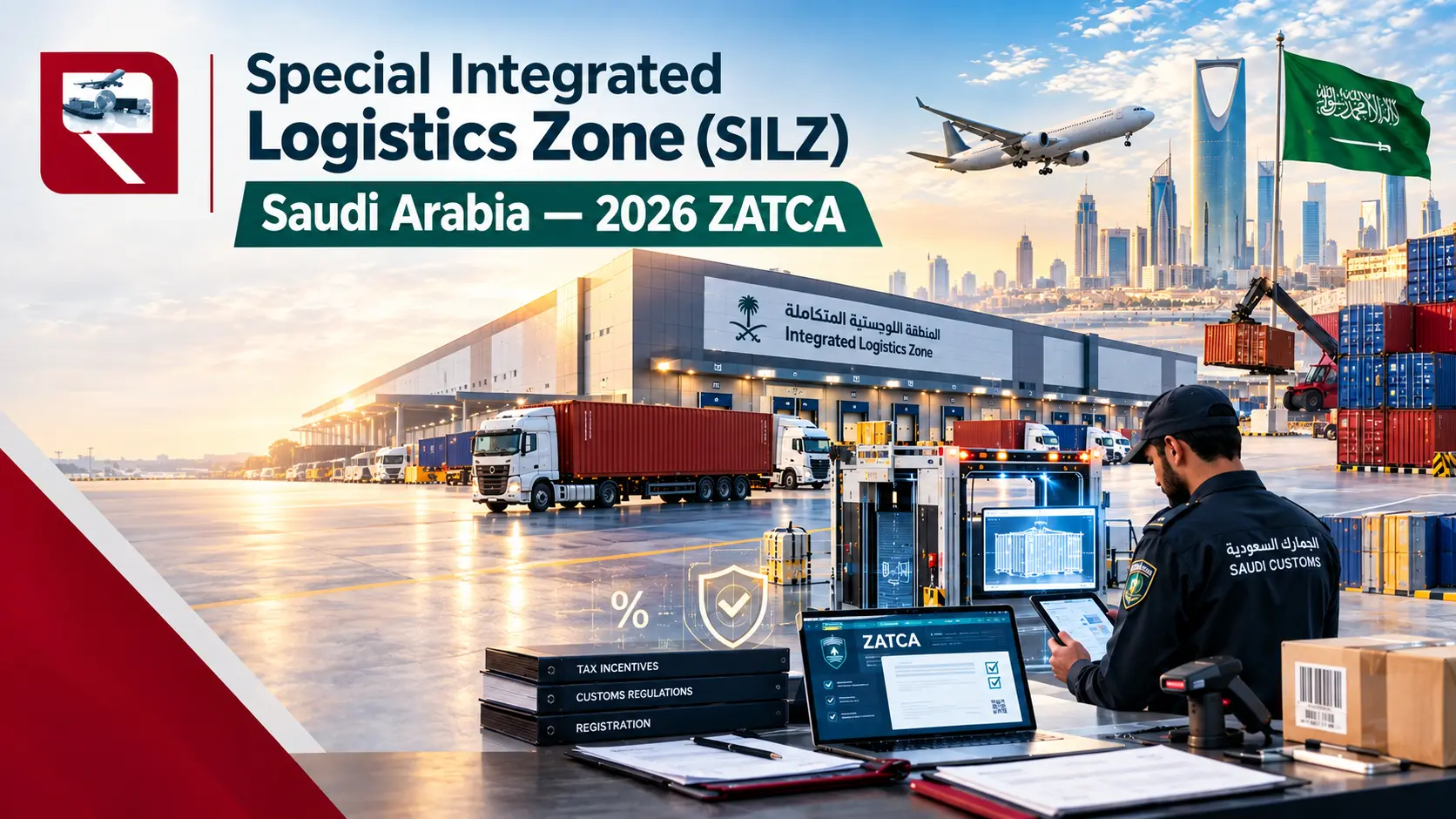
Zero percent corporate income tax. For fifty years. Inside a dedicated logistics zone minutes from Riyadh’s King Khalid International Airport.
That is not a headline from a company-formation sales brochure — it is the law of the Special Integrated Logistics Zone (SILZ), confirmed in the Zakat, Tax and Customs Authority’s (ZATCA) General Guideline for the Zone, now in its Second Edition published in May 2026.
If you are an importer, manufacturer, distributor, or a foreign-owned company evaluating Saudi market entry, SILZ is quite possibly the most under-discussed structural advantage in the Kingdom’s trade landscape. Yet the tax incentives only pay off when customs and compliance execution is handled correctly — a misclassified shipment or a missed suspension procedure can erase the benefit entirely.
This guide explains what SILZ is, how its tax and customs rules actually work in practice, and exactly what you must do to register, stay compliant, and protect the incentives. It is based on the official ZATCA General Guideline (Second Edition, May 2026) and GACA‘s Zone Statute — not recycled summaries — and why correct SILZ customs clearance is what protects every riyal of those savings.
What Is the Special Integrated Logistics Zone (SILZ)?
The Special Integrated Logistics Zone was formerly known as the Integrated Logistics Bonded Zone (ILBZ). It was established under Royal Order A/17 of 10 October 2018 as part of Saudi Arabia‘s broader plan to create special economic zones in competitive locations for priority sectors, and it has been operational since October 2022.
The Zone sits adjacent to King Khalid International Airport in Riyadh — giving airside-connected logistics a genuine customs-bonded advantage — and is planned for relocation alongside the new King Salman International Airport as that mega-project advances.
SILZ operates under Saudi Vision 2030‘s National Industrial Development and Logistics Program, and it is regulated jointly by two authorities:
- ZATCA — responsible for tax and customs rules, registration, returns, and audits;
- GACA (General Authority of Civil Aviation) — responsible for licensing entities and approving Zone activities.
In legal terms, the Zone has a ‘suspension status‘: goods inside it are under customs suspension, meaning duties and VAT are not due until the goods enter the Saudi mainland market.
SILZ vs. Saudi Arabia’s Other Special Economic Zones
Saudi Arabia now operates a network of special economic zones, but they are not equal — and the differences matter enormously for your tax planning.
| SEZ | Location | Core Focus | Headline Incentive |
| Special Integrated Logistics Zone (SILZ) | King Khalid Int’l Airport, Riyadh (relocating to King Salman Int’l Airport) | Logistics, light manufacturing, storage, trade | 0% corporate income tax for 50 years; VAT & customs suspension |
| King Abdullah Economic City (KAEC) | Red Sea coast, Makkah Province | Manufacturing, general industry | Reduced income tax (reported 5% for 20 years); 100% foreign ownership |
| Ras Al-Khair SEZ | Eastern Province | Shipbuilding, maritime industries | Reduced income tax (reported 5% for 20 years) |
| Jazan Economic City (JEC) | Jazan, southwest KSA | Food processing, metal conversion, logistics | Reduced income tax (reported 5% for 20 years) |
| Cloud Computing SEZ | Virtual / multiple cities | Cloud & data services | Reduced income tax (reported 5% for 20 years) |
SILZ‘s 0% rate for a 50-year tax relief period is the most generous corporate tax incentive in the Kingdom. The newer SEZs approved under Council of Ministers Resolution No. 468 (in force from April 2026) offer a reduced 5% rate for 20 years — strong, but not SILZ-level. For logistics-driven businesses, the choice is clear.
Who Can Operate in SILZ? Licensed Zone Activities
You cannot simply rent warehouse space and claim the incentives. You must be licensed by GACA to carry out one of the prescribed Zone activities:
- Maintaining, repairing, processing, modifying, developing, assembling, and storing goods;
- Sorting, packing, repackaging, trading, and distributing merchandise or other goods, including simple manufacturing operations;
- Importing, exporting, and re-exporting;
- Value-added services, logistics services, and after-sales services;
- Recycling of waste and electronic waste.
GACA licenses entities under categories such as Sector Leaders, Logistics Providers, and Regional Distributors. The licensing application typically requires investor information (global licensing, financials, ownership structure) and a five-year business plan covering the project, staffing, and expected investment. SILZ also permits 100% foreign ownership, with no share capital requirement, and relaxed Saudization requirements for the first five years of operation.
SILZ Tax Incentives Explained (2026 ZATCA Guideline)
Corporate Income Tax — 0% for up to 50 Years
Eligible income earned by a licensed entity from prescribed Zone activities is subject to 0% corporate income tax throughout the Tax Relief Period. That period runs from the date the entity obtains its Zone license until the earliest of:
(a) the expiry of 50 years, or
(b) the entity ceasing to exist in the Zone — including license cancellation or suspension.
Income from ineligible sources (activities outside the licensed list) — or any income after the holiday ends — is taxed at the standard 20% mainland rate. Where eligible and ineligible income are not separated in the books, ZATCA applies a pro-rata formula. Clean segregation is therefore not optional; it is the mechanism that protects your 0% rate.
A further, often-missed benefit: a non-resident person with no physical presence in the Kingdom that conducts activities related to goods located in the Zone is not treated as having a permanent establishment (PE) in Saudi Arabia for income tax purposes.
Withholding Tax Exemptions
During the Tax Relief Period, payments from a Zone entity to related non-residents are exempt from withholding tax on:
- Dividends;
- Loan charges (interest and related payments);
- Royalties;
- Technical and other services fees.
The exemption covers payments to related non-residents within the incentive framework — it does not turn the Zone into a general WHT-free corridor for unrelated third parties, and payments that fall outside the exempted categories remain subject to normal rules.
VAT & Customs Duty Suspension
Goods imported into the Zone — and goods moving between the Zone and other suspension territories or SEZs — remain under customs suspension: no customs duties, no import restrictions, and no VAT, provided the goods relate to licensed activities and the customs procedures are met. The suspension ends the moment goods are moved from the Zone to the mainland for free circulation, at which point VAT and duties become due.
Zakat — the Exception to the Incentives
Here is the nuance most competitor articles skip: there is no special exemption for Zakat. There is also no exemption for excise tax or real estate transaction tax. Licensed Zone entities remain subject to these obligations exactly as mainland entities are. Any ‘SILZ is completely tax-free’ claim you read elsewhere is simply wrong.
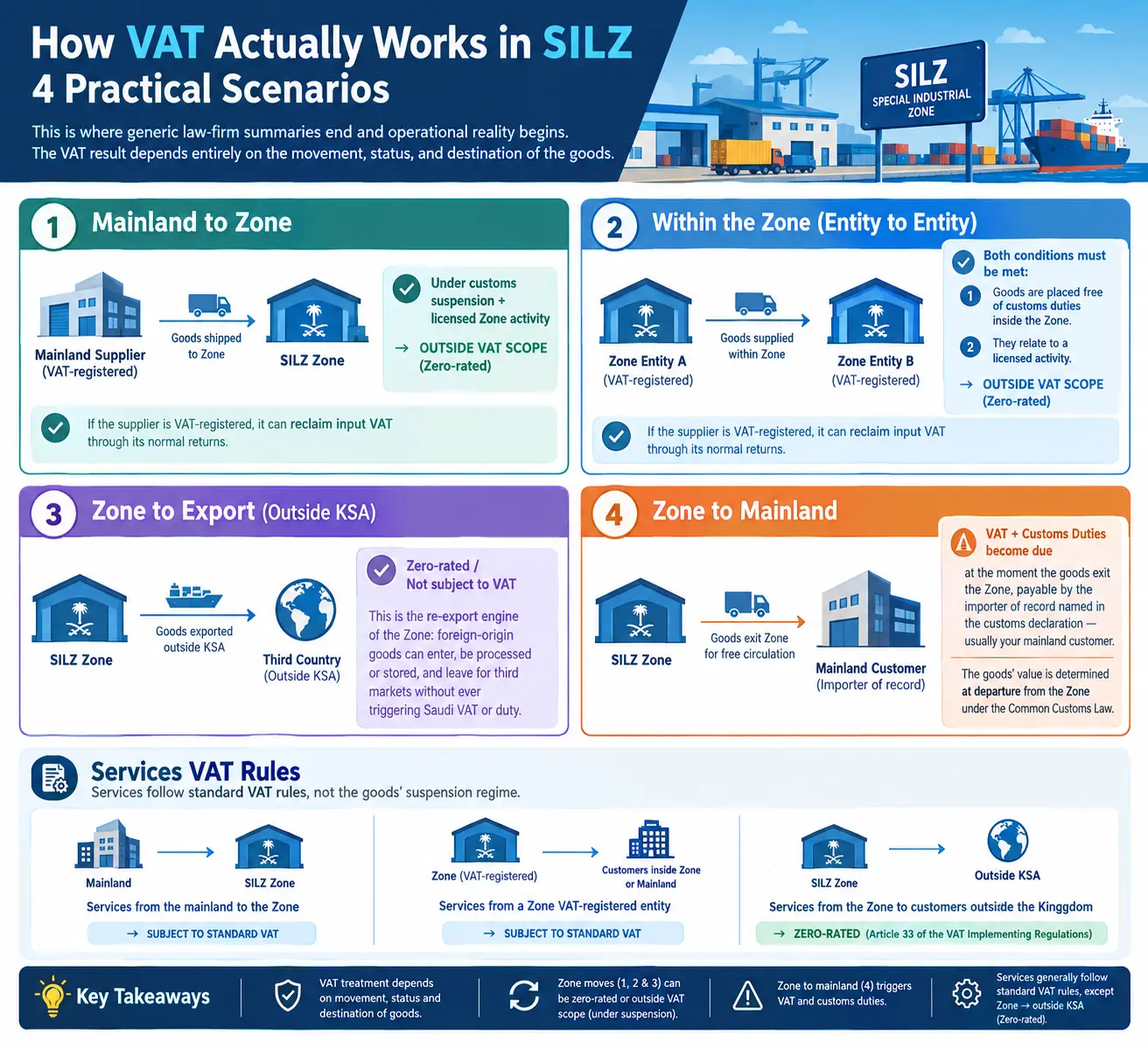
Customs Duty Suspension & Clearance Procedures
Suspension is a privilege with conditions, and the conditions are procedural:
- Goods must be imported into the Zone under the suspension procedures of the Common Customs Law and must relate to a licensed activity;
- Temporary transfer to the mainland for maintenance or completion of manufacturing keeps the suspension alive — but the clock is procedural: the goods must return within the temporary exportation period, and VAT/duty apply only to the value added by the maintenance or manufacturing operation upon re-import;
- Re-export and re-import are exempt from customs duties where the re-imported goods return in accordance with the Common Customs Law and ZATCA‘s exemption conditions — duty is calculated only on the increase in value;
- Goods moving from SILZ to another SEZ with suspension status remain free of duty, restrictions, and VAT, provided the destination zone also operates suspension provisions.
Every one of these outcomes depends on correct HS classification, accurate declarations, and documented customs status at each movement. That is precisely why the choice of SILZ customs clearance partner determines whether the incentives on paper become savings in your P&L.
Registration & Ongoing Tax Compliance Requirements
ZATCA Registration
Zone entities must register with ZATCA. Critically, a Zone branch holds its own Tax Identification Number (TIN), separate from the mainland parent. And the reverse is also true: a branch of a Zone entity opened on the mainland is registered separately with its own TIN — and receives none of the Zone incentives. The mainland branch and the Zone entity are legally independent taxpayers.
Corporate Income Tax Returns
The annual income tax return is due within 120 days of the end of the tax year — and must be filed even when the entity is fully exempt and its rate is 0%. Exempt does not mean exempt from filing.
Withholding Tax Returns
Withholding tax returns are filed monthly, within 10 days of the end of the month in which the payment was made, accompanied by a mandatory annual summary declaration — which is due even if the value is zero. Many newly licensed Zone entities are caught out by this zero-value annual filing.
VAT Returns & Refunds
Zone entities follow the standard VAT filing cycle. Because Zone supplies are frequently zero-rated, input VAT often exceeds output VAT — creating a refundable credit balance. Refund claims can be submitted together with the regular return or as independent requests, within five years from the end of the calendar year in which the suspension occurred.
Zakat Returns
Zakat returns are filed within 120 days of the Zakat year-end, with an installment option available for outstanding amounts.
Transfer Pricing Obligations
Related-party transactions follow the Arm’s Length Principle. Zone entities must maintain master file, local file, and country-by-country reporting where thresholds are met — and must disclose any transfer of activities from the mainland into the Zone as a related-party transaction.
Record-Keeping & E-Invoicing Requirements
- Zone books and records must be kept separately from the parent company’s — the pro-rata allocation between eligible and ineligible income depends on it;
- Customs-related documents and correspondence must be retained for a minimum of five years;
- ZATCA‘s E-Invoicing (FATOORAH) regulations apply mandatorily to Zone entities registered with ZATCA — electronic invoices are required for Zone supplies.
ZATCA expects an auditable electronic inventory-management system that consistently identifies the status and destination of every consignment. Groups operating across mainland and Zone locations should review ERP location codes, inventory controls, and customs guarantees before the first shipment moves.
Anti-Avoidance Rules for Zone–Mainland Transactions
The incentives come with teeth. Zone entities must:
- Disclose any transfer of activities from the mainland into the Zone as a related-party transaction under the Transfer Pricing Bylaws;
- Provide, upon request, information on profits realized from activities previously practiced on the mainland;
- Apply fair market value to any such transfer.
Tax incentives do not apply to activities previously conducted on the mainland unless the transfer was disclosed at fair market value. Penalties — on top of the tax itself — apply where an entity knowingly submits false or misleading declarations, intentionally misapplies the Zone tax rules or misuses incentives, or assists another party in obtaining an advantage for non-prescribed activities.
Penalties for Non-Compliance
Non-compliance can mean fines, suspension, or license cancellation for regulatory breaches. On the customs side, violations and smuggling are treated differently — customs violations attract fines, while customs smuggling carries materially more severe penalties, including imprisonment under the Common Customs Law. ZATCA may also amend customs declarations where discrepancies are found, and pre-clearance declarations are expected to be submitted electronically before arrival at Saudi ports.
Step-by-Step Checklist — Setting Up and Staying Compliant in SILZ
- Confirm your activity qualifies as a licensed Zone Activity and apply for a GACA license (with your five-year business plan);
- Register the Zone entity separately with ZATCA and obtain its own TIN — never operate under the mainland parent’s registration;
- Set up segregated books, records, and VAT registration where applicable, from day one;
- Implement ZATCA E-Invoicing (FATOORAH) before your first Zone supply;
- Map your filing calendar: monthly withholding tax within 10 days, the VAT cycle, the mandatory WHT annual summary, and the 120-day income tax and Zakat deadlines;
- Document the customs status of every shipment — suspension, re-export, or import for free circulation — at the point of movement, with an auditable electronic inventory system;
- Engage a licensed customs clearance partner to manage declarations, HS classification, and ZATCA/GACA correspondence.
Frequently Asked Questions
Is SILZ the same as the ILBZ?
Yes. The Special Integrated Logistics Zone is the new name of the Integrated Logistics Bonded Zone (ILBZ), established by Royal Order A/17 in 2018.
What is the SILZ tax rate after the 50-year incentive period ends?
Income earned after the Tax Relief Period expires is taxed at the standard mainland corporate income tax rate of 20%. Ineligible income earned during the period is also taxed at 20%.
Can a 100% foreign-owned company operate in SILZ?
Yes. SILZ permits 100% foreign ownership, with no minimum share capital requirement and no restrictions on repatriating capital, profits, or dividends.
Does a SILZ branch need its own Tax Identification Number?
Yes. A Zone entity or branch must hold a TIN separate from its mainland parent. Conversely, a mainland branch of a Zone entity has its own TIN and receives none of the Zone incentives.
What happens to VAT when goods move from SILZ to the Saudi mainland?
The supply is treated as an import. VAT and customs duties become due when the goods exit the Zone for free circulation, payable by the importer of record on the customs declaration.
Is Zakat exempted for companies operating in SILZ?
No. There is no Zakat exemption in SILZ. Excise tax and real estate transaction tax also remain fully applicable. Only income tax, withholding tax (on covered payments), and VAT/customs suspension carry special treatment.
How long does customs suspension status last for goods stored in the Zone?
For as long as the goods remain in the Zone (or move between suspension territories) and relate to a licensed activity. Suspension ends when the goods enter the mainland for free circulation, are finally exported, or the licensed activity link is broken.
Who can help a company handle customs clearance for SILZ shipments?
A customs clearance agent licensed in Saudi Arabia with direct experience in special economic zones — handling HS classification, suspension declarations, re-export documentation, and ZATCA/GACA correspondence. See the next section.
Why Work With a Licensed Customs Clearance Partner in SILZ
Everything in this guide converges on one practical point: the 0% tax rate, the 50-year holiday, and the duty suspension are only as real as the customs execution behind them.
A single misclassified HS code can trigger the standard duty and VAT liability the Zone was designed to avoid. A suspension procedure filed late can turn a zero-rated flow into a taxable import. A missing five-year record can turn an audit into an assessment. In SILZ, customs clearance is not an administrative afterthought — it is the mechanism that converts legal incentives into actual margin. As a flagship of Saudi Vision 2030‘s logistics transformation — and with the Zone’s planned relocation alongside King Salman International Airport — businesses that set up correctly now will hold the strongest positions for the next fifty years.
At Radhi Customs Clearance, we handle SILZ customs clearance for importers and Zone operators across Saudi Arabia — HS classification, suspension and re-export declarations, ZATCA and GACA correspondence, and full compliance calendars — so your SILZ structure delivers exactly what the law promises.
→ Talk to our team today — or message us to review your SILZ setup before your next shipment moves.
Add a Comment