
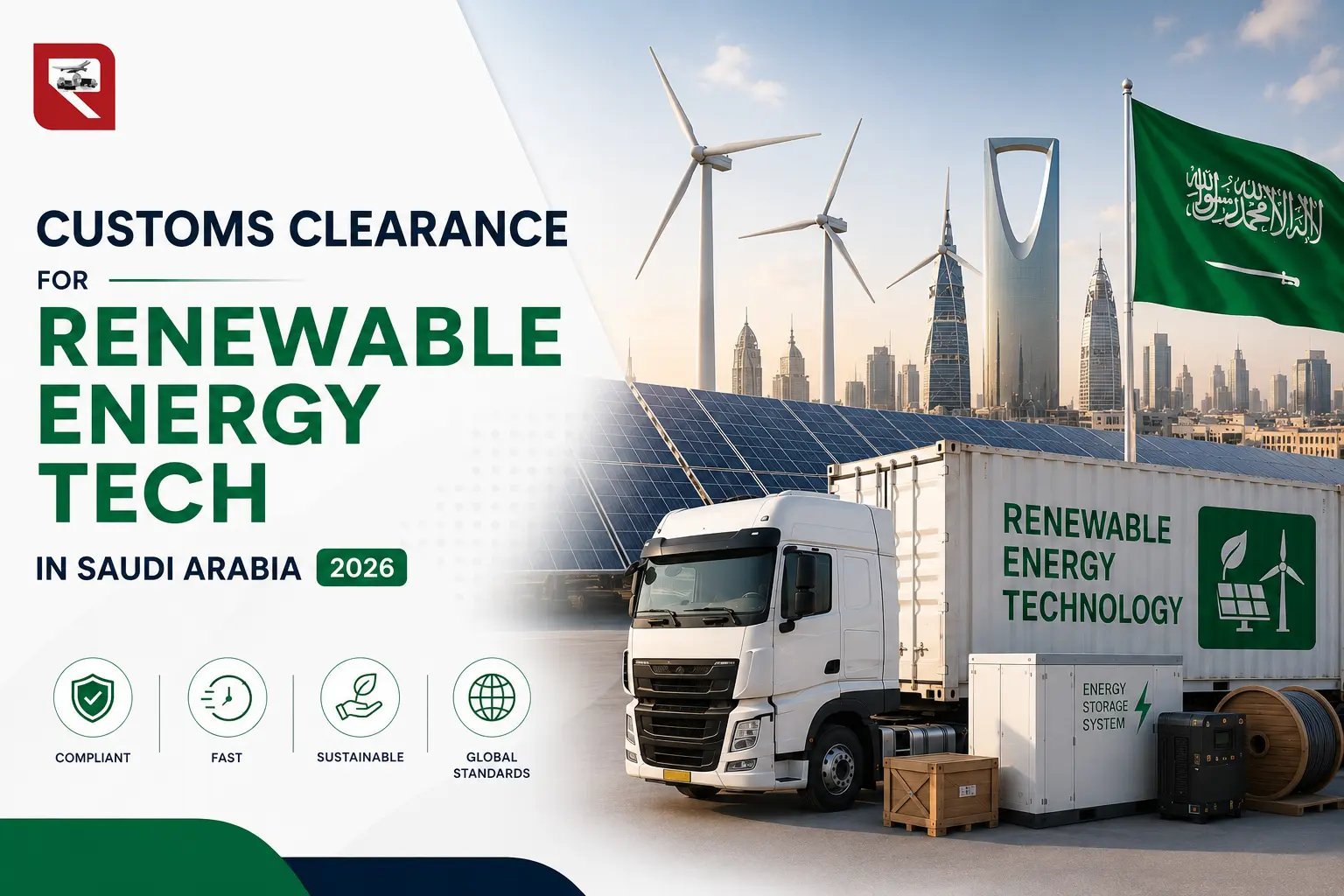
The Definitive Guide to ZATCA, SABER & Giga Project Logistics
Saudi Arabia is executing the most ambitious renewable energy transformation in modern history. With $100 billion+ committed to clean energy infrastructure and a target of 50% renewable energy by 2030, the Kingdom is not merely participating in the global green transition—it is redefining it.
The scale is staggering. NEOM, the $500 billion futuristic city, will host the world’s largest green hydrogen plant. The Red Sea Global is building the world’s most sustainable tourism destination across 28,000 km². Sudair Solar PV, with 1.5 GW capacity, represents just the beginning of Saudi Arabia’s solar ambitions. These are not projects—they are civilizational shifts.
But here’s what most industry publications won’t tell you: the success of these giga projects hinges not on technology or capital, but on customs clearance.
A single delayed shipment of solar inverters can stall a 500 MW solar farm for weeks. An incorrectly classified electrolyzer can trigger a 30-day ZATCA hold, costing millions in demurrage and project penalties. A missing SABER certificate can turn a routine customs process into a bureaucratic nightmare.
The data is clear. Under ZATCA’s new AI-powered risk assessment system, 60% of shipments now clear within 2 hours through the Green Channel—but renewable energy equipment, with its complexity and high value, often falls into the Red Channel, requiring physical inspection and extended processing.
This is not a theoretical concern. When NEOM’s green hydrogen project—valued at $8.5 billion with 1.4 million tons of components—needed to move 190 wind turbines and 67 tower sets from port to desert installation sites, the logistics challenge was unprecedented. The solution wasn’t better technology. It was specialized customs clearance expertise that understood Saudi Arabia’s unique regulatory, cultural, and logistical landscape.
This guide is the most comprehensive resource available for clearing renewable energy equipment through Saudi customs in 2026. Whether you’re an EPC contractor, logistics manager, customs broker, or renewable energy investor, you’ll find actionable intelligence that your competitors likely don’t have.
The Renewable Energy Tech Landscape in Saudi Arabia (2026)
Understanding what you’re importing is the first step to clearing it efficiently. Saudi Arabia’s renewable energy sector spans three primary technology categories, each with distinct customs requirements, HS codes, and compliance frameworks.
Solar Power Components: The Foundation of Saudi’s Energy Transition
Saudi Arabia possesses some of the world’s highest solar irradiance levels, making solar the cornerstone of its renewable strategy. The components you’ll import fall into specific regulatory categories:
Photovoltaic (PV) Panels (HS Code: 8541.40.10)
Solar panels are the most imported renewable energy component in Saudi Arabia. But clearing them is not straightforward. Every shipment requires:
- SASO Energy Efficiency Label: Mandatory since 2023, this label certifies that panels meet Saudi Arabia’s specific performance standards for desert climates. The testing must be conducted by SASO-accredited laboratories.
- Environmental Conformity Certificate (ECC): Required for all electrical equipment, confirming compliance with Saudi environmental regulations.
- SABER Product Certificate of Conformity (PCoC): Valid for one year per product model, obtained through the SABER electronic platform before shipment.
- SABER Shipment Certificate of Conformity (SCoC): Per-shipment certificate required for customs clearance, obtained after PCoC validation.
The critical detail most importers miss: SASO-IEC 61215 certification for PV modules is not merely recommended—it is enforced. Panels without this certification face automatic rejection at Saudi ports.
Solar Inverters (HS Code: 8504.40.90)
Inverters represent the second-highest value component in solar imports. Their clearance requires:
- SASO Efficiency Certification: Saudi Arabia mandates specific efficiency thresholds for static converters.
- IECEE Recognition Certificate (SIRC): For electrical products, this international certification must be obtained before SABER PCoC application.
- Grid Connection Approval: From the Ministry of Energy, required for utility-scale inverters before installation.
Battery Energy Storage Systems (BESS) (HS Code: 8507.60.00)
Lithium-ion batteries are the fastest-growing import category, driven by Saudi Arabia’s need for grid stabilization. But they are also the most heavily regulated:
- UN38.3 Safety Report: Mandatory for all lithium battery shipments, testing crush, impact, and thermal stability.
- Civil Defense Import Permit: Required for hazardous materials, with specific packaging and labeling requirements.
- Temperature-Controlled Transport: Batteries must maintain specified temperature ranges during port storage and inland transport.
- SASO Labeling: Energy efficiency and safety labels in Arabic.
Mounting Structures (HS Code: 7308.90.90)
Often overlooked, mounting structures require:
– Environmental Conformity Certificate (ECC)
– Corrosion Resistance Certification: Critical for Saudi Arabia’s harsh desert and coastal environments.
– Structural Load Reports: For areas with specific wind or sand load requirements.
Wind Energy Infrastructure: Moving Mountains Across Deserts
Wind energy is expanding rapidly, with the Dumat Al Jandal Wind Farm (400 MW) already operational and multiple projects in development. The challenge is not just technical—it’s logistical.
Complete Wind Generating Sets (HS Code: 8502.31.00)
Wind turbines are classified as complete generating sets for customs purposes. Requirements include:
– SASO Noise and Performance Standards: Saudi Arabia has specific noise limitations for wind installations.
– Environmental Impact Assessment: Required before installation permits are granted.
Turbine Blades (HS Code: 8412.90.20)
The most challenging component to import. A single blade can exceed 80 meters in length and 20 tons in weight.
- Structural Conformity Reports: Certification of blade integrity for Saudi wind conditions.
- Oversized Cargo Permits: Special transport licenses from the Ministry of Transport.
- Route Surveys: Mandatory for blade transport, with police escorts for certain routes.
The Dumat Al Jandal Example
When Vestas delivered turbines for the Dumat Al Jandal project, the logistics were extraordinary:
– 98 turbines, each 205 meters long, weighing 69 tons
– 1,700-kilometer journey from Duba Port to the Al Jouf region
– Specialized trailers with hydraulic steering for desert roads
– 6-month transport window coordinated with customs pre-clearance.
This is not standard freight. This is precision engineering applied to logistics, with customs clearance as the critical enabler.
Green Hydrogen Systems: The Future of Saudi Energy Exports
NEOM Green Hydrogen Project is the crown jewel of Saudi Arabia’s renewable energy strategy—and the most complex customs challenge in the Kingdom.
The Scale – $8.5 billion investment – 2.2 GW solar + 1.65 GW wind powering electrolysis – 650 tonnes/day green hydrogen at full capacity (2027) – 1.4 million tons of components to be imported and installed – 257 installation sites across NEOM
Key Components and Their Challenges
| Component | HS Code | Customs Complexity | Special Requirements |
|---|---|---|---|
| Electrolyzers | 8543.30.00 | Very High | SASO chemical safety, pressure vessel certification |
| Hydrogen Storage Tanks | 7311.00.00 | High | ASME certification, Civil Defense approval |
| Specialized Piping | 7304.11.00 | Medium | Material certificates, welding specs |
| Ammonia Synthesis Equipment | 8419.60.00 | High | Process safety review, environmental permits |
| Power Transformers (>10MVA) | 8504.23.00 | High | SASO efficiency, grid code compliance |
The Timeline Pressure
Commercial operations began in Q2 2026, with full capacity targeted for 2027. This means customs clearance cannot be reactive—it must be predictive. Every component must be pre-classified, pre-certified, and pre-cleared before it reaches Saudi waters.
Navigating the Saudi Regulatory Landscape (2026 Update)
Saudi Arabia’s customs and regulatory environment has undergone a digital transformation that rivals its renewable energy ambitions. Understanding these systems is not optional—it is survival.
ZATCA & The Fasah Digital Platform: The New Customs Reality
Zakat, Tax and Customs Authority (ZATCA) has unified all customs procedures under a single digital ecosystem. The implications for renewable energy importers are profound.
The Fasah Single Window System
Fasah is not merely a portal—it is the central nervous system of Saudi trade. All customs declarations, certificates, and payments flow through this platform. For renewable energy equipment, the process works as follows:
- Advance Cargo Declaration (ACD): Submitted 48 hours before vessel arrival
- Document Upload: Commercial invoice, packing list, bill of lading, certificates of origin
- Certificate Verification: Automatic cross-checking with SABER, SASO, and IECEE databases
- Risk Assessment: AI assigns Green, Yellow, or Red Channel status
- Duty Calculation: Automated based on HS code and declared value
- Payment: Electronic transfer or bank guarantee
- Release: Digital customs release order
The Channel System: Your Risk Profile
| Channel | Clearance Time | Inspection Level | Typical for Renewable Equipment |
|---|---|---|---|
| Green | 0-2 hours | Document check only | Low-risk AEO operators, routine solar components |
| Yellow | 4-24 hours | Document + selective physical | New suppliers, complex classifications |
| Red | 2-30 days | Full physical inspection | High-value tech, first-time imports, discrepancies |
The 2026 Critical Update
In April 2025, ZATCA implemented new VAT regulations specifically affecting large-scale projects. Key changes:
- Reverse Charge Mechanism: Expanded for qualified renewable energy projects, shifting VAT responsibility to the Saudi recipient
- SEZ Treatment: Zero VAT on goods under customs suspension within Special Economic Zones (KAEC, Ras Al-Khair, Jazan)
- Input VAT Recovery: Enhanced mechanisms for project developers to recover VAT on imported equipment
These changes are not minor administrative adjustments—they represent millions of riyals in cash flow impact for giga project developers.
SABER & SASO: The Two-Certificate Compliance Wall
SABER (Saudi Product Safety Program) is the mandatory conformity assessment platform for all imported goods. For renewable energy equipment, the two-certificate system is non-negotiable.
Certificate 1: Product Certificate of Conformity (PCoC)
- Scope: Per product model, per manufacturer
- Validity: 1 year
- Process: Technical file review by SASO-accredited body
- Requirements: Test reports, factory audit (for some categories), quality management system certification
- Cost: $500-$2,000 per product family
Certificate 2: Shipment Certificate of Conformity (SCoC)
- Scope: Per shipment
- Validity: Single use
- Process: Verification that shipped goods match PCoC specifications
- Requirements: Invoice, packing list, photos, PCoC reference
- Cost: $200-$500 per shipment
The Renewable Energy Specifics
For solar panels and electrical components, an additional layer exists:
IECEE Recognition Certificate (SIRC)
Before applying for SABER PCoC, electrical products must obtain SIRC. This requires: – CB Test Certificate from IECEE-member lab – Factory quality assessment – Annual surveillance audits
The timeline is critical: SIRC application takes 4-6 weeks, and PCoC cannot proceed without it. For a giga project with 500+ component types, this means starting certification 6 months before first shipment.
Additional Regulatory Bodies: The Compliance Ecosystem
Beyond ZATCA and SABER, renewable energy imports intersect with multiple Saudi authorities:
Saudi Food and Drug Authority (SFDA)
– Regulates chemical components in battery storage systems
– Requires material safety data sheets (MSDS) in Arabic
– Environmental release permits for certain electrolytes
General Directorate of Civil Defense
– Import permits for hazardous materials (lithium batteries, hydrogen storage)
– Fire safety compliance for battery storage facilities
– Emergency response plan approval
Ministry of Energy
– Grid connection approvals for utility-scale equipment
– Renewable energy project registration
– Power purchase agreement (PPA) coordination
Ministry of Environment, Water and Agriculture (MEWA)
– Environmental impact assessments for large projects
– Water usage permits for hydrogen production
– Waste management plans for decommissioned equipment
The Coordination Challenge
A single container of solar panels with lithium battery storage might require interaction with 6 different government agencies. Without a customs broker who understands these interdependencies, clearance delays are inevitable.
HS Code Classification & Duty Structure for Renewable Equipment
HS code classification is where most renewable energy imports fail. A single digit error can change duty rates by 15% or trigger incorrect regulatory requirements. Precision is not optional—it is financial survival.
Critical HS Codes for Renewable Energy (2026)
| Equipment Category | HS Code | Description | Duty Rate | Key Compliance |
|---|---|---|---|---|
| Solar PV Panels | 8541.40.10 | Photosensitive semiconductor devices | 5% | SASO energy label, ECC, SABER PCoC+SCoC |
| Solar Inverters | 8504.40.90 | Static converters | 5% | SASO efficiency, IECEE SIRC, SABER |
| Wind Turbines (Complete) | 8502.31.00 | AC generating sets >750KVA | 5% | SASO noise/performance, environmental assessment |
| Wind Turbine Blades | 8412.90.20 | Parts of engines and motors | 5% | Structural conformity, oversized transport permits |
| Lithium-Ion Batteries | 8507.60.00 | Lithium-ion | 5% | UN38.3, Civil Defense permit, temperature control |
| BESS Systems | 8507.20.00 | Lead-acid accumulators (for BESS classification) | 5% | ECC, SASO labeling, grid code compliance |
| Power Transformers (>10MVA) | 8504.23.00 | Liquid dielectric transformers | 5% | SASO efficiency, grid connection approval |
| Electrical Cables | 8544.42.90 | Other electric conductors >80V | 5% | IEC + SASO safety standards, fire resistance |
| Mounting Structures | 7308.90.90 | Other structures and parts of structures | 5% | ECC, corrosion resistance, structural load reports |
| Electrolyzers | 8543.30.00 | Electrical machines and apparatus | 5% | SASO chemical safety, pressure vessel certification |
| Hydrogen Storage Tanks | 7311.00.00 | Containers for compressed gas | 5% | ASME certification, Civil Defense approval |
The 5% Duty Rate: A Strategic Advantage
In 2025, Saudi Arabia reduced customs duties on solar panels and electric vehicle components from 12% to 5% as part of its renewable energy incentive framework. This is not automatic—it requires:
- Correct HS code classification
- Proof of renewable energy end-use
- Project registration with Ministry of Energy
- Compliance with local content requirements (where applicable)
The Classification Trap
Consider a BESS system. Is it classified under:
– 8507.60.00 (Lithium-ion batteries)?
– 8504.40.90 (Inverters)?
– 8537.10.00 (Electrical control boards)?
It depends on the primary function as declared in the technical specifications. A containerized BESS with integrated inverter might require multiple HS codes, each with distinct compliance requirements.
VAT Framework: The 15% Factor
Saudi Arabia’s 15% VAT applies to most imported goods, but renewable energy projects have specific considerations:
Standard VAT Treatment – 15% on CIF value + customs duty – Paid at clearance or via bank guarantee – Recoverable as input VAT for registered businesses
Reverse Charge Mechanism – Applicable for cross-border B2B transactions – Shifts VAT liability to Saudi recipient – Requires specific contractual structures and VAT registration
– 2026 Update: Expanded for qualified renewable energy EPC contracts
SEZ Zero VAT – Goods under customs suspension within Special Economic Zones – KAEC, Ras Al-Khair, and Jazan SEZs offer this benefit – Requires SEZ entity registration and specific customs procedures
– Critical: Equipment must remain in SEZ or be transferred under customs bond
The Cash Flow Impact
For a $50 million solar farm import: – Customs duty (5%): $2.5M – VAT (15% on $52.5M): $7.875M
– Total upfront: $10.375M
With proper structuring (SEZ placement + reverse charge), this can be reduced or deferred. Without it, the project faces a $10M+ cash flow hit before generating a single kilowatt-hour.
Duty Exemptions & Incentives: The Vision 2030 Advantage
Beyond the 5% reduced rate, specific exemptions exist:
Ministry of Industry and Mineral Resources Exemptions – Zero customs duty for manufacturing equipment – Requires industrial license and local partnership – Renewable energy component manufacturing qualifies
GCC Unified Industrial Regulation (2025) – Exemptions on industrial imports across GCC states – Facilitates regional supply chains – Requires GCC origin certification for components
Project-Specific Exemptions – Certain Vision 2030 giga projects have negotiated exemptions – Requires royal decree or council of ministers approval – Typically limited to specific component categories
Specialized Transport: Engineering Meets Logistics
Wind Turbine Blade Transport
A single 80-meter blade requires:
– Specialized blade trailer with hydraulic steering (12+ axles)
– Route survey 30 days before transport
– Police escort for certain highway segments
– Night transport for reduced traffic (in some regions)
– Permits from Ministry of Transport and municipal authorities
The Dumat Al Jandal experience: 98 turbines, 1,700km, 6 months. This is not freight—it is mobile infrastructure installation.
Hydrogen Electrolyzer Transport
Electrolyzers for NEOM’s green hydrogen plant:
– High value: $2-5M per unit
– Sensitive: Shock monitoring, climate control
– Heavy: 50-200 tons per unit
– Dimensions: Require flat-rack or open-top containers
– Insurance: Specialized marine and inland cargo coverage
Pre-Clearance & AEO Strategies: Speed as Competitive Advantage
Pre-arrival Clearance (PAC)
ZATCA’s PAC system allows customs processing before vessel arrival:
– Document submission: 72 hours before arrival
– Risk assessment: Completed while cargo is at sea
– Duty payment: Electronic transfer before discharge
– Release: Immediate upon vessel arrival (Green Channel)
For renewable energy projects with tight construction windows, PAC is not optional. A single day of port storage for 500 containers costs $15,000-$25,000 in demurrage.
Authorized Economic Operator (AEO) Status
AEO certification is the gold standard for Saudi importers:
| Benefit | Impact |
|---|---|
| Priority inspection | Green Channel default, Yellow maximum |
| Reduced physical checks | 90% document-only clearance |
| Faster digital review | 24-hour processing guarantee |
| Deferred payment | Monthly duty settlement vs. per-shipment |
| Simplified procedures | Reduced documentation for regular shipments |
AEO Requirements
– 3 years of compliant import history
– Financial solvency proof
– Security management system (ISO 28000)
– Record-keeping system audited by ZATCA
– Timeline: 6-12 months for full certification
For giga project suppliers, AEO status should be pursued 18 months before first shipment.
Common Customs Challenges & Risk Mitigation
Even with perfect preparation, renewable energy imports face specific challenges that can derail timelines and budgets. Here’s how to anticipate and mitigate them.
Documentation Pitfalls: The Devil in the Details
Arabic Translation Errors
All customs documents must include certified Arabic translations. Common failures:
– Technical specifications translated by non-specialists
– Inconsistent terminology across documents
– Missing Arabic labels on product packaging
– Mitigation: Use ZATCA-approved translation services with renewable energy expertise
Quantity Mismatches
Discrepancies between packing list, invoice, and actual shipment trigger automatic Red Channel inspection:
– Partial shipments without updated documentation
– Sample units not declared separately
– Spare parts included without specification
– Mitigation: Implement triple-check system before document submission
Certificate Gaps
The most common cause of shipment holds:
– Expired PCoC: Valid only 1 year, must be renewed
– Missing SCoC: Cannot be obtained after shipment arrival
– Incorrect SIRC scope: Certificate doesn’t cover exact model variant
– Mitigation: Certificate tracking system with 90-day expiration alerts
Physical Inspection Risks: When Red Channel Strikes
Why Renewable Energy Gets Flagged
ZATCA’s AI risk assessment considers:
– High declared value: >$100K shipments auto-flagged for review
– First-time importer: No customs history = higher risk
– Complex HS classification: Multiple codes in single shipment
– Sensitive technology: Electrical, chemical, or pressure equipment
– Origin from certain countries: Enhanced scrutiny applies
Managing Physical Inspection
If flagged for inspection:
1. Immediate response: Broker must be present within 4 hours
2. Document preparation: Original certificates, technical manuals, photos
3. Sample availability: If testing required, samples must be accessible
4. Time management: Inspection can take 2-30 days depending on complexity
Cost of Inspection Delays
| Delay Duration | Cost Impact |
|---|---|
| 2-5 days | $5,000-$15,000 (demurrage, storage) |
| 5-10 days | $15,000-$50,000 + project penalty risk |
| 10-30 days | $50,000-$200,000 + potential contract breach |
Local Content Requirements: The IKTVA & LCA Factor
IKTVA (In-Kingdom Total Value Add)
Aramco’s localization program requires suppliers to achieve 70% local content:
– Local manufacturing or assembly
– Saudi workforce utilization
– Local supplier spending
– Technology transfer
For Renewable Energy Imports
While IKTVA is primarily an Aramco requirement, it influences the broader market:
– Local assembly partnerships: Reduce import volume and complexity
– Saudi component sourcing: Certain steel, concrete, and electrical components
– Training programs: Saudi workforce development counts toward localization
Local Content Authority (LCA)
Government-wide mandate expanding beyond Aramco:
– Vision 2030 projects: Increasing localization requirements
– Customs implications: Higher local content can qualify for duty exemptions
– Strategic response: Partner with Saudi entities early in project development
The Partnership Strategy
Rather than viewing local content as a barrier, successful importers:
– Form joint ventures with Saudi logistics providers
– Establish local warehousing for inventory and pre-assembly
– Hire Saudi customs specialists for regulatory navigation
– Invest in training for local workforce development
2026 Compliance Checklist for Renewable Energy Imports
Use this checklist as your operational framework. Missing any item can delay clearance by days or weeks.
Pre-Shipment (8-12 Weeks Before Arrival)
- Confirm HS codes with ZATCA or certified customs broker
- Verify HS code against actual product specifications (not just category)
- Obtain PCoC via SABER platform for all product models
- Complete IECEE/SIRC for all electrical components
- Secure SASO energy efficiency labels for solar equipment
- Arrange UN38.3 testing for lithium batteries (8-week lead time)
- Apply for Civil Defense permit for hazardous materials
- Prepare Arabic translations of all technical documents
- Confirm port selection based on final destination and cargo type
- Book specialized transport for oversized cargo (30-day lead time)
- Arrange cargo insurance with Saudi coverage
- Verify AEO status (if applicable) or initiate application
Pre-Arrival (2-4 Weeks Before)
- Apply for SCoC via SABER (after PCoC validation)
- Submit Advance Cargo Declaration (ACD) to ZATCA
- Upload documents to Fasah platform:
- Commercial invoice (Arabic + English)
- Packing list (detailed, per container)
- Bill of lading or airway bill
- Certificate of origin
- PCoC and SCoC references
- IECEE/SIRC certificates
- UN38.3 test reports (for batteries)
- Civil Defense permits (for hazardous materials)
- Arrange customs broker with renewable energy expertise
- Confirm duty payment method (electronic transfer or guarantee)
- Coordinate with port for oversized cargo handling
- Book inland transport with specialized carriers
- Arrange warehousing if immediate site delivery not possible
Arrival & Clearance (0-3 Days)
- Track channel assignment (Green/Yellow/Red) via Fasah
- Respond immediately if Red Channel inspection required
- Present original certificates if physical inspection called
- Verify duty calculation against expected amount
- Confirm VAT treatment (standard, reverse charge, or SEZ zero)
- Obtain customs release order digitally
- Coordinate container pickup with port operator
- Inspect cargo for damage before inland transport
- Document any discrepancies immediately
Post-Clearance (1-4 Weeks)
- Arrange specialized transport to project site
- Obtain transport permits for oversized cargo
- Coordinate site delivery with construction schedule
- Maintain customs records for 5 years (ZATCA requirement)
- Process VAT recovery if applicable
- Update certificate tracking for renewal alerts
- Review clearance performance for process improvement
The Future of Renewable Energy Logistics in Saudi Arabia (2026-2030)
Saudi Arabia’s customs and logistics landscape is evolving as rapidly as its energy sector. Understanding emerging trends is essential for long-term competitive positioning.
Digital Transformation: The AI Customs Revolution
ZATCA’s 2026-2028 Roadmap
- Full AI risk assessment: Machine learning models trained on 5 years of import data
- Blockchain documentation: Immutable certificate and origin verification
- Predictive compliance: AI alerts for certificate expiration and regulatory changes
- Autonomous clearance: Green Channel expansion to 80% of shipments by 2028
Impact on Renewable Energy
For compliant importers, clearance times will decrease from days to hours. For non-compliant importers, AI will flag risks faster and more accurately than ever before. The gap between efficient and inefficient importers will widen dramatically.
Local Manufacturing: The Import Reduction Strategy
Saudi Arabia is aggressively building local renewable energy manufacturing:
- Solar panel factories: Vision Industries, JinkoSolar partnerships
- Battery assembly: Lithium-ion cell production planned for 2027
- Wind turbine components: Local blade manufacturing
- Electrolyzer assembly: NEOM-based green hydrogen equipment production
For Importers
This creates a dual opportunity:
1. Component imports will decrease for locally manufactured items
2. Machinery and technology imports will increase for manufacturing facilities
The customs strategy must evolve from “import finished goods” to “import manufacturing equipment”.
Green Port Initiatives: Sustainable Logistics
Saudi ports are adopting renewable energy:
– Jeddah Islamic Port: Solar-powered operations by 2027
– NEOM Port: 100% renewable energy from project inception
– King Abdullah Port: Wind and solar hybrid power
Logistics Implication
Green port certification may become a selection criterion for environmentally conscious project developers. Partnering with green-certified logistics providers will become a competitive advantage.
Hydrogen Export Infrastructure: The Next Frontier
By 2027, NEOM will begin ammonia exports to global markets:
– Ammonia export terminal: Operational at NEOM Port
– Customs procedures: New HS codes and safety protocols for hydrogen derivatives
– International standards: Alignment with IMO and IRENA guidelines
For Customs Broker
Hydrogen logistics expertise will be the next high-value specialization. Early movers in this space will capture significant market share.
The Competitive Advantage of Customs Clearance Expert
Saudi Arabia’s renewable energy revolution is not just about technology or investment. It is about execution at scale—and execution depends on logistics, and logistics depends on customs clearance.
The importers and contractors who master Saudi customs in 2026 will build the projects that define the Kingdom’s energy future. Those who don’t will watch from the sidelines as competitors capture the $100 billion opportunity.
Key Takeaways
- Customs clearance is strategic, not administrative. A 2-day delay can cost more than a year’s broker fees.
- The 2026 regulatory landscape rewards preparation. AEO status, pre-classified HS codes, and advance SABER certification are competitive weapons.
- Port selection is project-critical. NEOM cargo through Jeddah is not just inefficient—it is irrational.
- Local partnerships are compliance multipliers. Saudi customs expertise, IKTVA compliance, and local content requirements all favor local collaboration.
- The window is narrowing. As AI-driven customs systems mature, the advantage of early compliance investment will compound.
The Cost of Inaction
For a typical 100 MW solar project:
– Equipment value: $50-80 million
– Customs duty (5%): $2.5-4 million
– VAT (15%): $7.9-12.6 million
– Potential delay costs: $500K-2M per week
– Total at risk: $11-19 million in customs-related costs
With proper structuring (SEZ placement, reverse charge, AEO status), 30-50% of these costs can be reduced or deferred.
Your Next Step
The renewable energy projects transforming Saudi Arabia will be built by companies that understand customs clearance is not a cost center—it is a competitive advantage.
Whether you’re planning your first solar panel shipment or managing logistics for giga projects, the difference between success and delay often comes down to who you partner with for customs expertise.
Don’t let customs complexity determine your project timeline. Contact Radhi Customs Clearance who understand ZATCA’s 2026 digital framework, SABER’s two-certificate system, and the unique logistics of Saudi giga projects.
Frequently Asked Questions (FAQ)
Q: How long does customs clearance take for renewable energy equipment in Saudi Arabia?
A: With proper documentation and AEO status, Green Channel clearance takes 0-2 hours. Without preparation, Red Channel inspection can extend to 2-30 days.
Q: What is the total cost of SABER certification for solar panels?
A: PCoC ($500-$2,000 per model) + SCoC ($200-$500 per shipment) + IECEE SIRC ($1,000-$3,000) = approximately $1,700-$5,500 per shipment.
Q: Can I get customs duty exemption for renewable energy equipment?
A: Yes, through Ministry of Industry exemptions (manufacturing equipment) or specific Vision 2030 project approvals. Standard renewable components qualify for reduced 5% duty.
Q: What happens if my shipment is flagged for physical inspection?
A: ZATCA will inspect cargo within 2-5 days. You must provide original certificates and technical documentation. Costs include demurrage ($100-$500/day) and potential project delays.
Q: Is NEOM Port operational for commercial imports?
A: Yes, NEOM Port is operational with specialized facilities for giga-project cargo. It offers the most efficient clearance for NEOM-bound equipment.
Q: How do I apply for AEO status in Saudi Arabia?
A: Apply through ZATCA’s online portal. Requirements include 3 years of compliant history, financial solvency proof, ISO 28000 security management, and audited record-keeping. Timeline: 6-12 months.
Ready to streamline your renewable energy imports to Saudi Arabia? Get a free customs strategy consultation tailored to your specific equipment and project timeline.
Add a Comment