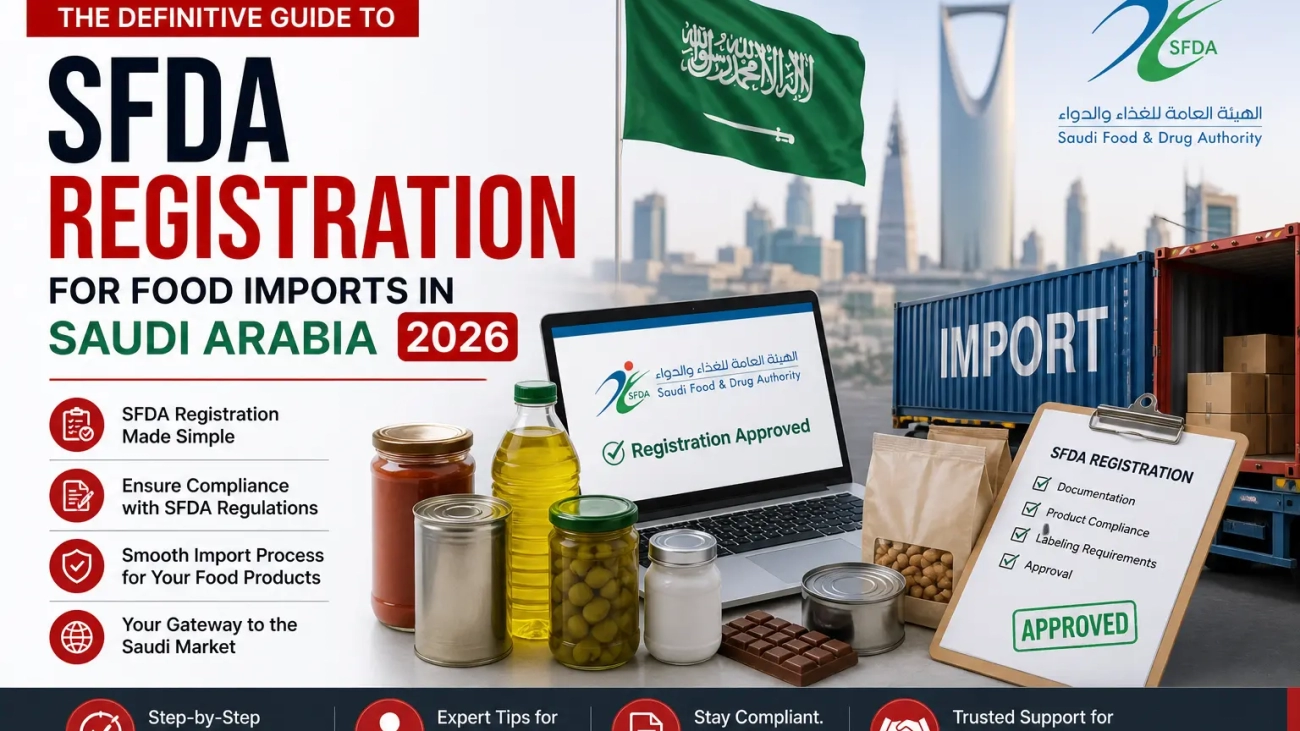
SFDA Registration for Food Imports in Saudi Arabia 2026

The Definitive Guide to SFDA Registration for Food Imports in Saudi Arabia 2026

Saudi Arabia’s food sector stands as one of the most lucrative markets in the Middle East, driven by a population of over 36 million, rising disposable incomes, and ambitious diversification goals under Vision 2030. The Kingdom’s strategic push to reduce oil dependency has transformed its food and beverage industry into a priority sector, with government investments aimed at boosting local production while simultaneously opening doors for high-quality international imports. For global food exporters, this represents an unprecedented opportunity—but one that comes with a rigorous regulatory gatekeeper.

Saudi Food and Drug Authority (SFDA) — الهيئة العامة للغذاء والدواء

At the center of this regulatory framework sits the Saudi Food and Drug Authority (SFDA) — الهيئة العامة للغذاء والدواء. Established to safeguard public health, the SFDA enforces some of the most stringent food safety and compliance standards in the Gulf region. Every food product destined for Saudi shelves must earn the authority’s approval through a structured digital registration process. Understanding this system is not optional; it is the fundamental prerequisite for market access.

Navigating SFDA regulations, ZATCA customs protocols, and bilingual labeling requirements can overwhelm even experienced exporters. This is where the expert customs clearance agent become indispensable—bridging the gap between global food manufacturers and Saudi regulatory compliance. From initial documentation to final customs clearance, expert guidance transforms a complex bureaucratic maze into a streamlined pathway to market entry.

What is the SFDA Food Registration System?

The Food Registration System (نظام تسجيل الغذاء) is the SFDA’s mandatory digital framework for regulating all imported and locally manufactured food products. This system ensures that every item entering the Saudi market meets strict safety, quality, and labeling standards aligned with Gulf Cooperation Council (GCC) regulations.

The Digital Gateway: Ghad Portal

All registrations flow through the Ghad Portal (منصة غد), the SFDA’s official electronic platform for product registration, approvals, and compliance tracking. The portal serves as a centralized command center where companies submit product data, upload technical documentation, and monitor application status in real-time. As of 2026, registration on the Ghad platform is mandatory for all companies intending to import food products into Saudi Arabia.

SFDA Certificate (شهادة الهيئة العامة للغذاء والدواء) & Customs Clearance (التخليص الجمركي)

The ultimate objective of this process is obtaining the SFDA Certificate (شهادة الهيئة العامة للغذاء والدواء). This certificate acts as your product’s passport for Customs Clearance (التخليص الجمركي) at Saudi ports of entry. Without it, shipments face detention, rejection, or destruction at the importer’s expense.

Essential Certifications & Standards

Success in the Saudi market demands more than just quality products—it requires a portfolio of internationally recognized certifications that demonstrate commitment to safety and compliance.

HACCP Certification in Saudi Arabia (نظام تحليل المخاطر ونقاط التحكم الحرجة)

The Hazard Analysis and Critical Control Points (HACCP) system serves as the baseline for food safety management. Saudi regulators expect imported food to originate from facilities implementing HACCP principles, ensuring systematic identification and control of potential biological, chemical, and physical hazards throughout the production process.

ISO 22000 Certification in Saudi Arabia (شهادة آيزو 22000)

ISO 22000 provides the global framework for food safety management systems, integrating HACCP principles with interactive communication and system management. While not always explicitly mandatory, possessing ISO 22000 certification significantly strengthens your SFDA application and signals manufacturing excellence to Saudi inspectors.

The Saudi Barcode (الباركود السعودي)

For retail distribution, products must carry compliant barcodes enabling Traceability (تتبع المنتجات) across the supply chain. This requirement supports the Kingdom’s broader food safety objectives and facilitates rapid response in case of product recalls or safety alerts.

Halal Certification (شهادة حلال)

Since November 2020, Saudi Arabia mandates Halal certification for all meat and poultry shipments. Under regulations SFDA.FD/GSO 2055-1 and SFDA.FD/GSO 993, this requirement extends beyond raw meat to include composite products containing animal-derived ingredients such as gelatin, collagen, animal fats, and rennet. All Halal certificates must be issued by certification bodies designated by the SFDA Halal Center.

Technical Requirements for Product Labels

Saudi labeling regulations are among the most strictly enforced in the region. Non-compliance remains the leading cause of border rejections.

Bilingual Labeling

Arabic Labeling (البطاقة الغذائية باللغة العربية) is mandatory. While English may accompany Arabic, all information must be identical across both languages. Arabic stickers are only permitted if affixed by the manufacturer, are irremovable under normal handling conditions, and do not obscure original labeling.

Mandatory Data Elements

Every prepackaged food label must include:

  • List of Ingredients (قائمة المكونات): Listed in descending order of predominance, with additives identified by functional class and international numbering.
  • Nutritional Facts (البيانات التغذوية): Presented in the approved format following GSO standards.
  • Production & Expiry Dates (تاريخ الإنتاج والانتهاء): Displayed in both Hijri and Gregorian calendars.
  • Country of Origin (بلد المنشأ): Must be indicated through permanent marking (printing, engraving, or embossing). Stickers are acceptable only if irremovable.
  • Allergen Warnings: Mandatory disclosure for 13 specified allergens including gluten, crustaceans, eggs, fish, peanuts, soybeans, nuts, milk, sulfites, celery, mustard, sesame, and lupine.

Step-by-Step SFDA Registration Process

Step 1: Account Setup

Register your company on the SFDA Electronic Portal (البوابة الإلكترونية للهيئة). This requires submission of your Commercial Registration (CR), tax ID, and authorized contact information. Account verification typically takes several business days.

Step 2: Product Categorization

Select the correct HS Code (الرمز التنسيقي) for your food item. Accurate classification determines applicable regulations, testing requirements, and duty rates. Misclassification can trigger delays or compliance failures.

Step 3: Document Upload

Submit your technical dossier including:

  • Product composition and formulation details
  • Manufacturer licenses and GMP certificates
  • Health Certificate (الشهادة الصحية) from the country of origin
  • Laboratory analysis reports from SFDA-accredited labs
  • Halal certificates (where applicable)
  • Label artwork with Arabic translations 

Step 4: Final Approval

Upon successful review, the SFDA issues the Product Registration Number (رقم تسجيل المنتج). Average processing timelines range from 3–6 weeks, with additional time required if laboratory testing is mandated.

Why Radhi Customs Clearance is Your Strategic Partner in KSA

Navigating ZATCA (هيئة الزكاة والضريبة والجمارك) regulations requires specialized knowledge of Saudi customs procedures, VAT obligations (currently 15% on imports), and documentation requirements. Radhi team ensures your shipments meet every customs checkpoint without surprises.

Time Efficiency

Port delays cost money. By ensuring complete documentation and pre-clearance compliance, Radhi Awad reduces bottlenecks at the Port of Entry (منفذ الدخول), preventing demurrage charges and preserving product shelf life.

End-to-End Logistics

From SFDA Registration (تسجيل الهيئة) through customs clearance to final delivery, a single strategic partner eliminates coordination gaps between regulators, shipping lines, and ground transport—transforming complex multi-stakeholder logistics into a seamless operation.

Conclusion: Streamlining Your Saudi Trade Journey

Saudi Arabia’s food import market offers extraordinary potential for global exporters, but that potential is gated by rigorous regulatory requirements. Success demands more than quality products—it requires precise compliance with SFDA registration protocols, bilingual labeling standards, Halal certifications, and ZATCA customs regulations.

Compliance is the key to market access. In a regulatory environment where a single missing document or mistranslated label can result in shipment rejection, working with experienced local expertise isn’t just convenient—it’s essential.

Don’t let regulations slow you down. Partner with Radhi Customs Clearance for expert SFDA Registration (تسجيل الغذاء) and efficient customs services.

Ready to enter the Saudi market? 

Contact Radhi Customs Clearance today to transform regulatory complexity into your competitive advantage.

📍 Office: Uhud District, Eastern Province City Dammam, Kingdom Of Saudi Arabia

📧 Email: Info@radhiawad.com.sa

📞 Phone: +966558959205

The Strategic Advantage of a Local Customs Clearance Expert at Jeddah & Dammam

The Strategic Advantage of a Local Customs Clearance Expert at Jeddah & Dammam

The Complexity of the Saudi Gateway

Saudi Arabia is the beating heart of global trade in the Middle East. Strategically positioned at the crossroads of Asia, Europe, and Africa, the Kingdom handles millions of TEUs annually through its world-class ports. Jeddah Islamic Port (ميناء جدة الإسلامي) — the largest port on the Red Sea — and King Abdulaziz Port Dammam (ميناء الملك عبدالعزيز بالدمام) — the Gulf’s premier gateway — serve as the primary arteries for goods flowing into the largest economy in the Arab world.

But here is the critical reality that every importer must understand: Saudi Arabia’s ports have unique rules that can make or break your business. The Kingdom operates one of the most digitally integrated yet least forgiving customs frameworks in the region.

A single missing document, a misclassified HS Code (رمز النظام المنسق), or an expired SABER certificate (شهادة سابر) can trigger a cascade of catastrophic consequences — weeks of delays, thousands of SAR in fines, and in worst-case scenarios, criminal prosecution and permanent blacklisting.

Under Vision 2030 (رؤية 2030), Saudi Arabia is aggressively modernizing its trade infrastructure. The FASAH platform (منصة فسح) has been fully integrated under ZATCA (الهيئة الزكاة والضريبة والجمارك), the SABER system (نظام سابر) now enforces stricter digital compliance, and as of January 1, 2026, all parcels must include a valid Short Address (العنوان الوطني المختصر).

The regulatory landscape is evolving faster than ever — and only a local customs clearance expert (مخلص جمركي محلي) with physical presence, native fluency, and deep institutional knowledge can navigate this system from the inside out.

This is where Radhi Customs Clearance doesn’t just “clear” cargo — we engineer compliance.

The Radhi Customs clearance Difference: Proximity is Power

Physical Presence at the Customs Counter

While remote “global” forwarders send emails and hope for the best, our team is physically present at the customs counters at Jeddah Islamic Port and King Abdulaziz Port Dammam every single day. We don’t rely on distant phone calls or ticket systems — we stand face-to-face with ZATCA officers (موظفو الهيئة الزكاة والضريبة والجمارك), resolve issues in real-time, and prevent problems before they metastasize into costly delays.

This proximity is not a luxury — it is a competitive necessity. When a shipment is flagged for inspection, when a document requires clarification, or when a last-minute regulatory change affects your cargo, seconds matter. Our physical presence translates directly into hours and days saved for your business.

Native Arabic Fluency: Navigating Arabic-Only Documentation

Saudi customs operates primarily in Arabic (العربية). The FASAH portal (بوابة فسح) — now migrated to ZATCA.Fasah.sa — requires navigation through Arabic-only interfaces for critical functions.

ZATCA declarations (إقرارات الزكاة والضريبة والجمارك), SABER registrations (تسجيلات سابر), and SFDA submissions (تقديمات الهيئة العامة للغذاء والدواء) all demand precise Arabic terminology.

A single mistranslated product description, an incorrectly Arabic-labeled certificate, or a misunderstood customs notification can trigger mandatory physical inspection (الفحص الجمركي الإلزامي) — adding days to your clearance time and exposing your cargo to additional scrutiny. Our team’s native fluency ensures every document, every portal entry, and every government communication is handled with 100% linguistic accuracy.

Speed as a Metric: Same-Day Clearance for Compliant Shipments

At Radhi Awad, we measure success in hours, not days. For shipments that arrive with complete, accurate documentation, our operational goal is “Same-Day Clearance (التخليص في نفس اليوم)”. In an environment where standard clearance can take 2–5 working days even with correct paperwork, and where non-compliant shipments face demurrage fees of $80–$150 per day per container, same-day clearance is not just a service promise — it is a profit protection strategy.

The Pillars of Saudi Trade: ZATCA, SABER, & SFDA

ZATCA Compliance: The Digital Backbone of Saudi Customs

The Zakat, Tax and Customs Authority (الهيئة الزكاة والضريبة والجمارك) is the single most powerful regulatory body governing trade in Saudi Arabia. In 2026, ZATCA has intensified its digital enforcement across multiple fronts:

E-Invoicing Waves (موجات الفوترة الإلكترونية)

ZATCA’s Fatoora portal (بوابة فاتورة) is rolling out mandatory e-invoicing in waves. Wave 23 took effect on March 1, 2026, targeting taxpayers with annual revenue exceeding SAR 500 million. Wave 24 is scheduled for June 1, 2026, covering taxpayers with revenue exceeding SAR 375 million. Non-compliance triggers penalties starting at 5% and escalating to 25% of undeclared tax value.

VAT & Withholding Tax Precision

Saudi Arabia imposes 15% VAT (ضريبة القيمة المضافة) on all commercial imports from the first riyal — there is no minimum value exemption for B2B commercial entries. VAT is calculated on CIF value plus customs duty, creating an effective import tax rate of approximately 20.9% for standard goods.

ZATCA also enforces strict withholding tax (الضريبة المقتطعة) compliance. The authority recently urged establishments to submit March 2026 withholding tax forms by April 10, 2026, warning that penalties of 1% per 30 days of delay apply to late submissions..

FASAH Platform Integration (دمج منصة فسح)

The old Fasah.sa portal is history. The new official platform is ZATCA.Fasah.sa, featuring mandatory OTP verification (التحقق بكلمة المرور لمرة واحدة), unified integration with ZATCA tax services, and a modernized interface designed for Vision 2030’s massive trade volume growth.

The FASAH platform now serves as the sole sovereign interface for managing cargo movement between international ports and Special Economic Zones (المناطق الاقتصادية الخاصة), with all operations requiring documentation under the “Sovereign Transit” system.

Radhi Customs Clearance handles all ZATCA compliance with 100% accuracy — from VAT calculations and withholding tax submissions to FASAH portal navigation and e-invoicing integration — ensuring your business never faces a ZATCA audit or penalty.

SABER Excellence: Your Product’s Digital Passport

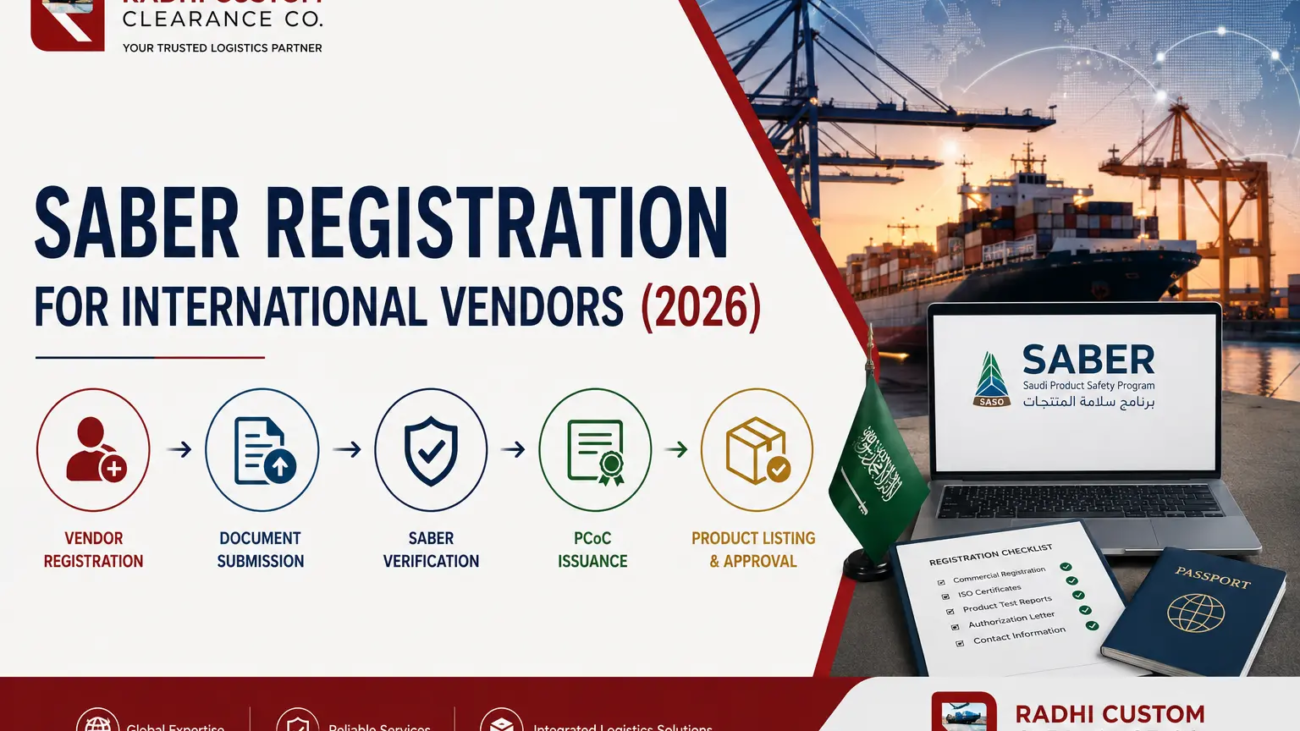
SABER (نظام سابر) — the mandatory electronic portal operated by the Saudi Standards, Metrology and Quality Organization (SASO) — is the digital gatekeeper for all non-regulated product imports. No SABER certificate means no customs clearance.

Critical 2026 Update: HS Code Changes

As of January 1, 2026, Saudi Arabia updated multiple Customs Tariff Codes (رموز التعريفة الجمركية) in the SABER platform. This change affects products across:

  • Textiles
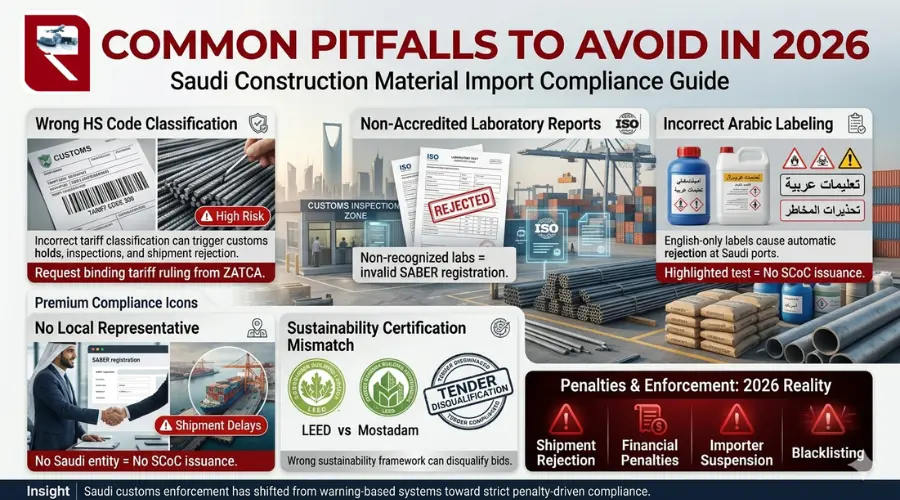
  • Building materials (metals, ceramics, sanitaryware, pipes)
  • Pressure equipment and simple pressure vessels
  • Electrical equipment and appliances
  • Machinery and lifting equipment
  • ICT devices
  • Electric vehicles
  • Vehicle spare parts

Valid Product Certificates of Conformity (P-CoCs) and Shipment Certificates of Conformity (S-CoCs) issued under old tariff codes remain valid until expiry, but customs will auto-assign new codes during clearance. Mismatches between tariff codes and product data cause immediate delays.

Mandatory SCoC Before Clearance

Since October 1, 2025, Saudi Arabia requires the SABER Shipment Certificate of Conformity (SCoC) to be issued before customs clearance for all imported products. Attempting to clear goods without an active, pre-issued SCoC results in immediate rejection at Jeddah/Dammam ports.

Required SABER Documentation:

CertificatePurposeValidity
Product Certificate (PCoC)Initial product registration; links product to HS codeUntil expiry/renewal
Shipment Certificate (SCoC)Per-shipment clearance authorizationSingle shipment only

Radhi Customs Clearance ensures SABER compliance before your cargo even leaves the origin port. We audit every SKU against the 2026 tariff codes, verify PCoC validity, and secure SCoC issuance before vessels reach Saudi waters.

SFDA Specialists: Food, Medical & Cosmetics Compliance

The Saudi Food and Drug Authority (الهيئة العامة للغذاء والدواء) maintains some of the strictest import controls in the region for food products, pharmaceuticals, medical devices, and cosmetics.

Medical Devices (الأجهزة الطبية)

All medical devices require SFDA MDMA registration (تسجيل الهيئة العامة للغذاء والدواء) before import. Registration timelines can extend to several months, and the classification level determines the registration pathway. CE/FDA certification serves as supportive evidence, but SFDA approval is mandatory.

Food Products (المنتجات الغذائية)

SFDA-regulated food imports require:

  • Halal certificate (شهادة حلال) from an SFDA-recognized body (where applicable)
  • Health certificate (شهادة صحية) from the country of origin
  • Certificate of Free Sale (شهادة البيع الحر)

In February 2026, SFDA notified the WTO of a major update to technical regulations governing vitamin and mineral fortification in food products, establishing comprehensive standards for permitted nutrients and enforcing a zero-addition rule for unprocessed foods.

Cold Chain & GDP Compliance

For temperature-sensitive healthcare products, GDP (Good Distribution Practice) compliance and cold chain requirements apply from the point of entry through final delivery. Any temperature deviation during customs hold or port storage can result in total cargo rejection.

Radhi’s SFDA specialists manage the entire approval chain — from pre-arrival registration verification to cold chain monitoring during customs clearance — ensuring your sensitive products pass inspection without compromise.

Why Remote “Global” Forwarders Are Not Enough

Massive global logistics companies have impressive networks, sophisticated tracking systems, and recognizable brand names. But what they lack is the ground-level agility (المرونة على مستوى الأرض) required to operate successfully in Saudi Arabia.

Here is the uncomfortable truth: Saudi customs does not operate on “global standard” procedures. The Kingdom’s trade framework is a unique ecosystem combining:

  • Arabic-only government portals with no English support for critical functions
  • Rapid regulatory changes that are announced in Arabic and implemented immediately
  • Relationship-based resolution where knowing the right ZATCA officer can mean the difference between same-day clearance and a 3-week hold
  • Multi-authority coordination requiring simultaneous compliance with ZATCA, SASO, SFDA, Ministry of Commerce, and Transport General Authority

A global forwarder sitting in London, Singapore, or Dubai simply cannot provide this level of localized execution. They rely on third-party subcontractors in Saudi Arabia — often with minimal oversight, no direct accountability, and no incentive to prioritize your shipment over hundreds of others.

Radhi Customs Clearance: Your Local Wing in the Kingdom

We position ourselves as the “Local Wing (الجناح المحلي)” for international businesses. You bring the global strategy; we ensure it meets Saudi reality.

Our value proposition is simple:

Global ForwarderRadhi Customs Clearance
Email-based communicationPhysical presence at customs counters
English-only documentation supportNative Arabic fluency + certified translations
Subcontracted local agentsDirectly employed, trained local team
Reactive problem-solving (after delays occur)Proactive compliance (preventing delays before they happen)
Generic HS code classificationSKU-level audit against 2026 ZATCA tariff codes
5–10 day standard clearanceSame-day clearance goal for compliant shipments

The True Cost of Port Delays: A Financial Reality Check

Let us be explicit about what port delays actually cost your business:

Direct Costs (التكاليف المباشرة):

Cost CategoryRate30-Day Delay (1 Container)
Demurrage (رسوم التأخير)$80–$150/day$2,400–$4,500
Port storage (رسوم التخزين)$25–$50/day$750–$1,500
Customs fines (الغرامات الجمركية)10%–30% of goods value (capped at 3x value)Variable — potentially catastrophic
Inspection fees (رسوم الفحص)$200–$500 per inspection$200–$500
Documentation correction$500–$2,000$500–$2,000

Indirect Costs (التكاليف غير المباشرة):

  • Production line stoppage: Idle factory workers, missed deadlines, contractual penalties
  • Lost sales: Empty shelves, disappointed customers, market share erosion
  • Reputation damage: Unreliable supplier perception among Saudi partners
  • Cash flow disruption: Capital tied up in detained inventory instead of generating revenue

The Worst-Case Scenario (السيناريو الأسوأ):

Under Article 45 of the Saudi Criminal Code, smuggling, forging SABER certificates, importing counterfeit brands, or bringing in religiously prohibited items can trigger:

  • Heavy fines and potential imprisonment
  • Permanent blacklisting of both the exporting company and the Saudi importing company
  • Effective termination of your Middle East business 

Even “honest mistakes” can escalate to forced destruction of goods if required certificates are not provided within the permitted timeframe — meaning total cargo loss, zero recovery, plus destruction costs billed to the importer.

Vision 2030: The Logistics Revolution Accelerating in 2026

Saudi Arabia’s trade infrastructure is not standing still. Under Vision 2030, the Kingdom is investing billions to transform itself into a global logistics hub. Key developments directly affecting importers in 2026:

King Abdullah Economic City (KAEC — مدينة الملك عبدالله الاقتصادية)

Located 100km north of Jeddah on the Red Sea coast, KAEC is the most operationally mature of Saudi Arabia’s economic cities. Unlike NEOM, which remains primarily under construction, KAEC offers:

  • King Abdullah Port (ميناء الملك عبدالله) — one of the fastest-growing ports in the Middle East
  • Industrial Valley (الوادي الصناعي) with fully serviced plots for manufacturing and logistics
  • Up to 100% foreign ownership in most sectors
  • Bonded zone status allowing duty-free storage and processing before onward distribution
  • Direct Red Sea shipping routes to Europe, Africa, and Asia 

Special Economic Zones (المناطق الاقتصادية الخاصة)

The FASAH platform now manages cargo movement between international ports and SEZs under the “Sovereign Transit” system, ensuring tax-exempt commodity data validity. Companies operating in SEZs benefit from:

  • 0% corporate tax for up to 50 years (Riyadh Airport SEZ)
  • Customs duty suspension on imports for re-export
  • Streamlined regulatory procedures

Short Address Mandate (إلزامية العنوان المختصر)

Since January 1, 2026, all parcels arriving in Saudi Arabia must include a valid Short Address (العنوان الوطني المختصر) — a standardized 8-character code (4 letters + 4 digits) generated by the Saudi National Address platform. Shipments without a proper Short Address face:

  • Customs clearance delays
  • Delivery disruption or rejection
  • Fines according to Saudi regulations 

Radhi Customs Clearance stays ahead of every Vision 2030 regulatory change — we don’t just react to new rules; we anticipate them and prepare your shipments accordingly.

Don’t Let Your Profits Sit at the Port

Logistics in Saudi Arabia is moving faster than ever under Vision 2030. New digital platforms, stricter compliance requirements, and massive infrastructure investments are transforming the Kingdom into a global trade powerhouse.

But here is the question: Is your current partner keeping up?

Every day your cargo sits at Jeddah Islamic Port or King Abdulaziz Port Dammam is a day your capital is frozen, your customers are waiting, and your competitors are gaining ground. The cost of inadequate customs clearance is not just measured in demurrage fees — it is measured in lost opportunities, damaged relationships, and eroded market position.

Radhi Customs Clearance Offers You:

Same-day clearance for compliant shipments
Physical presence at Jeddah & Dammam customs counters
Native Arabic expertise navigating ZATCA, FASAH, SABER & SFDA
SKU-level compliance audits against 2026 tariff codes
Proactive problem-solving before issues become delays
Transparent pricing with no hidden fees

[Get a Free Customs Compliance Audit from Radhi Customs Clearance Experts]

Our team will review your current import process, identify compliance gaps, and provide a clear roadmap to eliminate delays and hidden costs.

Contact Us Today:

📍 Jeddah Office: [Physical address near Jeddah Islamic Port]

📍 Dammam Office: Uhud District, Eastern Province City Dammam, Kingdom Of Saudi Arabia

📧 Email: Info@radhiawad.com.sa

📞 Phone: +966558959205

🌐 Website: https://radhiawad.com.sa/

Importance of HS Code

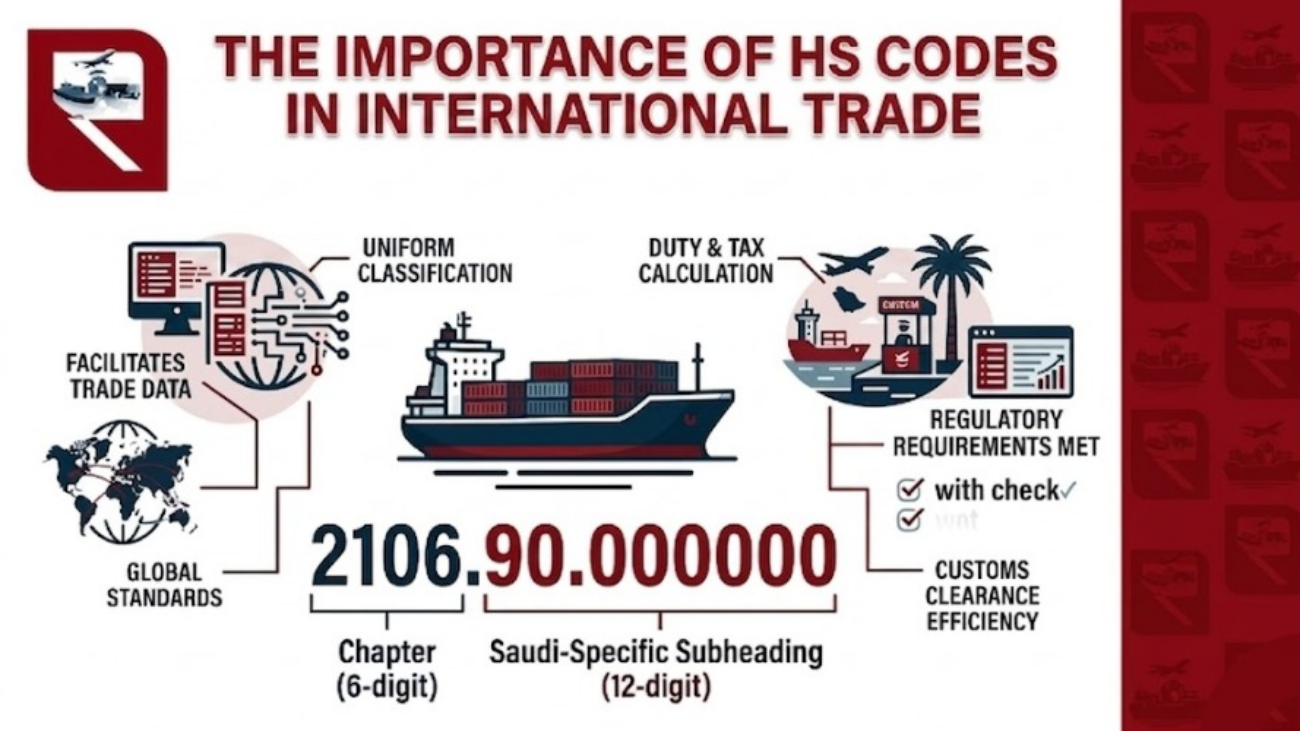
The Importance of HS Codes in International Trade

The Harmonized System (HS) Code — or رمز النظام المنسق — is the universal language of global trade. It is a standardized numerical classification system used to categorize traded goods for customs and statistical purposes. Developed by the World Customs Organization (WCO) — المنظمة الجمركية العالمية — this system is used by over 200 countries worldwide to facilitate international trade, reduce trade expenses, and standardize trade documentation . The code typically ranges from 6 to 12 digits (من 6 إلى 12 رقمًا), with the first six digits representing the globally harmonized standard, while additional digits allow countries to apply more granular, country-specific classifications .

The Global Standard (المعيار العالمي)

The World Customs Organization (WCO) — المنظمة الجمركية العالمية — maintains and updates the Harmonized System, with the most recent major revision being the 2022 edition, which came into effect in January 2022. The WCO reviews the system every five years to accommodate technological advancements, new product categories, and evolving trade patterns . This ensures that the system remains relevant in an era of rapid innovation—from electric vehicles to renewable energy components.

Core Objective (الهدف الأساسي)

At its heart, the HS code serves as the foundation for identifying goods and calculating tariffs — الأساس لتحديد البضائع وحساب الرسوم الجمركية. It determines not only the customs duty rate but also which regulatory requirements, trade agreements, and statistical tracking mechanisms apply to a shipment. Without accurate HS classification, the entire machinery of international trade—from customs clearance to trade policy enforcement—grinds to a halt.

The Vital Importance of HS Codes in Global Trade (الأهمية الحيوية لرموز HS في التجارة العالمية)

Tariff and Duty Determination (تحديد الرسوم الجمركية والضرائب)

Accurate HS classification is the only reliable way to calculate correct customs duties and taxes — الطريقة الوحيدة الموثوقة لحساب الرسوم الجمركية والضرائب الصحيحة. A single digit error can mean the difference between a 5% standard duty and a 20% luxury rate—or even duty exemption. In Saudi Arabia, where the standard GCC common external tariff is 5% but certain categories like tobacco face 100% duties, precision is not optional . The HS code directly determines the financial viability of an import transaction.

Trade Policy Enforcement (تطبيق سياسات التجارة)

HS codes are the enforcement mechanism for anti-dumping duties (رسوم مكافحة الإغراق), quotas (الحصص), and trade agreements (اتفاقيات التجارة). Governments use these codes to identify products subject to special trade measures. For example, when Saudi Arabia introduced new sugar content classifications in November 2025—creating four distinct tiers for sweetened beverages based on added sugar levels—all enforcement relied on precise HS subcategories . Similarly, the new HS code 98.04 — الرمز الجمركي 98.04 — introduced in late 2025, specifically covers goods transferred between customs zones within Saudi Arabia, including free zones .

Global Trade Statistics (إحصائيات التجارة العالمية)

Governments and international organizations rely on HS-coded data to analyze import/export trends and economic health — تحليل اتجاهات الاستيراد/التصدير والصحة الاقتصادية. The United Nations, World Bank, and national statistical offices use this data to track trade flows, identify emerging markets, and formulate economic policy. Over 98% of international trade products are classified using HS codes, making it the most comprehensive trade dataset in existence .

Supply Chain Efficiency (كفاءة سلسلة التوريد)

HS codes ensure consistency across shipping manifests (قوائم الشحن), insurance documents (وثائق التأمين), bills of lading (بوليصات الشحن), and customs declarations (الإقرارات الجمركية). When every party in the supply chain—from manufacturer to freight forwarder to customs broker—uses the same classification, the risk of documentation mismatches, port delays, and compliance failures drops dramatically. This consistency is especially critical in multimodal shipments where goods cross multiple jurisdictions.

The Specific Role of HS Codes in Saudi Customs (ZATCA) (دور رموز HS في الجمارك السعودية — هيئة الزكاة والضريبة والجمارك)

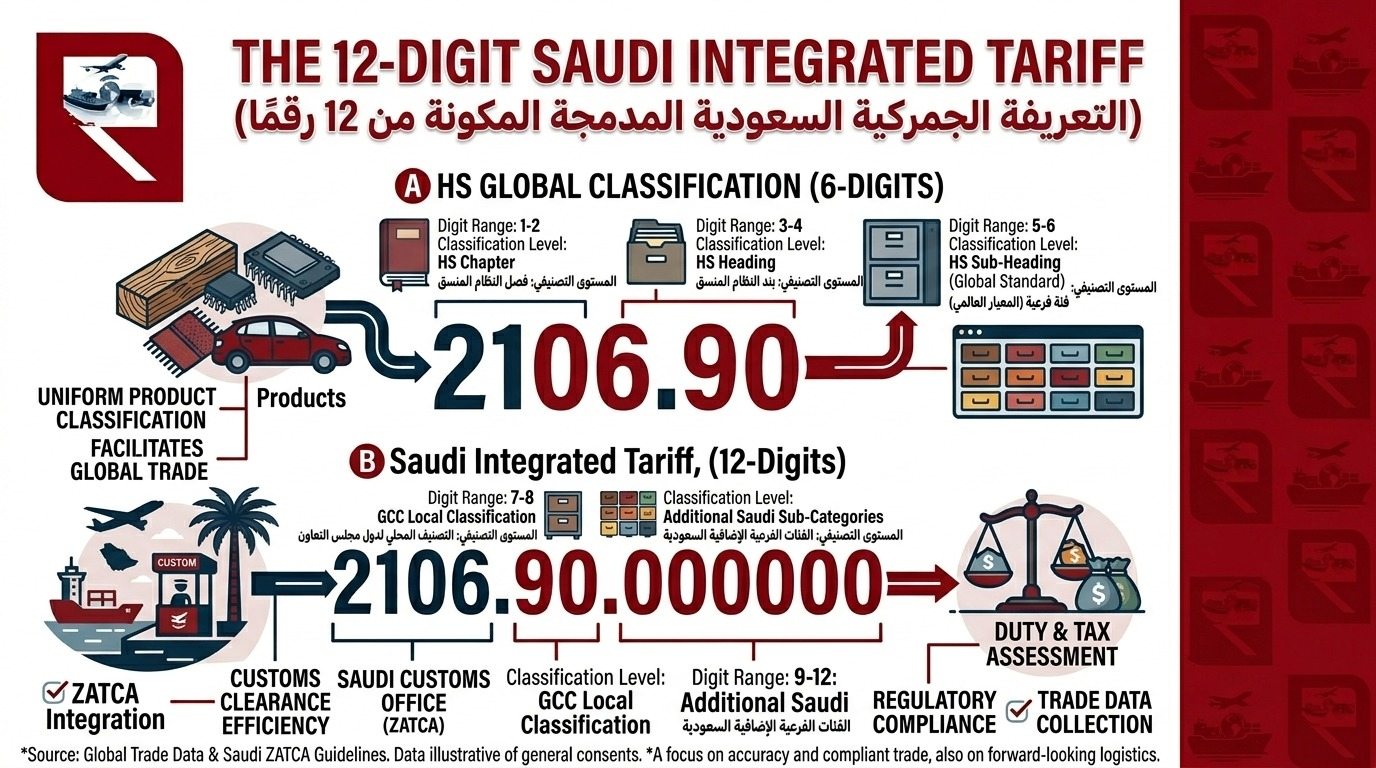
The 12-Digit Saudi Integrated Tariff (التعريفة الجمركية السعودية المدمجة المكونة من 12 رقمًا)

Saudi Arabia, along with other GCC nations, transitioned to a 12-digit Integrated Customs Tariff — التعريفة الجمركية المدمجة المكونة من 12 رقمًا — on January 1, 2025 . This represents a significant expansion from the previous 8-10 digit system. The structure breaks down as follows:

12 Digit Saudi Customs Tariff Code

This expansion increased the number of tariff lines from approximately 7,800 to over 13,400 — nearly doubling classification possibilities . The 12-digit system provides Saudi authorities with granular control over product categories, enabling more precise duty application and regulatory oversight.

ZATCA Regulations (2025-2026 Update) (تحديثات هيئة الزكاة والضريبة والجمارك 2025-2026)

In late 2025, Saudi Arabia issued significant amendments to its Integrated Tariff through Decision No. (1447-88-5) dated 27 October 2025, and Decision No. (1447-88-7) dated 14 November 2025 . These amendments, published in the official Saudi Gazette on 27 November 2025, introduced several critical changes:

  • Over 400 new HS codes — أكثر من 400 رمز جديد — and 100+ sub-categories to improve classification accuracy
  • Revised tariff classifications across food products, construction materials, chemicals, industrial inputs, and consumer goods
  • Transition of some previously exempt products into standard duty categories
  • New sugar content classifications for beverages, creating four tiers based on added sweetener levels (effective January 1, 2026)
  • Introduction of HS code 98.04 for goods moved between customs zones, including free zones
  • Revised customs duty rates for specific HS codes, with some items now subject to rates up to 20%

These changes reflect Saudi Arabia’s ongoing efforts to align with WTO commitments — التزامات منظمة التجارة العالمية — and GCC tariff harmonization — توحيد التعريفة الجمركية لدول مجلس التعاون — while supporting domestic industrial policy .

Automated Risk Management (إدارة المخاطر الآلية)

Saudi Customs leverages HS codes within its automated risk management systems — أنظمة إدارة المخاطر الآلية — to flag prohibited or restricted items. The FASAH platform (منصة فصة) — Saudi Arabia’s unified digital single-window for trade clearance — uses HS code data to conduct pre-arrival risk assessment . This automated screening identifies:

  • Prohibited items (البضائع الممنوعة) such as pork products (HS 02xx), alcohol (HS 22xx), and weapons (HS 93xx)
  • Restricted goods (البضائع المقيدة) requiring special permits, such as pharmaceuticals (SFDA approval — موافقة هيئة الغذاء والدواء), wireless devices (CST certification — شهادة هيئة الاتصالات), and chemicals
  • High-risk categories (الفئات عالية المخاطر) subject to enhanced inspection, including used electronics, camouflage clothing, and certain technical equipment

The system cross-references HS codes against multiple databases—including SABER conformity certificates, import licenses, and sanctioned party lists—before the shipment physically arrives at the border .

HS Codes in the Saudi Digital Ecosystem (رموز HS في النظام البيئي الرقمي السعودي)

The SABER Platform (منصة سابر)

The SABER platform (منصة سابر) — Saudi Product Safety Program — is the mandatory electronic portal for product conformity certification, and HS codes are the entry key — المفتاح الدخول — to the entire system . Here’s how it works:

  1. Product Registration (تسجيل المنتج): Importers must categorize products based on the Customs Code (HS Code) — الرمز الجمركي — when creating SABER accounts
  2. Certificate of Conformity (CoC) — شهادة المطابقة: A correct HS code is mandatory to obtain both the Product Certificate of Conformity (PCoC) — شهادة مطابقة المنتج — valid for one year—and the Shipment Certificate of Conformity (SCoC) — شهادة مطابقة الشحنة — required for each individual shipment
  3. Technical Regulations (TRs) — اللوائح الفنية: The HS code determines which SASO Technical Regulations — لوائح الهيئة السعودية للمواصفات والمقاييس — apply to a specific product. For example, electronics fall under HS Chapter 85 and must comply with IEC safety standards and EMC requirements

Critical 2026 Update: As of January 1, 2026, the SABER platform automatically rejects Product Certificate applications that do not align with the new 12-digit Saudi-specific classification . Existing certificates issued under old tariff codes remain valid until expiry, but new registrations must use updated codes . This affects major categories including textiles, building materials, electrical equipment, ICT devices, electric vehicles, and vehicle spare parts .

The FASAH Portal (بوابة فصة)

FASAH (فصة) — Facilitate Sea, Air, and Highway Customs Clearance — is Saudi Arabia’s unified digital single-window platform that integrates all customs procedures . HS codes are embedded throughout the FASAH workflow:

  • Pre-clearance filing (الإيداع المسبق): Submitting shipment data before cargo arrival, including HS codes, invoice values, and consignee details
  • Automated duty calculation (الحساب الآلي للرسوم): The system instantly calculates duties based on the declared HS code and CIF value
  • Certificate validation (التحقق من الشهادات): FASAH cross-checks HS codes against SABER certificates, CST approvals, and SFDA registrations in real-time
  • Release authorization (تصريح الإفراج): Only after HS code validation and duty payment does the system issue release notifications

Pre-clearance filing through FASAH significantly reduces port storage fees and clearance delays by catching document or classification issues before the shipment reaches the border .

Technical Regulations (TRs) (اللوائح الفنية)

Saudi Arabia’s Technical Regulations — اللوائح الفنية — are HS-code dependent. The classification determines:

  • Which standards apply (أي المعايير تنطبق): Electronics must meet SASO IEC standards; toys must comply with EN 71; construction materials require fire resistance testing (SASO 34)
  • Labeling requirements (متطلبات التسمية): Food and cosmetics require Arabic labeling; electronics need specific safety warnings
  • Inspection protocols (بروتوكولات الفحص): High-risk categories like batteries and children’s products may require factory audits or virtual inspections
  • New sustainability mandates (متطلبات الاستدامة الجديدة): As of 2025, environmental impact reports are required for certain plastics, and biodegradable certifications are being introduced

Risks and Consequences of Misclassification (المخاطر والعواقب الناتجة عن التصنيف الخاطئ)

Heavy Financial Penalties (الغرامات المالية الثقيلة)

ZATCA imposes severe financial penalties — غرامات مالية شديدة — for misdeclaration or incorrect HS code usage. According to official ZATCA documentation:

  • Tax evasion penalties (عقوبات التهرب الضريبي): Submitting false documents to evade payment can result in fines of at least the amount of VAT due, up to three times the value of the goods
  • Late filing fines (غرامات التأخير في الإيداع): Up to 25% of the tax value that should have been declared
  • Late payment fines 5% of the unpaid tax amount per month or part thereof until payment
  • General violations (المخالفات العامة): Maximum fines of SAR 50,000 for violations of VAT regulations, failure to maintain records, or obstruction of ZATCA officials
  • Incorrect tax returns: 50% of the difference between calculated tax and actual tax due

Additionally, applying an incorrect HS code can result in underpayment or overpayment of customs duties — الدفع الزائد أو الناقص للرسوم الجمركية — both of which trigger financial consequences. Underpayment may be treated as duty evasion, while overpayment represents lost working capital.

Shipment Delays and Demurrage (تأخير الشحنات والرسوم التأخيرية)

Misclassification is one of the leading causes of customs holds — الأسباب الرئيسية لاحتجاز الجمارك — in Saudi Arabia . When a shipment is flagged for incorrect HS coding:

  • Immediate customs hold (الاحتجاز الفوري): The shipment cannot clear until the classification is corrected
  • Re-classification process (عملية إعادة التصنيف): Requires formal correction through ZATCA, often involving physical inspection and documentation review
  • Demurrage charges (رسوم التأخير): A shipment delayed by three days at Jeddah Islamic Port can incur demurrage of SAR 3,000 to SAR 15,000 depending on container size and terminal
  • Storage fees (رسوم التخزين): Additional daily charges accumulate while the shipment awaits resolution
  • Supply chain disruption (تعطل سلسلة التوريد): Delayed raw materials halt production lines; delayed retail shipments miss sales seasons

In 2025, customs brokers reported that incorrect HS codes trigger inspections and delays in 15-30% of held shipments .

Legal Action and Blacklisting (الإجراءات القانونية والقائمة السوداء)

The consequences extend beyond immediate financial penalties:

  • Import license suspension (تعليق ترخيص الاستيراد): Repeated misclassification can lead to suspension or revocation of import privileges
  • Criminal charges (التهم الجنائية): Intentional misdeclaration to evade duties may be prosecuted as customs fraud
  • Blacklisting (القائمة السوداء): Companies with repeated violations may be added to watchlists, subjecting all future shipments to 100% inspection
  • Loss of Trusted Trader status (فقدان صفة المتداول الموثوق): Companies in the Authorized Economic Operator (AEO) program may lose their privileged “Green Lane” access, forfeiting benefits like 48-hour clearance and reduced inspections
  • Goods confiscation (مصادرة البضائع): Prohibited items imported under false codes may be seized and destroyed, with no compensation to the importer

Expert Tips for Choosing the Correct HS Code (نصائح الخبراء لاختيار الرمز الجمركي الصحيح)

Gather Full Product Specifications (جمع المواصفات الكاملة للمنتج)

Before attempting classification, compile comprehensive product data:

  • Material composition (تركيبة المادة): What is the product made of? (e.g., stainless steel — الفولاذ المقاوم للصدأ, plastic — البلاستيك, cotton — القطن)
  • Function and use case (الوظيفة وحالة الاستخدام): What is the primary purpose? (e.g., medical device — الجهاز الطبي vs. consumer gadget — الجهاز الاستهلاكي)
  • Manufacturing process (عملية التصنيع): How was it made? (e.g., forged — مُطرق, molded — مُشكّل, assembled — مُجمّع)
  • Technical specifications (المواصفات الفنية): Dimensions, weight, voltage, chemical composition
  • Packaging and labeling (التعبئة والتسمية): How is it sold? Does it include accessories?

The General Rules for Interpretation (GRIs) — القواعد العامة للتفسير — of the Harmonized System require classification by heading and legal notes, considering similarity when goods fit multiple headings, and classifying packaging with the product when applicable .

The Value of Professional Consultation (قيمة الاستشارة المهنية)

For complex shipments, partnering with a licensed customs broker — وسيط جمركي مرخص — is not a luxury—it’s risk management. Expert brokers provide:

  • Classification audits (تدقيق التصنيف): Reviewing product portfolios to ensure all SKUs use correct codes
  • Regulatory alignment (مواءمة اللوائح): Ensuring HS codes match SABER certificates, import licenses, and technical regulations
  • System updates (التحديثات النظامية): Monitoring tariff amendments and updating classifications proactively
  • Pre-clearance filing (الإيداع المسبق): Submitting FASAH declarations before cargo arrival to catch issues early
  • Penalty mitigation (تخفيف العقوبات): If misclassification occurs, experienced brokers can navigate ZATCA correction procedures to minimize delays and fines

Given that the 2025-2026 amendments introduced over 400 new HS codes and reclassified numerous product categories , even experienced importers benefit from professional review of their classification databases.

Conclusion (الخاتمة)

The HS code is far more than a bureaucratic number—it is a strategic asset in international business — أصل استراتيجي في الأعمال التجارية الدولية. In Saudi Arabia’s rapidly evolving trade environment, accurate HS classification determines:

  • The cost of doing business (through correct duty calculation) — تكلفة ممارسة الأعمال
  • Market access (through SABER conformity requirements) — الوصول إلى السوق
  • Operational efficiency (through FASAH pre-clearance) — الكفاءة التشغيلية
  • Legal standing (through compliance with ZATCA regulations) — الموقف القانوني
  • Competitive advantage (through supply chain predictability) — الميزة التنافسية

With the Kingdom’s shift to 12-digit codes, the introduction of hundreds of new classifications, and the integration of HS codes across digital platforms like SABER and FASAH, the margin for error has never been smaller—or the consequences of error more severe.

Vision 2030 Alignment (مواءمة رؤية 2030)

Saudi Arabia’s Vision 2030 — رؤية المملكة 2030 — aims to transform the Kingdom into a global logistics hub — مركز لوجستي عالمي — and diversify its economy beyond oil. Accurate HS code usage directly supports this vision by:

  • Enhancing trade data quality (تحسين جودة بيانات التجارة): Granular 12-digit classifications provide precise statistics for economic planning
  • Streamlining customs processes (تبسيط إجراءات الجمارك): Digital integration of HS codes across SABER, FASAH, and ZATCA systems reduces clearance times and administrative burden
  • Protecting consumers (حماية المستهلكين): Proper classification ensures dangerous or substandard goods are flagged before reaching the market
  • Supporting industrial policy (دعم السياسة الصناعية): Tariff adjustments via HS subcategories can incentivize local manufacturing and protect nascent industries
  • Facilitating foreign investment (تسهيل الاستثمار الأجنبي): Predictable, transparent classification systems reduce investor risk and compliance costs

As Saudi Arabia continues its customs modernization journey—with initiatives like the elimination of export service fees, reduction of import service fees to 0.15%, and the introduction of flat-rate e-commerce charges —the HS code remains the foundational element upon which all other trade facilitation measures depend.

For businesses trading with Saudi Arabia, the message is clear: invest in accurate HS classification today, or pay the price in penalties, delays, and lost opportunities tomorrow.

Let Radhi Awad Handle Your HS Code Classification!

Struggling with HS Code Classification? Let the Experts Handle It!

At Radhi Awad AlAnazy Custom Clearance Co. — شركة راضي عوض العنزي للتخليص الجمركي, we understand that navigating Saudi Arabia’s complex customs landscape is not just about knowing the rules—it’s about having the right partner by your side. Since 1988, we have been the trusted customs broker — وسيط جمركي موثوق — for businesses importing and exporting across Saudi Arabia’s key trade gateways including Dammam, Jeddah, Riyadh, Al Batha, Al Khafji, King Abdulaziz Port, King Fahad International Airport, and more .

Why Choose Radhi Awad? (لماذا تختار راضي عوض؟)

✅ Expert HS Code Classification — تصنيف خبير للرموز الجمركية: Our team ensures your products are classified under the correct 12-digit Saudi Integrated Tariff — التعريفة الجمركية المدمجة المكونة من 12 رقمًا, eliminating the risk of costly misclassification penalties.

✅ SABER Certification Specialists — متخصصو شهادات سابر: We handle the full Product Certificate of Conformity (PCoC) — شهادة مطابقة المنتج and Shipment Certificate of Conformity (SCoC) — شهادة مطابقة الشحنة process, ensuring seamless compliance with SASO Technical Regulations .

✅ FASAH Platform Pros — محترفو منصة فصة: We leverage the FASAH digital single-window — النافذة الرقمية الموحدة فصة for pre-clearance filing, reducing your shipment clearance time from days to hours .

✅ Nationwide Coverage — تغطية على مستوى المملكة: With branches across Saudi Arabia’s most critical trade gateways, wherever your goods arrive, our experts are nearby to clear them swiftly and compliantly .

✅ 24/7 Clearance Support — دعم التخليص على مدار الساعة: We don’t just work 9-to-5. Our team is available around the clock to handle urgent shipments and unexpected customs holds .

✅ Penalty Protection — حماية من الغرامات: Our proactive compliance monitoring saves clients from the heavy fines, demurrage charges, and legal risks associated with HS code misclassification .

📞 Get Your Free HS Code Consultation Today! (احصل على استشارتك المجانية للرمز الجمركي اليوم!)

Don’t let a single wrong digit cost your business thousands of Riyals.

Whether you’re importing electronics, textiles, construction materials, food products, chemicals, or industrial equipment, our team at Radhi Awad will:

  • 🔍 Audit your current HS code classifications — تدقيق تصنيفاتك الحالية
  • 📋 Identify compliance gaps — تحديد فجوات الامتثال
  • 🛡️ Protect you from ZATCA penalties — حمايتك من غرامات هيئة الزكاة
  • ⚡ Accelerate your customs clearance — تسريع إجراءات التخليص الجمركي

📍 Contact Radhi Awad AlAnazy Custom Clearance Co. Today!

📧 Email: Info@radhiawad.com.sa

📞 Phone: +966 50 635 5501

📍 Address: King Saud St, Said Ibn Haibara, Dammam 31412, Saudi Arabia

🌐 Visit our website: www.radhiawad.com.sa

“Time is money. Let’s not waste either.”

— Radhi Awad AlAnazy Custom Clearance Co.

Book your appointment now — احجز موعدك الآن and get your customs clearance done on a priority basis. Let us turn your customs complexity into competitive advantage! 🚢✈️🚛